comment 0

Photo Blast #3: Guess Who.

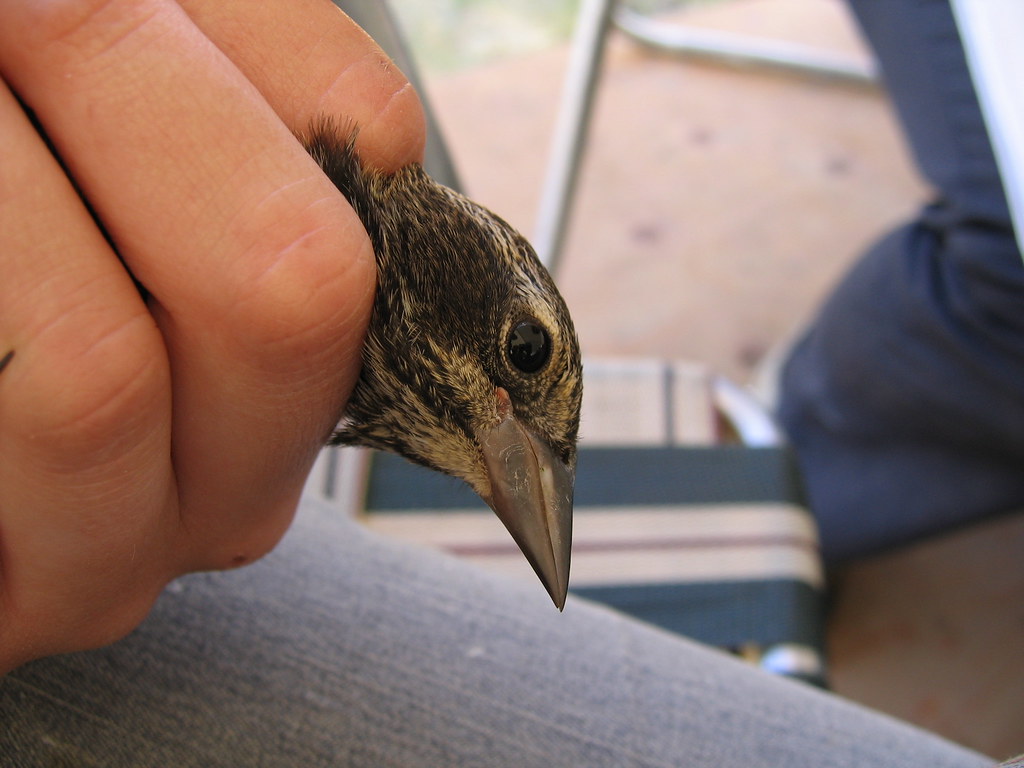
Looks can be deceiving.  If you showed me this photo of a Red-winged Blackbird (Agelaius phoeniceus), there’s a good chance I’d say it was a female.  For all intensive purposes, it does appear to be of the fairer gender.  But there’s a hint that should give the expert pause.  The gape, as in the bit of skin at the base of the bill, looks rather prominent, suggesting a young bird.  Do you really know that it’s a female if this is a young bird?

This is a little window into how bird banding works.  You start with your presumed knowledge and then, if you’re good, try to falsify your hypothesis on species, age, sex, etc.  (To be clear, when you catch birds to band, it’s not just to hold a bird and take pictures of them, you are recording data).  It’s actually a very fun process.

As it turned out this bird was a young male.  A bit of hunting in his coverts and we found the beginnings of his “red-wing” and black feathers were pushing up through his breast plumage.  Females are significantly smaller than males also, but without thinking of wing length or weight it’d be easy to make a base assumption and go with it.   In the case of a blackbird where size is significant this would be important because a band for a female bird wouldn’t fit properly on a male, it could even be dangerous.

This photo was taken on Shelldon National Wildlife Refuge in Northwestern Nevada at a place called Badger Camp.  Although it was late July in Nevada, banding birds here was fantastic, particularly because of the creek that ran right through.  Birds came in from all over for water including Western Scrub Jays ( or this blackbird) that you wouldn’t associate with the scrub steppe or grasslands that predominated the landscape.

comment 0

Gulf Aid and the American Birding Association’s Gulf Coast Oil Spill Blog

As the spill continues, I still find beauty in the unity disaster brings.  People make connections, whether to their reliance on a healthy environment or to people they might not have encountered.  Artistic expression can be just as valuable and motivating as an article or news blurb.  Check out this live performance by a favorite artist of mine Mos Def, teaming up with Lenny Kravitz and the Preservation Hall Jazz Band to perform a song he came up with “It Ain’t My Fault.”  Mos and other musicians were recently in New Orleans to play benefit shows for Gulf Aid.

Our friend Drew Wheelan, is also currently down in Louisiana blogging for the American Birding Association.  For a first hand accounts of what’s happening down there, please check out his well written entries at Gulf Coast Oil Spill Blog.  I can’t imagine being on the gulf right now is easy, Drew mentions that “there is a frenetic energy around, as if there’s a hurricane just offshore.”

Both the American Birding Association  and the Gulf Aid have links to donate on their pages.  As much as I believe we shouldn’t have to pay for any of this, it’s a show of support and these two organizations will do the right thing with your money.  Until this  happens, BP probably won’t be accountable for much beyond beginning to clean up.  Keep in tune for my two bits on the whole thing.

comment 0

Photo Blast #2: Funny Signs

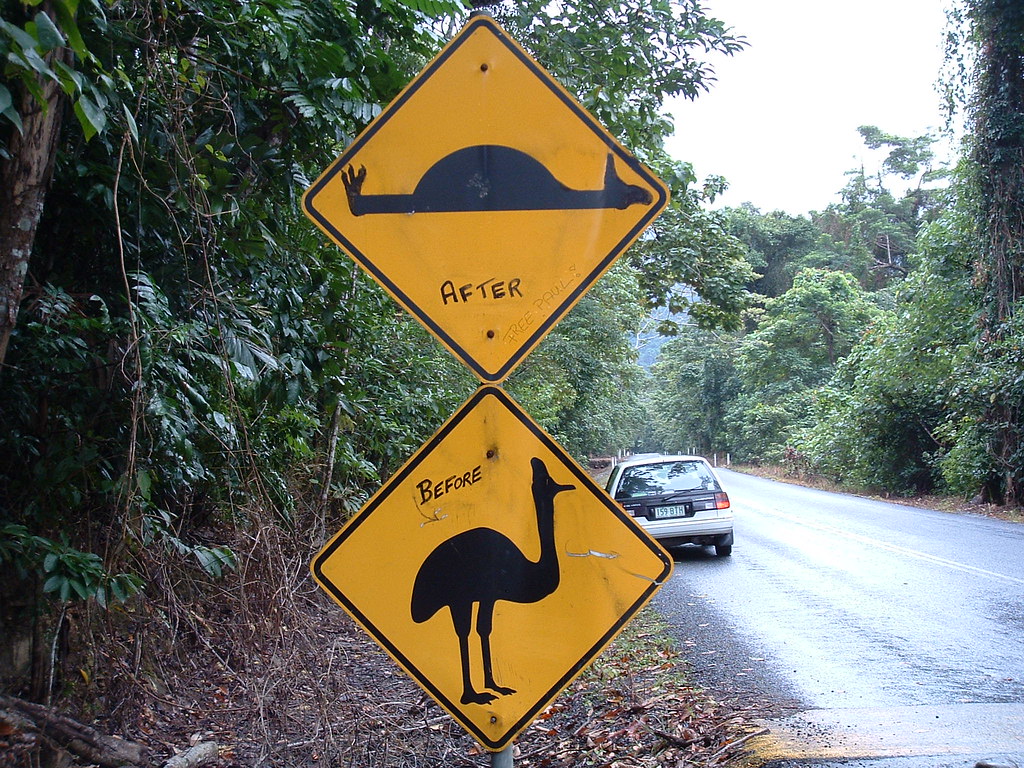
The abrupt, moist change in Seattle weather combined with a stuffy office got me daydreaming of places distant. Possibly it’s a little morbid, but I think the signs above are pretty amusing.  Just in case you are confused – the sign on top is a doctored speed-bump sign.  They actually have a bit of notoriety being on the main road along the east coast in Northern Queensland, Australia and in the middle of the Daintree Rainforest, people from all over see it.   It is rather iconic of the individuality of the land.

Thinking of Captain Cook shipwrecked just North at Cape Tribulation in 1770,  it’s hard to imagine his feelings.  Having mixed feelings about Cook himself, I relish the thought that he might have been scared by this dense, fragrant, and foreign landscape.  He didn’t discover Australia, it was there already with people and ecology.

When you hear talk of plants that have been around since the dinosaurs they are likely talking about the Daintree.  Two basal flowering plants that hearken back to those times are endemics: Austrobaileya scandens and Idiospermum australiens. The rain forest itself is about 130 million years old.  Long isolated on a lonely hunk of land, diversity has flourished.  Just look at the layers of vegetation, the amalgam of green, you can’t imagine the species that are tucked away inside.

Unfortunately, much of this gem is dwindling due to climate change and habitat destruction.  Species possibly unknown to science are disappearing. But thankfully the Daintree is there, the largest section still standing with 1200 square Km of undisturbed land.  I can’t let you get away without thinking about human impact and conservation.

When I first visited (I say first because I intend to go back), I had just graduated High School.  My parents and I were traveling around Australia as my graduation gift and to visit family.  Cassowaries are not an uncommon sight in this region (hence the sign) and I had them on my mind.  I managed only a glimpse of a bird’s brightly adorned head thrust from the brush but it was enough to satisfy me.  My wish is that I would have slowed to enjoy the whole landscape a little more instead of maniacally drifting from bird to bird.

If you want to read an ecological history of Australia, pick up a copy of The Future Eaters by Tim Flannery.  Flannery wields a truly unique mastery of melding human history and multidisciplinary science into a illustrative, readable text.

comment 1

Photographic Hindsight: The Photo Blast

In attempt to bring more content, I’ve decided to start doing photo blasts on a regular basis.  The general idea is to find a pretty picture that me or one of the contributors of Wingtrip have taken and say a few words about it.  Simple as that!

This picture was taken at the Hart Mountain National Antelope Wildlife Refuge.  Every year my ornithology professor and good friend Steve Herman takes a group of students out to Hart to band birds and enjoy the high desert.  These two Dusky Flycatchers fledged probably a day before the shot.  Someone found the nest and we were able to watch them grow in the Aspens over the course of a week.  It’s pretty insane to think these birds are probably a month away from  flying to Mexico!  A nice stretch of the bill ought to feel good!

Learn more about Dusky Flycatchers on Birdweb, Seattle Audubon’s free online database of Washington bird species.

comment 0

Wingtrip Does Arizona (Long)

(When I go on week long trips, see massive amounts, and come back with a lot to say, brevity goes out the door. I appreciate all my readers, however few, and I promise shorter entries in the future. However, I hope you enjoy my notes from a week in Arizona.)

“Can we go to the Sun City Golf Course?” came a voice from the back of the van. “They have water there.”


If you guessed this the plea of a link-obsessed geriatric under my watch, you’d be wrong. The voice belonged to one of the six high schoolers in the van, one in particular I was on the verge of strangling. I didn’t want to hear about the course one more time, mainly because I abhor golf (not the sport, the implications of green grass in places such as Arizona), and also because this wasn’t a golfing trip. Because one of their grandparents happened to see a few things on the edge of the golf course he lived by, this waste of water had been elevated to Mecca.

Wedged into a van we’d been driving around Southeastern Arizona for the past week. A little over a year ago I started volunteering with this mad hatter group of teens, Seattle Audubon’s Birdwatch program. My reasons, that is, beyond a pure benevolent nature? I’m alumni.

At the risk of revealing my tender youth, I joined Birdwatch 10 years ago, a bird crazed freshman. Already a seasoned Seattle Audubon member and I was chomping at the bit to be of age. It turned out to be one of the most important experiences of my life. Finding peers was paramount, but through Birdwatch I spent a summer volunteering in the ornithology collections at the Burke Museum. As a paid intern (!!) for a local bander Don Norman, I was introduced to the art of banding birds. I practiced environmental education. I went on fantastic spring trips all over the country.

Continuing to help a program so formative for me only makes sense. When I moved back to Seattle after college, I did. The fringe benefit is getting to go on the annual spring trip, which for the past years I have helped fundraise and organize. Peddling shade-grown coffee, executing rummage sales, and working in people’s yards – Birdwatch finds ways to make the trip happen. In an ideal world Seattle Audubon would be able to find grants and monies to float the entire trip, but we’re a non-profit. And not so secretly, I insist the importance for the kids to truly own the trip, providing most of the funding. They pay a fraction of the cost out of pocket because an accessible trip is essential.

For those who didn’t know, the many and jagged mountain ranges and baking deserts of Southeastern Arizona provide for some of the best birding in the United States. Part is due to the steep climbing mountains allowing for the so-called sky islands of stratified, distinct habitats and the summer storms with origins far south to revitalize every July and August. The proximity to the border of Mexico has much to do with the diversity too, but it also provides for an uneasy police state. The fact that it’s chalk full of specialty birds is a strange contrast. Calling them specialties is slightly misleading because almost all of these birds are just across the border, in higher abundance. Calling them specialties is a figment of our imaginary American divisions (the same goes for the Lower Rio Grande Valley in Texas – where went last year). No matter, the experiences these kids got scrambling around in the Southwest were priceless.

The value of cultivating teenage interest in the natural world is that these kids will go on to save the world. That’s not even vaguely a joke. Many of them have the passion and drive to change our planet. Birdwatch gave me that empowerment and I want to continue that legacy.

Starting our tour in the florid Saguaro National Monument, flush with new growth and pungently fresh from a week of rain, we headed south. The Santa Rita Mountains and infamous Madera Canyon were the first stop. Without going to Mexico you can’t stray too far – so we veered east at the border town of Nogales. Patagonia, the only vibrant riparian area we visited along the way, was on way to the steep Huachuca Mountains. Finally, we strode on to the Chiricahuas, the land of Jeronimo’s final stand, before circling back to Tucson. Whirlwind week is an understatement.

And oh the birds we saw! Although it was slow, with extended winter chill, we found almost all the species we could expect considering this constrained schedule. Any experienced birder knows a rushed schedule doesn’t leave time for error or time sunk into looking for uncooperative species. But I’ll be damned if we didn’t luck out (we missed some stuff, but who cares?!).

A nearly resident Flame-colored Tanager visited the bird feeders in Madera Canyon. A first for many, I’d only spied them through a patchwork of canopy. In neighboring Florida Wash, we teased out a Rufous-capped Warbler (Basileuterus rufifrons), which had been skulking about in a birder typical, trickily specific location. Unusual for Arizona, raucous water from the snowmelt made it impossible to communicate as we scoured the creek basin scrub for the bird. A male Elegant Trogon (Trogon elegans) at Patagonia Lake that was magnificently cooperative, hamming it up as we slammed down our shutters. Cave Creek Canyon in the Chiricahuas provided us a rather intimate moment as a pair of Elf Owls (Micrathene whitneyi), unabashedly going about the “business.” At the South Western Research Station where we stayed in Cave Creek, a Whiskered Screech Owl (Megascops trichopsis) was readily found. At the risk of boring the non-birder, I’ll stop the prattle on bird species.

Birds weren’t the only animals on the platter. We were fortunate to have a good number of budding herpetologists, including Sam Riley, who is well on his way to becoming a prodigy. Over my four high school trips, I never remembered thinking about anything beyond the avian; these kids had a one up on me. The winter also affected the reptiles we found but Sam and his fellows teased out a Black-tailed Rattlesnake (Crotalus molossus), a Banded Gecko (Coleonyx variegates), many Scleropus species, and a Regal Horned Lizard (Phrynosoma solare) (the lizard famed for squirting blood out it’s eyes in defense). Although Sam often tried to hijack the trip for his own purposes, I was glad to have this added element.

In the past (this was my third trip in the area), I’d underestimated watching birds around Tucson. But there were tons of places to visit and I began to appreciate the overgrown vacant lots filled largely with native plants. A rather surreal encounter with a Harris’s Hawk (Parabuteo unicinctus) was had at the Sweet Water Wetlands on our last day.

Although it sounds rather “new agey”, I firmly believe that many species are capable of comprehending human intentions. That being said, I don’t like to encourage tameness and trust in wild animals because while I have faith in humanity on the whole, a rotten few spoil it for the rest.

At the wetlands, one of the other photographers of the group, Colin and I were strolling through the converted sewage treatment ponds. Ahead of us we could see a young Harris’s Hawk perched on some of the treatment equipment. Over the two trips Colin and I have been on, we both think fairly alike in approaching birds. We stand shoulder-to-shoulder, walk slowly, and pause periodically with multiple frames – it’s the digital, nature photographer’s way. But this bird wasn’t phased. Suddenly we were five feet from it. In shock at it’s nonchalance, I didn’t know what to do next.

I ended up taking over 400 photos of the bird. Having the opportunity to fill your frame with a wild raptor’s face or talons is unquestionably thrilling and once in a lifetime. The teens ran to grab their cameras, other people walked up, I left and came back with a fresh memory card. The bird lounged. For a while I though it was sick or feared it would latch to the face of one of my charges. I had visions of a talon pocked face, blood streaming down a face as we missed our flight and took someone to the hospital. Wiggling my toes, I caught the hawk’s attention, muse for an inquisitive twist of the head. I realized that I didn’t want my toes the focus of a predator.

Only when I slid into my seat on the plane did I realize how tired I was. Now I finally understood what the Birdwatch coordinator, Emily Sprong, had meant when she’d wanted another week off to relax. But I didn’t sleep on the plane. Instead of took photos from the plane window for a whole three hours. These kids were non-stop, but I was just an enabler.

Considering myself an adult but being not too far out of the fold, working with teens is challenging. The little buggers are far from forgiving and constantly demanding. Sometimes I felt like I was losing rank with them because I’d have to rein in their perpetual wanderings (in retrospect I was the same way). Paranoid I’d become the grump chaperone, I convinced myself that being a grump isn’t a problem as long as the teens realized I really cared.

Birding is a pastime that very purely selfish. We drive about a landscape, using gas, water, and countless other resources in a manner that has seemingly no purpose. But if only one of the Birdwatch kids (and I suppose I count too), grows up to inspire others, it’ll all be worth it.

And thankfully we managed to avoid that f***ing golf course.

By the quantity of photos in the entry, you can tell I took a lot of photos.  I encourage everyone to check out my collection for the trip here.  I was fairly satisfied at my results.
comment 0

Oil – a slippery slope.

We all use it – even if you don’t drive and bike everywhere – you indirectly are a part of the system.  Oil is dirty and we’ve known a long time.  And while we can make a difference by decreasing our consumption, ultimately it’s up to legislation to get rid of it.  That’s what has to happen.

I’ve been musing about what to say about the BP spill in the Gulf of Mexico.   Although I have journalistic aspirations, the point of this blog isn’t news reporting and I’m frightened at the potential for anyone taking my posts as absolute fact.  My views are quite biased and current events Wingtrip will cover/is currently discussing are not news reporting.  They are reports, they are opinions (which is fine).

That being said I think that we can all recognize that environmental disaster is bad for everyone.  And I hate to be a cynic but BP isn’t going to be held fully accountable.  Oil has been vomiting out of the ocean floor since April 22nd.  Today is May 13th and they still haven’t made real progress.  The oil is creeping to land.  It’s hard to fathom the immensity of this disaster.  To give you an idea – I’d encourage you to follow this link: Oil Spill Over Seattle .  I searched Seattle to superimpose the current size of the spill over my home.  It essentially would fill all of my beloved, rhythmic, fingered Puget Sound and beyond.  I was horrified.  Find you city or compare it to major cities.

In every situation I try to see the positive and I’m grasping air here.  Animals are already starting to wash up on land.  Dolphins, birds, fish.  Seafood prices are going through the roof and many fishermen are going to become bankrupt and potentially  never go back to fishing.  A landscape is forever warped, gone.  And apparently the calculations of 5000 barrels spilling out per day is a gross underestimate. There’s never a stink far from huge corporations and this is no exception.  According to the NY Times, the U.S. allowed this drilling to go on without permits and despite the concerns of their scientists, pressuring them to “change the findings!”

“Under the Endangered Species Act and the Marine Mammal Protection Act, the Minerals Management Service is required to get permits to allow drilling where it might harm endangered species or marine mammals.”

The list goes on of the ills surround a disaster horrible enough, but there is one light in all of this.  Real energy reform.  There has already been a huge decline in the push for more offshore drilling.

The massive devastation is the sounding for real change in our energy use.  I could just as easily see this all be forgotten but I hope that it isn’t.  It now should be and is obvious to almost everyone that the risk we take in oil is not worth it.  Fox news can say all they want about the massive environmental devastation and suggest people are overreacting (which they fail to have any reporting about on the main page of their website), but I think a voting majority will come around.  This isn’t an overnight process but it’s a part of our legacy, our health, and I hate to talk about national security, but yes it involves that as well.  We are addicted and unless we want to one day wake up and the gutter ( and there won’t be anyone to pull us up by the bootstraps either), we all have to change.

I feel like crying when I think about the beautiful wetlands that coming generations will never enjoy on the gulf (simply that I’ll never have the opportunity).  Spectacular lands of salt, teaming with diversity, and space that will seen be completely choked for good.  Largely because of human greed and apathy.  A biome that will cease to exist.  An NPR correspondent went out on the marsh with a Nature Conservancy Head recently, a person that should be at battle stations in the wake of oil to land.  But he wanted to be with a place of stillness and be with it one last time, because he knew that it would never again exist as he knew it.  You could heard the pain in his voice and I was bleary eyed listening to it.  That enough should make people want to give up driving their car or taking jet rides.

Stay tuned for a dispatch from our friend Drew Wheelan at Drewtube as he covers the spill for the American Birding Association and gives us a brief post as well.

comments 2

Bird-a-thon 2010 (Long)!

I’d like to preface with a warning.  This entry contains the manic depictions of deviants.  Birding has many manifestations.  Some are the gentle musing of the causal observer, no less informed, simply less hastened or statistic driven.  This is a trip report of the absurdist, the crazed who don’t sleep for 24 hours, the big day birders.

Favored with employment in an organization that focuses heavily on birding, this April I was lucky to participate in our major fundraiser for work.  Birdathon is an event created to fuel fundraising through friendly competition.  Solo or on a team, birders get sponsors who either foolishly give $.50 per species (this gets expensive when lists soar above 100 species) or pledge a static amount.  Then they go birding and try their best to see as many birds as possible.

The big day has roots in the East (I could never see it coming out of say, California). According the Scott Weidensaul’s book Of a Feather (a brief history of American birding), as early as 1898 birders in Ohio were out on grueling daylong assaults.  Different areas had colloquial terms for their endeavors.  The bottom line was that you end up spoiling a perfectly respectable and cerebral activity into baseball statistics.  I’m the first to point out the flaws in this extreme form of birding, but I’ll be damned if it isn’t fun!

Half of Seattle Audubon’s staff was willing to ship out the night before our Birdathon and camp on the Columbia River, where we’d begin.  When we arrived at Wanupum Damn State Park, the reason for the windfarms perched on nearby hills was evident.  It was a blustery night.  Wind isn’t good for birds and if you haven’t figured it out yet, this practice in mania is grounded in number of species seen.

Thankfully the morning was calm.  With time to rake the surrounding area before a 7:30 rendezvous with the rest of the staff in Vantage, we wasted no time.  While only two of us were so far removed from reality as to wake up at 5 am to bird (before light), we had a good showing for the morning walk.  Yellow-rumped Warblers (Audubon’s specifically) dripped from the poplars, but they seemed to be the only songbirds about.  I started to get nervous.  But no worries, we soon stumbled into a Dusky Flycatcher, some Ruby-crowned Kinglets, a House Wren, Golden-crowned, Lincoln’s and Fox Sparrows.  You cherish every bird on a big day, you may not see it somewhere else.

With a large staff and no one nearly as enthusiastic as Adam, our science associate, and myself, a real big day wasn’t entirely possible.  Contrary to what you might believe, not all the staff at Seattle Audubon are expert birders, who would have been fine with a slapdash day.  People actually wanted to see birds, not rush through, ticking them off.  We also weren’t going to be able to go owling.  A final admission was that most big days are centered on mid-May. My most epic have always been as late as possible to coincide with Birdathon dates to maximize incoming migrant birds.  Late April was slightly premature. My main goal was to beat our board members’ team.  They’d amassed a respectful 122 species a few days earlier. (To avoid sounding like a sniveling snob, I had a great time birding with my coworkers regardless of their sane tendencies).

On the other side of the Columbia River, the Shrub Steppe opens up into the willow lined shores of the potholes and Moses Lake.  Water always attracts birds and we soon found ourselves another twenty species deep.  Never a certain bird, a Black-crowned Night Heron flushed into a tree at Martha Lake and we saw, astonishingly, our only sandpiper of the day, a Least.  Swainson’s Hawks glided on gracile wings overhead, back from their sojourn in Argentina.  Cinnamon and Blue-winged Teal floated on many a waterway.

Before we knew it, we’d blasted through the wetlands and headed back over the Columbia River to Vantage.  Wind had picked up again which meant finding things in the quickly diminishing shrub steppe (read: land being bulldozed for wind turbines), wasn’t going to happen.  We still managed Sage Thrasher and both Mountain and Western Bluebirds en route to Ellensburg.

Unfortunately one of our stops, Robinson Canyon, was closed till May (to allow Elk to winter in lowlands without being bothered by people).  Luckily Carly, a former staff member who ran Birdwatch, came through for us and suggested we visit Taneum Canyon.

Not only were the high basalt walls that wrapped the road in the canyon beautiful, we managed some good birds in Taneum.  Townsend’s Solitaire busied themselves on the hillsides, Evening Grosbeaks flew over, and we finally got both Mountain and Black-capped Chickadee.  A bonus was a Golden Eagle that came in low over the road!  Not being able to get into Robinson still cost us key species – it was time to get back on the road!
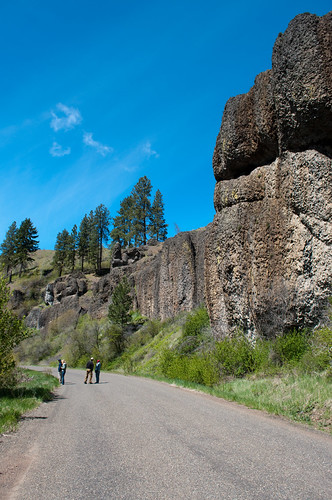
The intersection of the Teanaway and Yakima Rivers just outside of Cle Ellum is a traditional spot for any serious Washington-wide big day.  This is mainly because it’s a reliable and simple place to find American Dipper. Rufous Hummingbird (which I unfortunately missed), Downy Woodpecker (astonishingly only the second woodpecker of the day, and Vaux’s Swift were also about.

It was time to cut our losses and head to the less fruitful western slope.  With weather moving in, a stop a stampede pass didn’t seem promising but out of the car we had Golden-crowned Kinglets, Varied Thrush, Pine Siskin, and Red-breasted Nuthatch.  The beauty of big days is that they make every bird exciting!

Our only owl of the day was pure luck.  A few staff were trailing behind and luckily for the rest of us, heard a pair of Barred Owls!  Sitting listening to them we heard Red Crossbill, just as I had said they were something we hadn’t seen yet.  Finally we had Oregon Junco, a shock to not get sooner on the trip.  A Red-breasted Sapsucker called, giving Adam and I views.  Just as we started to walk back, I heard the quick, sweet call note of a Brown Creeper.  We could still beat those board members yet – I was above 100 species.

Rain was slamming down through Snoqualmie pass but when we finally started to get close to Seattle, during rush hour, the clouds parted and traffic was actually moving.  The group, diminished from dropping off a few deteriorated staff in town, descended on the last main stop at the Montlake Fill.  This was crunch time and Adam and I took off from the rest of the group to try to see as much as possible.  Cleaning up on easy species we had Savannah Sparrow, Anna’s Hummingbird, American Wigeon, Glacous-winged Gull, and Common Yellowthroat.  While we didn’t get Wood Duck, a regular at the fill, we had Cedar Waxwings and a Virginia Rail.  A Bewick’s Wren was singing as we left the park.  Chomping at the bit, we headed back to the office to drop off the rest of the staff, empty the van, and head to the rental place.  I followed Adam in his car and after the van was parked – we jetted off to West Seattle, our final stretch.

As absurd as it sounds, just writing this report is getting my heart rate up.  Birding like this is about uncertainties and it calls into action your absolute ability and attention.  You have to be on point perpetually.

Pigeon Guillemot, Western Grebe, Horned Grebe, Red-necked Grebe, Mew Gull, Brant.  We were doing well and the light was cooperating, it was past 8 pm by the time we’d reached the final park on our loop around Alki Point in West Seattle.  The sunset over the Olympics with a contrasting storm was so spectacular that I had break for a photo but then it was back to business.  An Eared Grebe was nestled in a group of Horned Grebes.  Finally a Harlequin Duck!  A Barrow’s Goldeneye flew away from us as we strained but failed to find Long-tailed Duck or Marbled Murrelet further out on the Sound.

As the light failed, we made out last-ditch attempt to find Western Screech Owl or Winter Wren in the forested section of Mee-Kwa Mooks Park.  Every crow back in the trees seemed to be an accipiter (it’s embarrassing to admit that we missed both Sharp-shinned and Cooper’s Hawks) as we stood patiently listening.  Finally the strangled croak of a Hermit Thrush rang out, as if calling the end to our day.  We’d been up since 5 am and by the time I got home it was 10pm.

As it turns out, I managed to squeeze by the board members at 124 species.  But that doesn’t really matter too much.  What was really important is that I raised over $600 for Seattle Audubon and all that money will be going to leave a legacy of the environment.  Maybe if I have kids and they are so unfortunate as to find themselves addicted to birding, they’ll be able to follow in my footsteps.

Thank you to all my sponsors (there’s still time to give money, till the end of May): Linda Carroll, Marti Davis,  Rebecca Evans,  Al Ferkovich,  Thomas Mansfield,  Jean Mills, Eldon Olson,  Roberta Roberts, Paul & Barbara Webster,  Diana Aubin de Paradis, Barbara Clark,  George Johnson,  Penny Koyama, and last but certainly not least Virginia Morrison!

comment 0

Mexico Part 8 – The End

Unfortunately for almost everyone else, food poisoning interrupted the group’s fun near the end of the trip. I managed to stay bug free and enjoyed all the food put in front of me. Although it’s easy for me to say, if relatively minor food poisoning (no food poisoning is really that minor in terms of comfort) was the only major issue we had, I think we got off pretty well!

We explored the surrounding region for the next two days and despite some illness, largely had fun. In the town of Aduana, we caught a glimpse of a Ferruginous Pygmy-Owl catch a unfortunate lizard mere feet from us. We watched Happy Wrens gaily flitting among the undergrowth. A return to the river granted us magical views of a young Tiger-heron and a troop of Rufous-belled Chachalacas. A Sinaloan Wren, which I’d only briefly seen before, gave Jeff and I quite a show, casting aside skulkiness to investigate an old becard nest.


Without poeticizing every little moment of the trip, this was a stunning way to begin many future travels to Mexico. We made out way back and crossed back into the United States scot-free. The trip was a success with 200 species of birds, I had 18 life birds.

However, it was strange how quickly we melded back into American culture on crossing an imaginary line. Nothing seemed as colorful, surreal, or interesting. Just chain restaurants and golf courses that shouldn’t exist. When I see and hear about lands and peoples far away, my first impulse is to rush off there. But as I’ve grown older I’ve tried to temper that excitement and make others see these places and care. Because it’s easy to watch Planet Earth on your wide screen TV, while eating a meal of takeout, and pretend to be concerned for the planet.

Wingtrip is a project to make these places real, comprehendible, and interesting. As beautiful as Planet Earth or other documentaries are, I believe they unfortunately represent a fantasy being gobbled up by an entertainment-addicted populace. I love these shows just as much as the rest, they are my fix for extended time in the city. I am in no way advocating their insignificance or suggesting they never inspire people. However I also believe that you need to see the people out there, the reality and interaction of people and place. I want you to know how much fun we’re having exploring and attempting to make a difference in the world. Conservation and Science (not that this trip was for conservation or science) are hard work often-unforgiving paths but the people involved experience so much. To put it poorly, it’s very cool and they deserve to be understood and appreciated.
The human role in the planet is palpable in places like Mexico. They can’t avoid their trash by throwing it in a bin and forgetting it; they have to make choices between living and destroying their environments. They can’t all sit in front of a computer and preach environmentalism while being very much removed  (yes I’m alluding to myself and my compatriots). My hope is that through reading about my friends’ and my travels in Mexico you’ll find yourself interested and possibly visit yourself. Maybe you’ll fall in love with the stark Pitayal or the verdant hills of Alamos and start to care yourself.  It’s easy, it’s cheap, the food is good and the people are amazingly friendly.  I look forward to hearing about your travels there soon.

comment 0

Happy Earth Day 2010!

“Everybody needs beauty as well as bread, places to play in and pray in where nature may heal and cheer and give strength to the body and soul.”

– John Muir

It’s been 40 years since the first Earth Day.  Some might suggest not much has been achieved since the birth of the modern environmental movement.  I’d like to remind the cynics that “solving” our role in a finite world is not something that’ll happen overnigh and from a global perspective 40 years is overnight.  I think we’ve done pretty damned good.

I want to encourage people to treat everyday as an Earth Day.  Yeah, I sound like a broken record, but we live on a beautiful planet.  There’s none other.  Most of us take all this for granted.

The best thing about this day is that it mobilizes us and even if people do that one day a year, a lot can happen.  But people need to remember that the effort isn’t done after that one day.  You don’t just buy some biodegradable garbage bags and call it good.

My meager contribution today was to ride my bike to work (hey, less cars on the road is good).  I would have loved to spent the day volunteering, but I figure my time helping Seattle Audubon’s teen Birdwatch group is worth much more than a few hours pulling Ivy or picking up trash.  After all – the ideas and hard work that will come out of inspiring a next generation are arguably more important than anything else.  If we can break kids of the modern cultural addictions we all suffer from and give them the support and tools to change our world, there’s nothing better.  Environmental education is half the battle.

Simple contemplation of the world and your role in its existence holds significant value.   However that needs to become a well trodden path.  I attempt to travel that road daily and through that imagination I believe my dreams for the planet will come to fruition.  These are both the most trying of times and the most exciting because I believe that the momentum of environmentalism is real to many people.  And people are trying, however we have to lean heavily on our own infrastructures to support what we want.  It is going to take everyone:  That’s why I am happy to have President Obama in the White House (give the guy a break, he’s got a lot on his plate). Part of leading people to a better world is telling them what they can be doing better,  not pulling holistic panacea out of a hat or making everyone happy, (my next question is why people aren’t happy with the idea of a healthy planet?).

I’ll leave you a few links to the web festivities surrounding this important day:

TreeHugger’s Slideshow of 11 environmental heroes is inspiring and full of some of my favorite people

Instructable’s DIY “Green” Projects for Earthday

National Audubon’s Earth Day Action Hero

Flickr Blog Earthday Photos

And last but not least, Earth Day HQ

Finally, get outside and enjoy yourself, it’s good for what ails ya!

Happy Earthday!

“we can never have enough of nature. We must be refreshed by the sight of inexhaustible vigor, vast and titanic features, the sea-coast with its wrecks, the wilderness with its living and its decaying trees, the thunder-cloud, and the rain.”

-Henry David Thoreau

comment 0

Mexico Part 7 – Rio Cuchujaqui

The Rio Cuchujaqui’s best birding is accessible through the Mentidero Wash, just outside of Alamos. Even as we started making our way down the wash it was starting to heat up and I was getting the anxious feeling that comes when I feel I’ve missed a good opportunity to see new birds. I was also developing a foul mood because the dogs kept screaming ahead of me, chasing all the birds.
I needn’t have worried. Our specific destination was a group of fig trees abutting a cliff wall about a mile up the river. Simone, Alex, and I were leading because we were frustrated with the dogs and accidentally stumbled on the figs. Almost immediately we found an Elegant Trogon!

As we stood there enjoying several trogons (I got excited and tried to make them the less common Mountain Trogon), Sarah stared fixedly at a spot deep in the fig. In a peculiar voice she said, “I feel like there’s something non-avian in that tree.” Was this some sort of 6th sense for the non-avian?
A second later, we saw movement where she was looking. The first Coati I’ve ever seen popped into view and started a retreat down the tree. Apparently we’d awakened it from a nap with our excited shouting. By the time the rest of the group arrived it had disappeared.
Things began whirl in excitement quickly after everyone showed up. Lifers were popping out of everywhere. A Rufous-bellied Chachalaca, in characteristic clumsiness, crashed out of a tree behind the fig. Rose-throated Becard flitted overhead in the tall Monterrey Bald Cypress. Hummingbirds were all around but one caught my eye, a Plain-capped Starthroat. I finally managed glimpses of a Sinaloan Wren. Not a lifer, but a good bird nonetheless, a Squirrel Cuckoo bounced off in the background. This was the spot!

After running into a colonial spider nest (think spiders in every orifice) while bushwhacking in the Amazon and encounters with Tiger Snakes in Australia, I’ve always been hesitant to dash into brush in exotic places. But ubiquitous birdlife can still overwhelm my prudence. Just as Oliver and I spotted Purplish-backed Jays high on the hillside behind the figs, some of the others had found Elegant Quail at the cliff base. No consideration necessary, into the bushes I dashed.


I didn’t manage to see the quail or a Yellow Grosbeak, which I barely missed getting onto. For people who aren’t birders or unfamiliar with these species, many are endemic to this region of Northwestern Mexico. These were special, special birds, seen nowhere else. However, as we stood admiring the orioles, magpie-jays, and warblers streaming in and out of the fig, we found another gem. A bird visually akin to a Townsend’s Solitaire, sat in view for a few seconds. A Brown-backed Solitaire, far away from the montane locales it was supposed to be!

Eventually the group decided that they wanted to sit by the river and go swimming. Simone and I weren’t done (we’re never really done). As the Common Black- and Gray Hawks soared overhead, we continued down the river for a bizarrely but appropriately name bird, a Bare-throated Tiger Heron.

It was strange seeing Lesser Yellowlegs in this seemingly tropical riverbed. I had to remind myself that we were at the intersection of North and South. From here the gray-green Tropical Deciduous Forest (which would harbor many more new species in breeding season) stretched south to Costa Rica. But high in the mountains were the Ponderosa Pine and Douglas Fir of back home. When enjoying nature, there’s nothing better at making you feel insignificant than contemplating biogeography.


We managed some fleeting views of the Tiger-heron, however they were being very skittish. As we started back we encountered a group of Mexican men walking the riverbed with guns and fishing poles (a possible reason for the herons being skittish). Seeing as there were seven of them and two of us, I was a bit nervous but it turned out they were only fishing and very friendly. They asked us if we’d seen any fish. “Solamente pajaros!” I dislike revealing insecurities that could be perceived as prejudice, but things can happen when you are alone with strangers in a remote places anywhere in the world and boys with guns are prone to taking the occasional shot at a living target.


Back at the Pedregal we picked up another new bird that Oli had mentioned he’d seen the day before. A Blue-hooded Euphonia, soon to be renamed Elegant Euphonia and gain status of endemism to Northwestern Mexico. A surreal blue and orange male sat high in a tree outside the straw bale emphatically spouting a vaguely Pine Sisikin-like array. It was a great end to a exciting day of birds.