comment 1

Photoblast #6: Imagination and Nature

I tend to subscribe to the notion that modern Western society likes to ignore our necessity for the natural world.  Frontier living especially, put our predecessors literally at odds with, striving against an ecosystem that hadn’t developed to support them.  So there is certainly no wonder in why many have moved away from wild places , our mentality is to avoid them or hold them as peculiarities, as novelties.  But I also know that practically everyone knows the value of a sunny day, the breeze off the water, or watching a captivating animal, even their pets.  These things relax us and enliven our imagination.  In my art, photography, and writing I try to embody that fundamental importance.

comment 1

Avian Beauty

While I write my next excerpt from my recent trip to Costa Rica I couldn’t help but post this photo of a male Gyrfalcon. I was able to sit with this bird today, on my fist. As I looked at the way his feathers overlapped perfectly, the small notch in his beak for dispatching prey and the cone in his nostrils to slow air flow as he stoops, I wondered if he was not the pinnacle of evolution of his kind.

What will his species look like in 1,000, 2,0000, 10,000 years? I do not know but today I felt honored to be in the presence of such a being.

comment 0

Seattle’s Common Nighthawks

(Quick note – I always strive to use either my own photos or those of my contributors but sometimes you just don’t have the photos you need!)

Two Common Nighthawks (Chordeiles minor) in a week!

With an English binomial such as this – you wouldn’t think it would warrant any excitement.  But so far as I can remember the last time I saw a Common Nighthawk within Seattle City limits was when I was in my early teens.  Never were they common but clearly they’ve declined because I was able to find them periodically in specific locations in the city as a child.

My presumption is immediately that humans have disturbed habitat that Nighthawks might have once used.  Make’s sense, most birds do not thrive with human density, especially ground nesters, inherently at risk from foot traffic, cats, and other feral animals.  Killdeer are not apparently at risk and similarly ground nest.   I don’t have a statistically based explanation, but I suspect that their babies being precocial (soon upon hatching they are capable of moving and finding food) and that they spend most of their lives walking is far more adaptable than the short legged, air adapted Nighthawk.  Without so much development however, the open spaces humans have created should provide ample foraging for the birds, historically I would guess they were in once common.  I also know that Common Nighthawks will use rooftops for nesting areas in cities, so why not now?  A lot of assumptions based on general facts I know are being foisted onto these Goatsuckers.  Time for a little more research.

Wait – did you say Goatsuckers?  You mean like the Chupacabra?  That’s an oddly profane sounding name for such an unassuming, cryptically plumaged group of species.  The history behind the unusual name comes from ancient Europe.  It was believed, erroneously, that Nightjars flew into barns and sucked their goats dry of milk.  In Latin, Caprimulgidae (the family nighthawks belong to), literally means “goat sucker.”  They are closely related to both Owls and Swifts but there’s been a decent amount of debate about their firm placement in bird phylogeny, which I often find a bit semantic beyond the fact that I enjoy pondering evolutionary development.

This order of birds, while having short legs ill adapted for terrestrial mobility, are excellent aeronauts and inhabit a multitude of  habitats minus the colder clines and aquatic regions of the world.  Although the order in general is unified by typically cryptic plumage and large nocturnally biased eyes, there are a huge variety of iterations.   There’s the atypically gregarious, cave dwelling, Oil Birds (they may actually be of a monotypic separate, order), which use a form of echolocation in low light.   And the spectacularly plumed Lyre-tailed Nightjar (which I’ve briefly seen in Ecuador).  Saying I’m a fan is silly because I can geek about any order, family, genus, or species – but I am none-the-less.

So, has there really been a decline in Common Nighthawks since I was a kid?  It’s hard to say specifically.  When I start doing research on bird populations in the United States my knee jerk reaction is to look up past Christmas Bird Counts, which in Seattle has been going for 80 years. Unfortunately this doesn’t work.  Common Nighthawks don’t winter here and are late migrants.  My assumption with the two birds I noted is that they were migrants, just arriving (as good an explanation as any).  But that doesn’t answer my question of their decline.

Another source I’d typically venture towards is the building base of data on Ebird, the Cornell Lab of Ornithology and National Audubon’s online checklist program. It is designed to provide a way for people to compile their data and in turn help keep better records of populations.  Under Common Nighthawk in King County, I found a handful of sightings in the last 20 years and the seasonal abundance bar graph shows them as just short of extremely rare from June through September.  This isn’t a definitive answer however. A lot of people, myself included, are not great at entering their sightings in their spare time (exactly why I don’t think I’d be a fantastic scientist).

Looking in Eugene Hunn’s Birding Seattle and King County, a book published in 1982 confirms that these birds were not common even then.  He suggested, partially in jest, that they should be considered an endangered species in Seattle.  The  book cited an old Auk (the American Ornithologist’s Union Journal) article from 1902 called “A List of the Land Birds of Seattle, Washington, and Vicinity” by Samuel F. Rathbun.  He listed them as “abundant summer residents.”  Hunn’s book also mentioned that they used to commonly nest on the rooftops of downtown Seattle.  Yet, still no explanation.

Seattle Audubon’s Birdweb finally started to give my assumptions a bit of traction.  The subspecies of Common Nighthawk that inhabits Western Washington was probably uncommon pre-European settlement according to their sources.  Then the white folks showed up and business as usual – all the trees disappeared and for a long time there was nothing but large open spaces.  Prime real estate.  From the early 1800s to the early 1900s they appear to have been fairly common.  Then in the early 1900s, we started to develop the city, sizable trees grew back, and those spaces started to dwindle.  What about all those rooftops?  Well Birdweb suggests, quite astutely that with an increase in human density came a certain sect of birds that enjoy the leftovers of big cities.  Glaucous-winged Gulls probably wouldn’t think twice before gobbling up a Nighthawk egg but they just as likely out-competed them for nesting areas on the still abundant rooftops.  What few birds were left might have slowly diminished due to increasing numbers of American Crows.  A story that while unsupported by any research I could find, makes a good deal of sense to me.

Stories like these are what make the world of Natural History so captivating.  Because we are so impactful.  Understanding how human history collides with nature is essential to our appreciation and for it’s conservation.  Much of our own history we hardly understand and significant research is required to even know a city 100 years in the past.  Consider a species that doesn’t have our words, our documentation (I’ll expand on this with an entry on the Burke Museum in the near future).  This was a pretty cut and dry, decently documented account of the boom and bust of a bird that exploited an opened niche and disappeared when that habitat was gone.  Stories like this have played out like this for eons and they’ll continue indefinitely so far as I know.  I’ll just be happy if I get to know a few of them.

comment 0

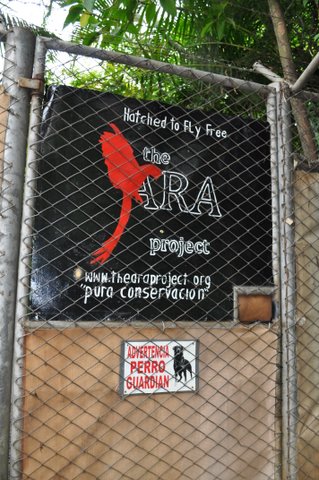
Costa Rica Pt.1 – The Ara Project

(A quick intro – Simone is the other main contributor to Wingtrip, but she’s been busy traveling, hunting bunnies with her hawks, and having intellectual freak outs about Carnivorous plants.  This is the first installment of her report from a trip to Costa Rica)

The GPS was confused. After circling many a block in Heredia, a town near the airport, we ended up five miles from where we had started.  Only it had taken us 1.5 hours. No matter we were in Costa Rica so I had barely noticed the length of the drive as we passed tiny houses with colorful clothes drying, graveyards with stark white, aboveground graves, and small shops advertising everything from tattoos to cow tongues. After an attempted use of a pay phone that didn’t work, we finally got a hold of Fernanda of the Ara Project, also known as Hatched to Fly Free, to tell her we were lost and our GPS was useless. She met us on the main street in town and we followed her down a winding road to the macaw sanctuary.

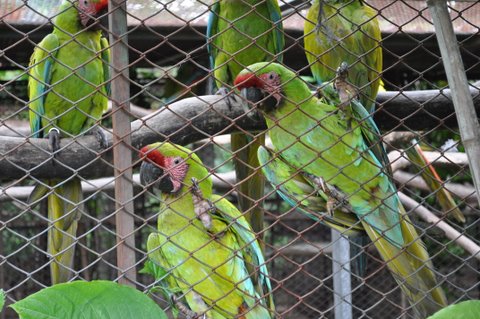
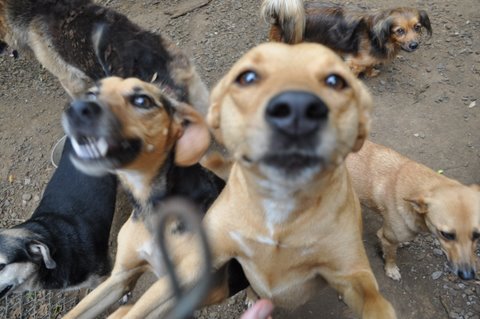
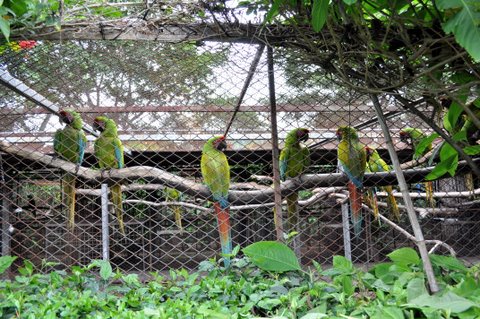
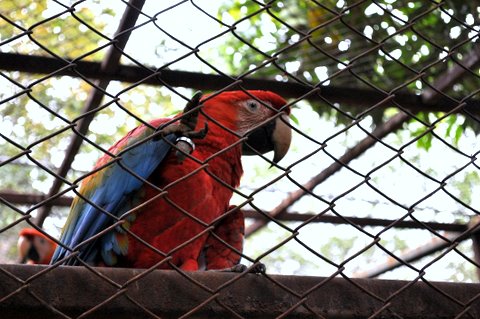
The first animals we saw were not macaws however; they were packs of friendly dogs rescued off the streets to greet us, along with a few cats. Chris, a young man from New Zealand, gave us a tour of the place and there were aviaries filled with Great Green Macaws (less than 200 survive in the wild in Costa Rica) and separate aviaries for the Scarlet Macaws. They clung to the sides of the aviaries as we walked by, their expressive faces following us almost as if they knew exactly what we were talking about. Many of these birds were hatched here and are waiting to be transported to release sites so they may join their brethren and help the dwindling population of these magnificent parrots survive. But other birds, in an aviary surrounded by plants, would never be returning to the wild. These birds were old pets or stolen from the wild and injured during the smuggling process. Many of these birds have a healthy distrust of humans (who can blame them?) but luckily have paired up and are producing chicks that will eventually be released in the wild. Their lives are not totally in vain.

When I think of all of these small organizations with very qualified people who are doing real “boots on the ground” work but are struggling to stay afloat I can’t help but wonder how we can change people’s priorities. Could anyone who has visited Costa Rica (especially for ecotourism) imagine it without macaws? If we let these magnificent birds slip away then the rest of the chain slides with them like a landslide into the sea.

To learn more about The Ara Project and how you can help please visit their website.


comment 0

Photoblast #5: New World Water

One of my favorite musicians, Mos Def, wrote a song about it (give it a listen).  Water is a basic necessity yet we seem to have a damned hard time keeping it clean and healthy.  Everyone needs it and recently there’s been a discussion of peak water.  One of the local radio stations in Seattle had water expert Peter Glieck on this morning discussing the bottling industry and public water and his new book “Bottled & Sold.” The National Geographic News Watch Blog ran an article earlier this month (in cohesion with a recent issue dedicated to the wonder molecule) about passing the point of cheap, easily accessible water for the world. (if you are at all tuned into international news you could probably have guessed this).  Something so simple shouldn’t become a financial burden yet there’s a distinct chance it will, even in more developed nations.  Although Wingtrip is about nature, people are integral and this isn’t a plea for other species, but for us as well.

Enjoy that water.  Relish it like this Great-tailed Grackle.  This water stuff, we live to it.

comment 0

Horrific Deepwater Impacts

Drew Wheelan has been doing an incredible job of covering the Deepwater Horizon Oil spill through blogging and video content managed by the American Birding Association.  If you ask me, this sort of reporting is more important than almost anything else out there.  Not only do I know I  can trust Drew, he’s not bogged down by impossible politics.  While I foresee a few posts from him in the future, I also know he’s got his hands full in the near future.  In the meantime I highly recommend viewing his videos, but be warned, some are very upsetting.

comment 0

Photoblast #4: The Light

This photo of a Hooded Oriole is an embodiment of enjoying nature.  Exploration of living systems is fleeting and one amasses their database for comprehension with repetitious events like this one.  At the risk of sounding sentimental or romantic (which I can be, but I try to leave out of at least some of my posts), this is why we find it so beautiful, because we don’t just observe and understand immediately.  We aren’t meant to achieve instantaneous expertise and we keep coming back for more.

comment 0

MABO 2010

A far parcel of Oregon houses a lasting corner of my imagination.  Down a seemingly endless road of silty dust, potholes, and bovine distressed shrub steppe, I find myself at a gate in late May.  It keeps happening every year now. No sign of nearby water, yet Franklin’s Gulls (Larus atricilla) dip over the sage and Willet’s (Catoptrophorus semipalmatus) call in the distance. This is a place of seeming discordance.

The Malheur Bird Observatory (MABO) is admittedly a bit of a misnomer.  Yes, work that would depict a scientifically founded organization has happened there and many of the field scientists of the West have found themselves there at some point or another.  But it’s not a functioning group like say, the Point Reyes Bird Observatory.  In the blandest of descriptions, MABO is a nice bit of shrub steppe acreage.

And arguably that’s the best thing about it.  Steve Herman, the owner and the inspiration for the gathering of the multi-generational students, just wants to get together with old friends and to make new ones.  Simone and I headed out from Seattle and saw people we admittedly could have seen in less than a 10-hour drive.  However friends from Wyoming, from Northern California, and elsewhere attended.  It was a sort of central meeting point.

At MABO we enjoy the company of our fellows, relax in the sweet smelling patch of intact shrub steppe, become enveloped by the dusty loam, and most importantly – watch birds!  An experienced birder of the Western United States will recognize Malheur National Wildlife Refuge as one of the best birding sites around.  Not only does it house a huge system of wetlands that nurse many a breeding waterbird but during migration songbirds descend on the refuge headquarters and other areas with planted trees, the artificial lushness we cultivate.  So amongst the Black Terns (Chlidonias niger), the White-faced Ibis (Plegadis chihi), and the Willets, you find Western Tanagers (Piranga ludoviciana), Swainson’s Thrushes (Catharus ustulatus), and Townsend’s Warblers (Dendroica townsendi).  Frequent “rarities” attract the so called “elite.”

As much as part of me wanted to dash out and find as many birds as possible over the weekend, a more persistent part of me wanted to slow down a bit.  I did just that for the weekend.  Sure, Simone and our close circle of friends (housed within a larger circle of Hermanites) got out and birded.  But it wasn’t rushed and we enjoyed quality not quantity.

Although the refuge headquarters didn’t quite live up to the fame of pulling rare birds this year, we had some fun stuff.  The “rarest” bird of our stay was a Black-and-White Warbler (Mniotilta varia), a bird that isn’t typically western but because it winters in Northwestern Mexico, tends to show in regular vagrancy. Also out of place, a Lewis’s Woodpecker (Melanerpes lewis) worked the compound of cottonwoods.

But I had just as much fun watching the family of Great-horned Owls (Bubuo virginianus) and Black-billed Magpies (Pica hudsonia) both with recently fledged chicks.  An opportunity to watch awkward adolescence, full of imaginative approaches to locomotion is full of endless hilarity.  I was disappointed when the Magpie fledglings moved out of range of easy observation on the second day.

Further out from the headquarters or MABO there’s much more.  Bobolinks (Dolichonyx oryzivorus) spurred up periodically in a wet field to sing their hearts out before flashing back to hide in the grass they so like.  I often wish I could spy on them in their moist domain.  Ibis dotted the countryside, either flying by in formation or probing spotted wetlands.  Crane cacophony rolled through the dust as we sped past ditches brimming with ruddy Cinnamon Teal (Anas cyanoptera).  A well established (multi-generational) Golden Eagle (Aquila chrysaetos) nest we’d discovered the year before was active with well developed young.  Just beyond the dwindling town of French Glen,  at the base of the east climbing slope of Steens Mountain is Paige Springs Campground.  I’ve never seen Yellow-breasted Chat’s (Icteria virens) in higher numbers or so atypically visible as at the entrance to the campground.

Wildlife in general abounds in Malheur (where cows haven’t been grazing).  We watched a Long-tailed Weasel (Mustela frenata) hunting Belding’s Ground Squirrels (Urocitellus beldingi) at the Malheur Field Station.  Pronghorn (Antilocapra americana) strutted through  the shrub steppe.  Coyotes (Canis latrans) rang out every night, culminating in a shouting match with our amassed dogs.

The time always comes to say goodbye (if I have anything to say about it, I’ll soon stop having to say goodbye to exploration and do it for a living).  All our dear friends parted ways, we brushed off the soot of good times, sighed our last breath of sage, and hit the road home.  Rain ushered our departure and the Cryptobiotic crust gleamed as we bounced down the road in admiration of a greatly undervalued landscape of shrub and steppe in the Great Basin.

Check out my photos from this year and last year on Flickr.

comment 0

Malheur Bird Observatory Time!


Simone, a large number of our cohorts, and I are off to the Malheur Bird Observatory for Memorial Day weekend.  It’s a tradition upheld by Steve Herman, seeing as he is the proud owner of the observatory.  So – down to Central Oregon for the weekend!  It’s a time of celebration, old friends and new, wonderful birding, and peace.  I for one can’t wait.  You’ll hear more about it when we get back.  Here’s some  shots I took last year for now:

comment 0

Photo Blast #3: Guess Who.

Looks can be deceiving.  If you showed me this photo of a Red-winged Blackbird (Agelaius phoeniceus), there’s a good chance I’d say it was a female.  For all intensive purposes, it does appear to be of the fairer gender.  But there’s a hint that should give the expert pause.  The gape, as in the bit of skin at the base of the bill, looks rather prominent, suggesting a young bird.  Do you really know that it’s a female if this is a young bird?

This is a little window into how bird banding works.  You start with your presumed knowledge and then, if you’re good, try to falsify your hypothesis on species, age, sex, etc.  (To be clear, when you catch birds to band, it’s not just to hold a bird and take pictures of them, you are recording data).  It’s actually a very fun process.

As it turned out this bird was a young male.  A bit of hunting in his coverts and we found the beginnings of his “red-wing” and black feathers were pushing up through his breast plumage.  Females are significantly smaller than males also, but without thinking of wing length or weight it’d be easy to make a base assumption and go with it.   In the case of a blackbird where size is significant this would be important because a band for a female bird wouldn’t fit properly on a male, it could even be dangerous.

This photo was taken on Shelldon National Wildlife Refuge in Northwestern Nevada at a place called Badger Camp.  Although it was late July in Nevada, banding birds here was fantastic, particularly because of the creek that ran right through.  Birds came in from all over for water including Western Scrub Jays ( or this blackbird) that you wouldn’t associate with the scrub steppe or grasslands that predominated the landscape.