comments 2

Sea Changes: Birding on Washington’s Coast pt. 3

“The sea is a really nice thing, isn’t it?”

“Yeah, it is. Makes you feel calm.”

“Why is that?”

“Probably because it’s so empty, with nothing on it” Hoshino said, pointing. “You wouldn’t feel so calm if there was a 7-eleven over there, or a Seiyu department store, would you? Or a pchinko place over there, or a Yoshikawa pawn shop? But as far as the eye can see there’s nothing – which is pretty darn nice.”

Haruki Murakami, “Kafka on the Shore”

The rain started sometime during the night, making me thankful I decided to put a tarp over my hammock. It wasn’t a heavy, stormy rain, but a rain of sea fog, the kind squeezed from air and dripped from the trees ceaselessly. The kind that would have soaked my sleeping bag just slowly enough to not notice, until I was shivering at 4a.m (you might guess this has happened before).

Kalaloch campground is a place of personal mysticism. At face value it’s simply a campground, not very interesting, up against highway 101 and short, sand cliffs on the ocean. I would probably never think twice about it, having seen hundreds like it with the same spartan, damp bathrooms, meticulous lists of rules, and the same people who sprawl about the best spot in their fantasy trailer park of beer cans, ropes, tarps, barking dogs and sniveling children. Forgetting that, Kalaloch is where I was struck by my lifelong passion for birds.

The story itself is a little too perfect, verbose in my telling, and I’ll save it for elsewhere. Secretly I’d hoped we’d stay the night in the same camping stall where I came face to face with a Pileated Woodpecker. The Sitka Spruce seemed taller than before, which I realized was possible, considering it was twenty years since that summer vacation. I was a bit crestfallen when the approximate space was filled by a large camper van, so I decided to not delve too deeply into memories. Besides, this wasn’t meant to be a time to reminisce but to go birding. Forgoing breakfast for later, we rose at daybreak, hastily packed up, and headed North.

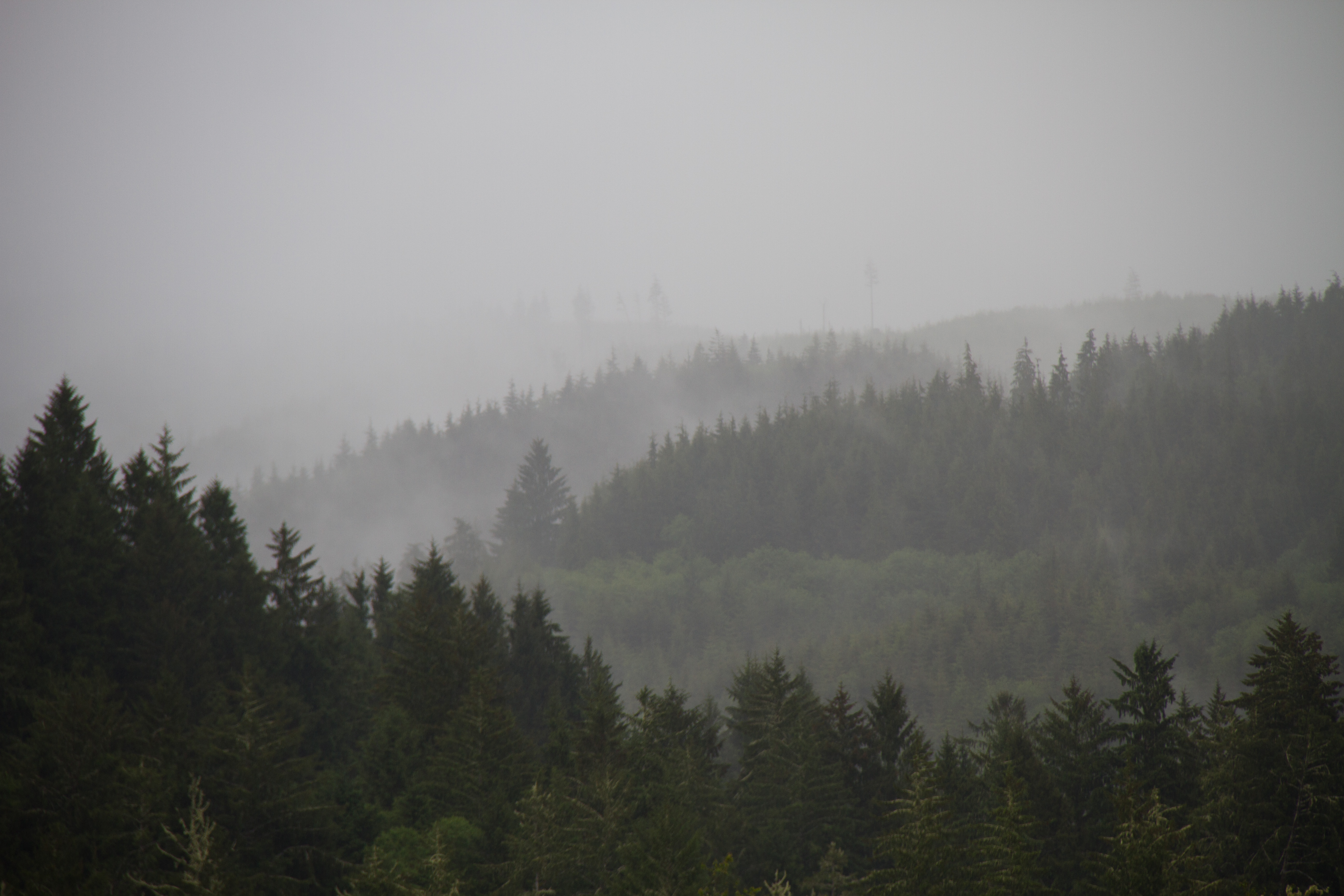
Ruby Beach might not be the best vantage for seabirding, but it is definitely a beautiful place to explore. We arrived to the quiet section of fine sand and immaculately rounded stones, appreciating the stillness of the morning mirrored in the freshwater lagoon. The sea stacks, broken off hunks of land carved from the mainland by time and waves, wore skirts of fog.

Someone was camping down between the drift logs, which was a surprise because the parking lot was empty (and it’s not strictly, allowed). We settled not too far from the tent, finding a suitable log to sit on. Adam, much more businesslike than myself, got right down to scoping for birds. I fired up my stove and got water boiling for coffee.

Breakfasting on bread and cheese, coffee in hand, I got around to earnest seawatching. The gray fog lingered, imperceptibly receding, revealing reefs and breaking waves. The shearwaters were out there, still streaming by. I thought about how many days out of the year they spent coursing back and forth against the West coast of North America and fantasized about being able to observe the entire year of their activity off Washington. Having the patience and luxury to spend that time would certainly provide personal insight at the very least.

DSC_6319

A pair of Peregrine Falcons flew by, no doubt living a successful life of eating seabirds. The slender male first, the bulky female second, they casually winged down the broken coastline. Their presence, despite the fact they are among the most common raptors in Seattle, finally gave me that warm feeling of being in a place not actively augmented for people. We’ve visited, but we’ve never stayed and the rich profusion of life told that story.

Scoters, gulls, grebes, and alcids dotted the ocean in front of us. A Sea Otter lazed about on its back. Black Oystercatchers blended perfectly with the rocks until their red bills rotated into view.

I am always quite focused on vertebrate life, but I knew that the foundation for all these creatures I observed was atop thousands of complex interactions between things we couldn’t see with the naked eye. You could easily feel insignificant in the face of this web of life and you should. You should think about all that you don’t know more than what you do. Could I name the crustaceans beneath rocks I overturned with careless feet? No. Did I care that they were there, when I noticed them? Yes. The naturalist’s compulsion to name is generally a good one, but it shouldn’t distract from an appreciation of form and function regardless of which dead white guy its named for.

Before I noticed the people in the tent rising, I knew they were contemporary hippies. From Alaska they told me, headed to San Francisco, whichever way life took them. The old folks who creaked down the path to stare at the sea gave them wide berth, as did Adam, but I wanted to know their story. I’ve always considered myself an introvert and shy, but I’m never troubled by a friendly conversation with strangers. Adam and I both seemed to enjoy this because we gravitated towards the interaction. Some people find a random approach off putting and you can always tell when they do. What’s more off putting is standing in proximity to other people, in the presence of a wonderful place, and not acknowledging them with a simple smile or joyful comment.

Ready to move on, two things thrust me back into modern human existence. The first was a training, for what appeared to be negotiators (like those who speak with the hostage holders), running an extremely noisy generator in the midst of their huge vehicles (they all also happened to be huge people), in the middle of the parking lot. The other was that when I rolled down my window to say goodbye to the hitchhiking hippies, regretful that I couldn’t offer a ride, the winder motor failed and my window no longer rolled up. Were these signs we shouldn’t head back? Maybe I could let Adam hitch back with the hippies and I could just stay there and eat starfish and kelp and live in a wave carved cave.

We made a couple more stops, talked to a couple more people, and saw many more birds. Destruction Island was a beacon for birdlife and a high vantage along 101 gave views of more seabirds. Several Black-legged Kittiwakes (the best gull name ever) flew by, distant but diagnostic. More Sea Otters were out in the rocks surrounding the island and a section of sandy beach was piled with lounging Harbor Seals. I remembered Roger Tory Peterson’s telling of his experiences on Destruction Island during his “Wild America,” jealous and grateful for his words at the same time.

The final conversation we had while scanning the rocks at one of the numbered viewpoints (what an absurd way to distinguish such beautiful places), was with a couple from Minnesota. New to the birds here, they were curious about what we could see, and as it turned out they too were birders (in a casual sense). We had a pleasant conversation, discovering we had mutual acquaintances and that we all loved ravens (they fed them at their home). Parting, wishing them luck and advice in their travels, they told me they’d look for my books in the future. My response was to blush and mumble a thanks. The random kindness of strangers in America is often startling.

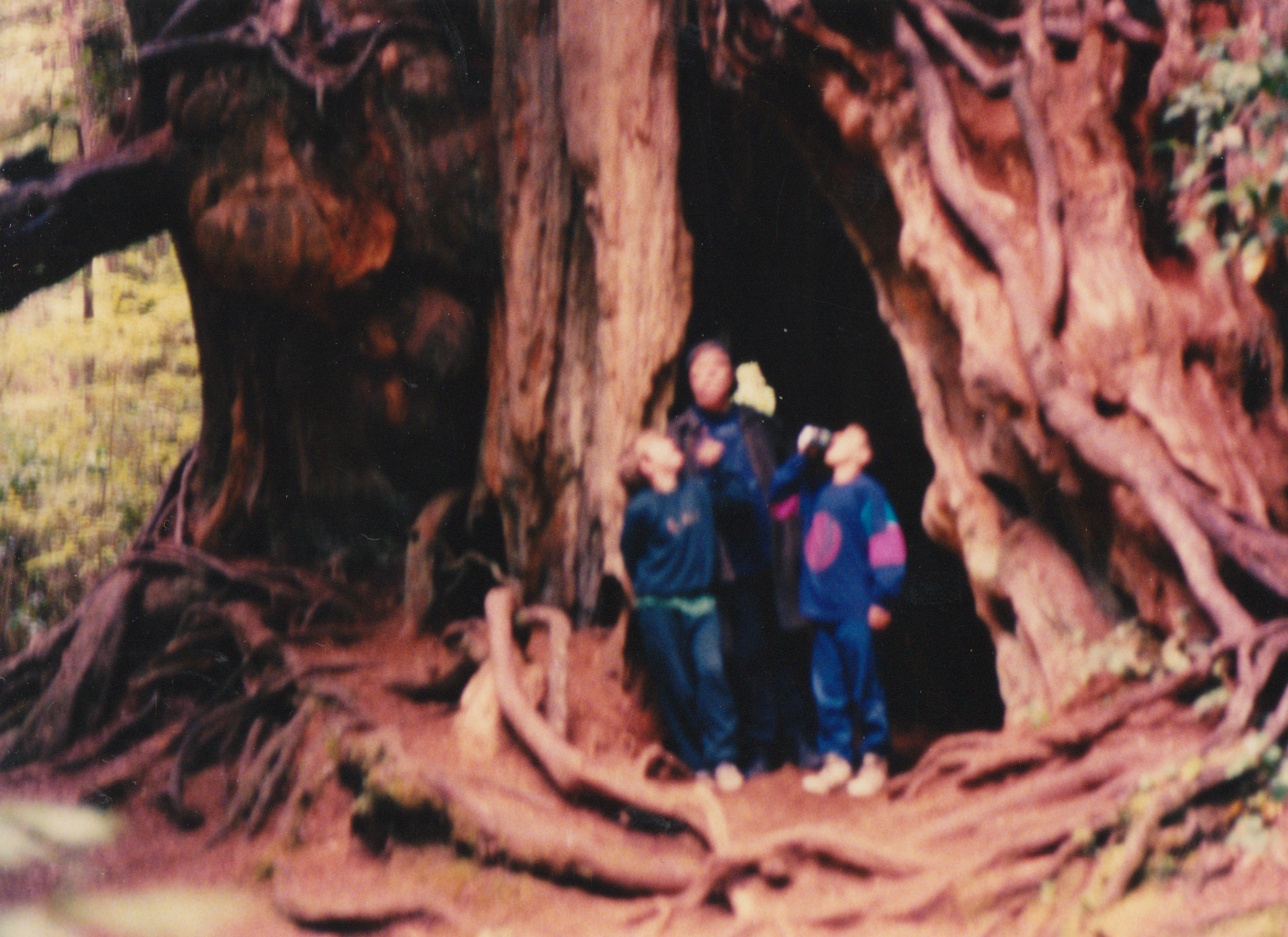
One final stop was at the “Big Cedar Tree;” a signed attraction. Like any of my travel companions, I subjected Adam to photography hi-jinks, climbing about the twisted tree for a few shots. Cedars this large smell as much of decay as they do of their fragrant oils, and this mangled behemoth was carved by plaguing rot, but still seemed elegant and powerful standing against time. It seemed familiar, so familiar that when I got home I looked through some old photos and discovered an out of focus photograph of my dad, my childhood friend Mathew, and I standing at the base of this same tree twenty years ago. Nothing seemed to have changed, and likely not much will for another twenty. I’ll make sure to come back and check.

comments 2

Sea Changes: Birding Washington’s Coast Pt. 2

We’d been standing there for nearly an hour and they hadn’t stopped. Any one moment framed at least 50, sometimes more, Sooty Shearwaters, winging past in what seemed an infinite supply. No number of encounters with this display make it less jaw dropping.

Birds of the order Procellariiformes are amazing enough as pan-oceanic conquerors, spending nearly their entire lives at sea. Throw in the reason for their other name, tubenoses, and one becomes even more enamored of their abilities. Their nasal adornments relate to two key traits. One, which pelagic birding trips take full advantage of by “chumming” the water with fragrant fish bits, is their ability to sniff out food (potentially) from miles away (and find their specific burrow when returning from nocturnal hunting in the case of some species). The streams of bird, which appear to be coming from the horizon, when chumming on a pelagic trip (scenting the water with fragrant fish bits) is quite miraculous. Equally amazing is a nasal gland at the base of their nostrils, allowing the birds to drink seawater (in tandem with complex metabolic pathways) and excrete excess salt. This is either a slow drip which follows the grooves of the bill or a blasting snort in the case of storm-petrels. These traits took careful study to understand and are truly marvels of evolution (then again most things are when using the refined lens of scientific understanding), but their lives at sea, through storm and fair weather, appeal to the poet as well.

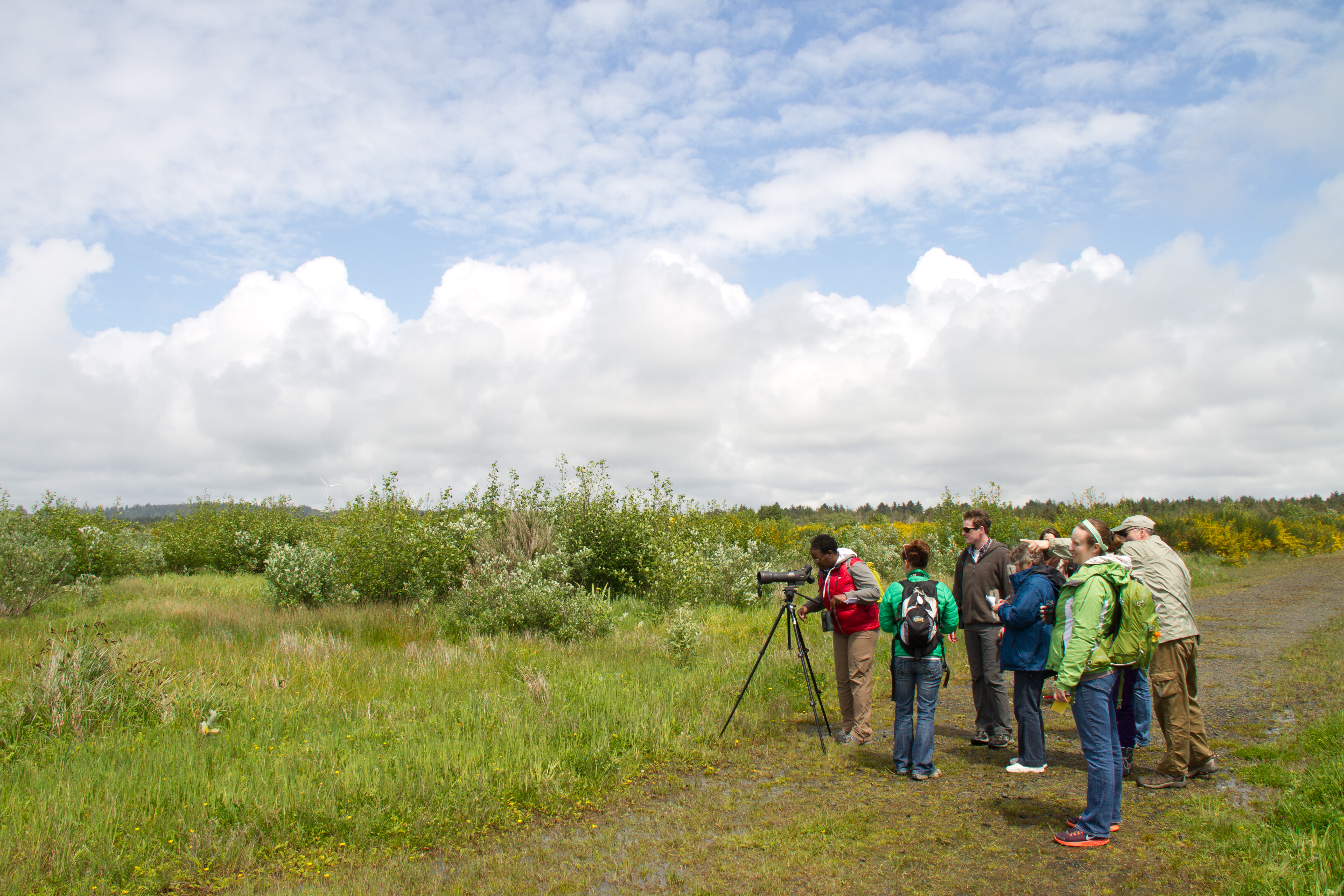
Adam and I convinced ourselves that by standing on a salt-sprayed breakwater and staring at the constant stream of birds before us, we might pick out a rarer species in the milieu of wings. Sooty Shearwaters are one of the most abundant bird in the world, and this was an excellent example of their abundance. We tried to sieve through them as thousands sped by, giving the impression that they’d never stop.

Abundance should not be confused with resiliency. Sooty Shearwaters have seen a decline in recent years and the reasons for this are likely complex. People hunt their young in large quantities, at least a quarter of a million taken in season. In New Zealand (and elsewhere) they are called muttonbirds (along with other nesting shearwaters) and fetch a good price, providing food and income for traditional Maori hunters. This hunting is probably a drop in the bucket towards decline, but in tandem with a floundering global fisheries due to climate change and over fishing, predation by exotic species on their nest islands, and by-catch from commercial gill netting, it’s not inconsequential. Bird Life International estimates that the world population is around 20 million, but no one has actually quantified their global decline. One study of nesting populations in the Northeast Island of The Snares, off New Zealand, saw a decline of burrows from around 3.2 million in the early 1970s to 2 million in the late 1990s (around a 37% decline). You can’t gauge a huge world population off of one nesting colony, but it’s certainly telling.

Sticky with sea-spray, I was thinking more about how difficult seabirds are to protect, than searching for a rarity in the mix. These birds were headed to New Zealand, but spend their lives in bodies of water controlled by dozens of countries, and in a wilderness that people are still trying to grasp. Their islands are an obvious fulcrum for preservation, but as these birds span thousands of miles yearly, it’s obvious other things need consideration. Without abundant fisheries, these birds could easily disappear.

Standing on the breakwater, I looked into grays harbor, once a thriving series of ports, now increasingly derelict. People logged too much (still do), people fished too much (still do), people wasted precious natural resources (still do). Sooty Shearwaters don’t eat salmon, but I couldn’t suggest over-fishing of salmon doesn’t relate, we might not understand all the connections. Even logging deep up the river valleys of the Olympic peninsula is connected to fisheries. Deforestation encourages erosion, which changes the sediments that flush into the ocean (and the fish that breed in the rivers). In moments like these, the world seems entirely hopeless and out of control, until I focused back on the beauty before me.

Sometimes Sooty Shearwaters aren’t nearly as close to shore. They were close now that I could have lobbed a rock amongst them as they passed. The Ocean Shores Jetty has always been a great spot for birders, providing a viewpoint into the Pacific and habitat for choice shorebirds that enjoy rocky shorelines instead of tidal mudflats. I wanted to find a Wandering Tattler or some turnstones, and to venture out to where two boys were fishing amongst the dangerously breaking of waves. The masses of Sooty Shearwaters seemed closer where they stood. But, my common sense got the better of me, and I merely crawled out halfway, slipping over the rocks, juggling fragile equipment I decided I’d like to keep whole.

Instead I talked to a couple who expressed curiosity in the copious birds. This may seem strange, considering the spectacle at hand, but no one except this couple appeared particularly piqued by it. Did they not see them? Did they simply not care? Birders are inherently observant people, whether through meticulous practice or by intuitive gift, so it’s always an astonishment to them when no one seems to notice anything but the most outlandish events, like when a gull plops on their head (or Bald Eagles). So, I didn’t veil my enthusiasm at their simple question of “what are those birds,” and breathlessly gushed to these unsuspecting souls about tubenoses, and nest colonies, and figure eights around the Pacific Ocean, and, and, and.

After over an hour of standing, watching the stream of birds, and hoping for another species of shearwater or petrel, we decided to move on. Darkness was not too far off and we had a long drive up the coast to Kalaloch, where we’d camp for the night. Turning our backs on the shearwaters, we clambered down the slick boulders of the jetty, getting out of the wind and water for the day. This same display will happen next year and has been happening for thousands of years, regardless of people. My hope is that we’ll not be the end of it.

Here’s a silly little video I made of the Shearwaters, condensed to 42 seconds from 2:40 seconds. (Watch in HD)

Postscript: While not about Sooty Shearwater decline, this article about sardines and Brown Pelicans came out right after I posted.

comments 4

Sea Changes: Birding Washington’s Coast Pt. 1

Unless you’ve encountered a truly large flock of migrating songbirds, it’s difficult to imagine the mass exodus of neotropical migrants vacillating between North and South. In reality we only get small views of their journeys, filtered by space and time, augmented by our imaginations and careful study. When you expose yourself to the sublime numbers of waterbirds, be they Western Sandpipers, Sooty Shearwaters, or White-winged Scoters, you witness the full intensity of bird migration. I’ve watched Broad-winged Hawks pick up as the day warmed in South Texas. I’ve seen hundreds of Western Tanagers flit through oases in the middle of the desert. Nothing leaves me more agog than the masses of birds I observe when I visit the Pacific Ocean.

For a birder, visiting the coast is an exercise in your ability to sieve through thousands of birds. A casual species found can make a trip, one missed can ruin it for some. Often you arrive at one location , stand and scan, and do so for hours. This may sound extremely tedious and it can be. From a naturalist’s perspective it’s a slightly a ridiculous practice in placing value on species that all have their link in an ecological chain. However, there’s more to it, and the more you do it, the more you appreciate the pedantic experience. The searcher becomes a shaman, muttering sacred incantations, fully immersed in the landscape. Inherently one appreciate the tides, the whirling throngs of birds, and the immediately ephemeral world of the coastline. You wouldn’t be standing there, calf deep and squinting at distant gray blobs for any other reason.

Adam and I got up fairly early to run down to the coast, have a full day of birding, crash in Olympic National Park, and get a half day scanning seabirds through passing along the craggy shore. Arriving at Bottle Beach, we discovered that the tide was still well out and decided to head down the coast while the advancing water pushed all the shorebirds closer to high tide mark. For those who don’t quite get this (you don’t all spend ludicrous amounts of your time thinking about the tide in relation to birds), shorebirds tend to stick nearer to the water’s edge and while every species has its different styles of foraging, closer water equals closer birds.

Leaving sunny Bottle Beach, with the massif of Mount Olympus visible to the North, we zipped south and immediately hit a fog bank. Stopping at several beaches near Grayland got us exactly zero birds. Despite this I was relishing the weather, the coastal quality of wind and imposing dreariness, the kind I’d happily walk through to mull life’s unanswerables. While this wasn’t conducive to birding, we did have a nice talk with a man and his dog, help a couple from New England get their camper van out of soft sand, and left feeling self-righteously human. Birders can be immensely nice people, but also can be cliquey when out birding, this was a nice aside from the shop talk in the field.

I won’t name names, but someone screwed up reading the tide schedule.

The mud flats looked all wrong when we reemerged from the fog at Bottle Beach. Why did the water seem to be farther away than when we started? Why were all the shorebirds almost a mile away now? Adam and I sat on a log, scratching our heads, staring at the tide table. Nothing on it suggested we’d arrived in time for high tide.

As a general rule, no one person should be in charge of scanning tide charts. Especially people who cannot count, add, or be relied upon to perform the adult heavy-lifting of reading the time. Namely every person who has screwed up reading the tides. Everyone. (To be fair, the tables are really endless lines of small numbers all squished together, recorded in too many numerals, and far too easy to skip a line).

We screwed up, didn’t get the better view desired. The side benefit was squelching about in the mud. We didn’t see a whole lot from the “listing” birder’s perspective just Western and Least Sandpipers, Semipalmated and Black-bellied Plovers, Northern Pintail, and Greater White-fronted Geese. In the duality of the naturalist that craves rare birds, I found great accomplishment in watching the eel grass beneath a thin sheet of water and tracing the prints of the shorebirds we now peered at on a sandbank across the channel. These birds had all done something we’d all consider remarkable for a human: traveled several thousand miles completely of their own power, with complex systems made up of essentially the same components, modified over time for their task, as humans. For every Outside Magazine article on some outlier who pogo-sticked across the Andes, there’s probably a million birds that do spectacular feats twice yearly. I love the idea of pushing my endurance, doing abnormal, wild things on the fringe of society, and then telling a story about it. I love day-dreaming about migration, my feet plunged into mud that might one day become mountain top shale, unfathomably more.

A good friend calls this strip of land, which will one day be swallowed by the sea along with every other distasteful seaside resort-town, Open Sores. Whatever your feelings about Ocean Shores, it’s irrefutably one of the best places in Washington to get to experience coastal birds. One moment you are circling through dizzying developments, on curving roadways that appear to have been drafted by a spinning top; the next you are pushing through a wall of willows to mudflats that bare no evidence of the nearby human settlement. .

Gray sea tones pillowed over the small ponds we came to visit, muting daylight but embellishing the green hues of squat coastal plants. Birds kept eluding us, whenever we’d shimmy for better vantage, slowly and quietly working closer, something would spook them. I blame the Northern Harriers, but I suppose it could have been us. The birds knew we were there the whole time, but would jump into the air when we were standing stock still.

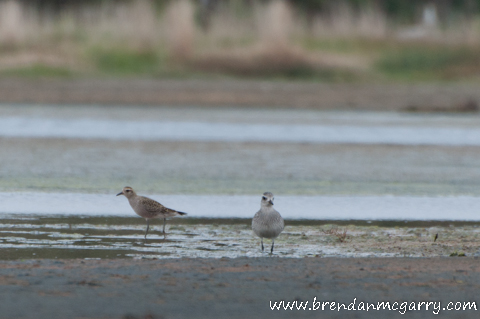
Adam was after one bird, an American Golden Plover we kept getting getting inadequate looks at. In the distance it would appear, just long enough for us to equivocate about the tail to wing length. Then, as if by magic, it would be gone again.

Encircling the pond, we carefully slid through slimy, rust-colored muck, trying to avoid slipping. It was an excellent canvas for tracks and I always enjoy these impressions. In most cases, I care less about what they tell me, their shapes and sizes are striking. Such a simple impression that will soon disappear, but still a marker of some creature that could have been here mere moments before. The Racoon prints, they were probably from the previous night, but I imagined their ambling gait as they scurried to the willows, away from Adam’s and my approach.

A group of Pectoral Sandpipers flew in remarkably close to us. I give shorebirds all the credit in the world for the challenges they face, but if you are standing stock still, I feel like they’d walk between your legs mistaking you for part of the landscape. Adam and I murmured appreciation for the close viewing and I squatted for some mediocre photos of wet grass and nervous birds.

The American Golden Plover had been there all along. In the midst of foraging, the bird would suddenly hunker down and remain still. This appeared to be in relation to large birds overhead, a cryptic means to avoid predators. Plovers travel in groups, but they don’t frenetically tear about the shoreline in huge like peeps (a birder term for small shorebirds, typically of the genus Calidris). Instead, they patiently stand on mud flats or grass, waiting for the perfect moment to rush and grab a food item (this is accurately described as “run-stop-peck” in literature). They generally do this in a solitary fashion, a loosely associated flock at best. Hurling themselves into the air when any predator is overhead would turn into a death race based on speed, not safety in numbers. While Dennis Paulson’s Shorebirds of the Pacific Northwest calls them “the high speed champions among shorebirds,” crypsis is less energetically costly than sprinting contests. We were constantly reminded of each time the bird sat in the mud, nearly disappearing.

We weren’t confident about this bird’s identity. My experience in identification of American Golden Plovers vs. Pacific Golden Plovers was mostly book learned, the relative few I’ve encountered in the flesh were either very obvious or pointed out to me. We needed a photograph to confirm. I had a camera, but a meager 300mm reach. However, I also get enjoyment from crawling in the dirt (or goose shit as it turns out).

Brendan_McGarry_130911_00192

My first Golden Plover, which I can’t confidently say was a Pacific or American (I was 10 years old and don’t trust my assessment), was from the Oregon Coast. This bird was on the ocean side of Bayocean Spit, ringing one side of Tillamook Bay. My parents graciously took me there to bird on semi-annual excursions to nearby Pacific City. My mother and I spotted this bird far ahead on the beach and lacking a scope, I chose to inch forward on my belly, using a large drift log to hide. When I got close enough, I peeked over the log and found myself immersed in a private encounter with this bird and a lone Dowitcher nearby. They seemed unaware of the nearby child, barely containing his excitement. I haven’t yet figured out how to describe the excitement of observing animals with no knowledge of your presence, but it’s much preferable to birds harried by your proximity. It feels real.

This was playing through my mind as I crept through goose shit to snap a diagnostic shot. The birds knew I was there, so it wasn’t the same, but I still got my daily snapshot of their world. I amused myself watching the bird lean forward in aggressive stance to chase off interloping Black-bellied Plovers and then suddenly press itself down, motionless as a gull flew over. Before long and for no apparent reason, every bird up scared up, noisily calling in alarm.

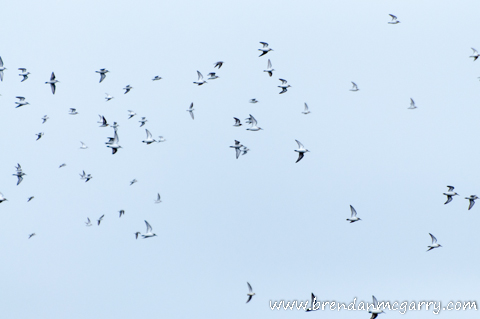
Cold and stiff, I got up to stretch and we headed off to the car, to our own human reality. There was more birding it to do. But, before we got there, we were reminded of the power of numbers. Just on the other side of the willows, I heard a rush and looked up to see see hundreds of sandpipers low overhead. I spurted something loud unseemly in my surprise and delight at their rushing wings. These were the moments we came for.

Brendan_McGarry_130911_00206

comment 1

“Rescuing” a Barred Owl

“It’s been in there for about a week.”

Hear this in a normal conversation and you would guess that it was…a package. A newly hung piece of art. Something molding in the fridge. But, no, in this case we were talking about a Barred Owl.

If a Barred Owl got into my pigeon coop and killed every bird it could find, I would’ve been furious. Steve, my friend and former teacher, was calm about the offense. I suppose that’s the value of long years working with animals. The lesson: shit happens. When we brought the culprit indoors for a brief viewing, recompense for the massacre, Steve merely mussed the bird’s head with unveiled appreciation.

“That interaction made losing a few pigeons completely worth it.”

Simone stepped into the coop, wearing clownish, yellow cowhide gloves, wielding a long-arm net. She was composed, from years of doing ridiculous things with birds with pointy ends. Hours before, her falconry Red-tailed Hawk accidentally grabbed her finger, excited over catching a Snowshoe Hare. I might have dribbled in my pants; she deftly snagged the bird. We were a bit let down by the lack of misadventure.

Barred Owls are newcomers to Washington State. Their first record is from 1965, in Northeast Washington. When Steve first started teaching here, they wouldn’t have been anywhere near Yelm. Now I’d hazard they are the most common owl in the state. In an attempt to alleviate pressure on their endangered congener, the gentle Northern Spotted Owl, a federal program exists to shoot Barred Owls where their ranges overlap. Barred Owls are intense birds, I’ve had more close, nearly painful encounters with them than any other bird. They are similarly hard on our native Spotteds, killing them as well as preying on other species like Western Screech Owls. What’s ironic is that their spread is completely due to human disturbance. They flourish in the open, mixed forests our logging practices create.


The receptacle for conveyance away from Steve’s coop was a burlap sack. This morphed into (thankfully!) a cardboard box. I’ve thrown probably a thousand, if not more, birds in bags. A burlap sack still seemed inappropriate. I had visions of it irrupting to scalp me before getting entangled in Simone’s hair. She’d run around screaming while I bled out, the first person to die by owl talon. If I’m going to die from a wildlife encounter, I’d at least like to be gutted by a Cassowary, or maybe trampled by stampeding Wildebeest. “Owl death” doesn’t sound becoming from where I’m sitting, but maybe I’m not into death metal enough.

The did owl bite Simone on her shoulder in the process of getting it into the box. Before that, it had been remarkably placid, likely because its “condition” was “blubbery,” a sure 5 for banding data. Though real damage is dealt with talons, blood welled from the wound inflicted through shirt and sweatshirt. This nibble was fair reason for circumspection around a bird that only weighed a few pounds at most.

Good lord was this bird pretty. Admittedly, I’ve never seen a Barred Owl and thought “you are the source of all our ecological ills.” Instead it’s something along the lines of “Be still my love, so I can count the cryptic chocolate patterning of your plumage and stare into the soulful depths of those black eyes.” We were respectful, but it took its fair share of poking, prodding, mussing of feathers, and flash photography in the process of “rescuing.” I did stay well away from those rapier talons though, I’m not into S&M.


There’s some legal ramifications to transporting and releasing a protected bird (that the government pays people to shoot). So we didn’t take it very far away. I know that’s not how laws work, but I don’t really care. There are greater ills in the world. Somewhere in the forest nearby, this character disappeared into the murky second-growth forest that welcomed his kind in the first place.


He was probably surprised, in a Barred Owl way, that we didn’t eat him. Had our relative sizes been reversed, I have no doubt we would have been dinner. We watched him disappear into the damp afternoon, happy to have experienced this creature for a few hours. Maybe this was rude treatment for a respectable species, maybe a bird on territory; but killing 12 pigeons is similarly impolite.

See some more photos here.

comments 5

Into the Wilderness Pt. 3

They say what goes up, must come down. I pondered that notion both in terms of physics (which I have no business in pondering) and philosophically, as the wind tickled the surface of hidden lake and I eyed the frozen peaks. We all were quietly steeling ourselves for the scramble up, inwardly wishing we could ever imbibe in the solitude of the North Cascades. What goes down, must come up?

The downside of hiking into a basin 1000 feet below your shelter, is that you have to go back up at some point. In numbers it sounds less impressive but we had to travel up 0.18 feet vertically for every foot horizontally, but this was no feeble climb. The elevation gain itself wasn’t the issue really, it was that we were doing it with no trail, over boulders and up cliffs. Strapping on packs, taking final longing gazes at this clear blue lake, we turned to face the slippery wall of granite.

I wasn’t morosely facing the exertion, I just felt this was far too quick of a departure. There were plants to identify, ones that I discovered when I was home, were endemic to the North Cascades. (The problem with last minute trips is that I never prepare enough to know everything, y’know, because when I have time, I do know everything). Maybe there were ptarmigan somewhere in this basin. With so many places for natural history to secret away within an endless jumble of boulders, I was anxious that I was missing too much. My 28 years of loving nature hasn’t taught me zen in the face of exploratory learning opportunities. I resisted the urge to frantically peer beneath every rock, to photograph ever inch of the way.

Despite respecting the risks one takes in backcountry travel, like inelegant clambering over loose rocks that weigh as much as your car, I generally never find myself overwhelmed or out of my element in wild places. The whole process seems pretty simple if informed choices are made and nothing bad happens (never impossible). That said, I am mindful at all times. We picked our way up, didn’t aim to tilt the loose rocks, didn’t jump too often, stopped to survey our progress. That’s the beauty of moving on foot, the control is in you alone. I find the simplicity elevates my confidence; one foot in front of the other.

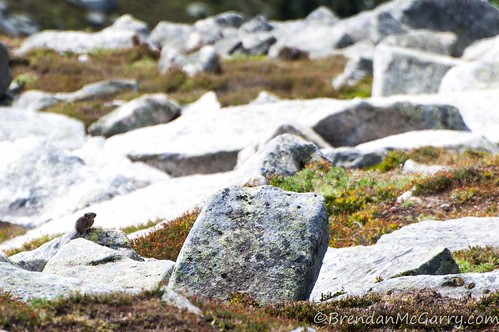
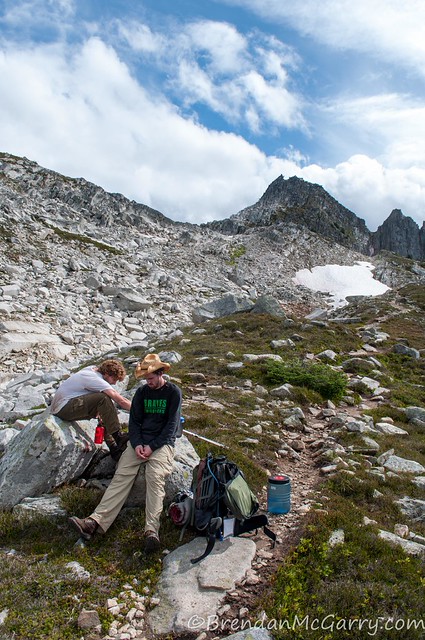
Three people use a lot of water and we refilled on a particularly beautiful bench halfway up. The route finding had been pretty fun, heading a totally different way up, with no white-knuckle slithers down algae-slicked cliffs. I got distracted from water purification by the miniature landscape of a pika’s little world where we sat.

Here an animal lived it’s whole life, bouncing into view, calling, watching us, and then disappearing behind rocks to repeat the process over. It was strange, almost muppet-like. This was its element, its evolutionary inheritance, but as temperatures warm, the alpine will be invaded by hoards of trees and winters won’t be the same the pika. The small stream might divert elsewhere or not flow enough, losing the oxygen to support the miniscule ecosystem of this flat, and maybe not grow the right plants to harvest and last the winter. For the pika lasts the winter by secreting away the hay of alpine perennials. I had no specific vision of what might change, but I knew that if a pika knew the wealth of place as people did, it would cherish it’s mini valley. There is no doubt in my mind that they do in their own inherent way; old middens were everywhere beneath the giant granite. We would share this spot for a moment, but soon forget and re-commence our plaguing consumption that spreads well beyond our immediate world.

Most of the snow left was pink with algae cast gray by melted grime. While interesting looking, one doesn’t immediately recognize that the organism growing on spent snow is persisting on ice cold water, the alluvial collection of nutrients, and a ephemeral sun. It was a marvel enough that between the ominous storm clouds and quick seasons that anything could live there. Does it make sense that we find the small scale life more difficult to appreciate and comprehend, when the existence of multicellular organisms is in some ways much more complex? Were we ruining colonies of photosynthetic organisms, ending inheritance lines with our feet as we skidded across a snow field to a cairn marking the end of our sojourn away from humanity?

Tired but satisfied, we trundled back up and found new companions at the lookout. You never know who these people might be, so it was a relief to find three bright-eyed siblings enthusiastically surveying the roof of the world. Their solidarity was immediately apparent when the elder sister told me my feet stank half jokingly. She was well aware that our perch had little to do with hygienics. Besides, small spaces are not for fragrant peakbaggers paired to sensitive noses.

Our new companions were of a different breed, but were easy to enjoy the mountains with. Noel and I couldn’t contain our urge to again snare the churning light in the passing depths of clouds. Watching the siblings take a picture on the penultimate slab on the peak, Sam and Noel were finally lured there for a group photo we’ll never forget. I escaped momentarily to attempt to photograph pika in the evening light, but instead merely watched the wind and listened to their constant squeaking as they ghosted about. Giving up, I returned to bounce around the peak for the rest of the night, laughing and free from worry.

A sunset and a brief moment of clear starry skies was a final treat on our trip. The next morning we woke again to torrential rain and our companions saddled up immediately to leave. We ate breakfast, trying to wait out a storm that wouldn’t stop. We packed our considerably lighter bags and began our slosh down the mountain. We didn’t talk too much, the creeks were noisy and swollen and we were lost in contemplation, swimming in our own moisture mingling with rain. The drenching didn’t matter, and somehow, I got away with dry feet.

comment 1

Into the Wilderness Pt. 2

Ultimately, as a species, we don’t belong in the high alpine. We visit them and occasional cultures embrace the peaks or wend above the treeline, but all our bones are easily dashed against the callous steeples. You climb for spiritual experiences and most descend unharmed.

Sam is a good sport when it comes to two good friends who are fiendish photographers. He lounged about wisely overseeing while Noel and I squawked over the orgasmical light vibrating across glaciers and rock. While it was truly spectacular, I had to remind myself to simply sit and observe as Sam did. The fear of missing out is strong beneath ephemeral storms clouds. Clear sky was enveloped by a wall of steel gray, at first spiting, then pummeling with heavy drops. We called it quits and retreated to shelter.

I believe I heard the shout first, because I stood up from our card game and looked out the window. There was Nicole, the girl who left the lookout hours ago. She was strangely far out on the edge of the peak, as if she’d climbed up the shear cliff. We went outside to meet her and stood in the wind while she told her story.

We were all just as confused as Nicole, who was soaked to the bone and vaguely incoherent, as she told us what happened. From what we could tell, she’d descended far from any trail, heading the complete opposite direction of the trailhead. It sound as if she had started to climb down a cliff. Her car keys were gone, she fell and lost them, and her cell phone was dead because she’d been taking pictures. Soaked, with no rain gear and no food, we insisted she come inside.

Her parents expected her at eight o’clock, which was fast approaching. It seemed obvious that she wouldn’t be heading down in the dark, but we didn’t have cell phones or any other way to communicate that she was alright. We shared our meal with her, lent her dry clothes, and made her use the extra blankets in the lookout to warm up. Sure, we felt bad for her, but this was a significant damper on the evening and we decided to turn in rather soon after her arrival.

The next morning I’d planned on waking for sunrise but when the alarm hit we appeared to be adrift in a cloud. Nothing was visible, not even the peak we were perched on, and rain smacked the hollow shelter. Sam and I got our obligate coffee and soon breakfast was cooked on the leeward side of the lookout. Nicole stayed in bed the entire time, lounging around post breakfast as if she wasn’t a missing person. Magically her cell phone worked again and she texted her Dad before it died. As the day cleared and I expected her to get on her way or ask us to lead her back, but she simply sat around, even after I explained that there was certainly a search party out for her. Having waited out the storm, it was approaching 11 A.M before Sam, Noel, and I were ready to leave for the lake below and guide Nicole to the main trail.

With mountains always in the distance, I think many people in the Northwest become familiar with their beauty but forget they aren’t a benign playground. I’m a firm believer that we should take the wilderness seriously. We did all that we could to help Nicole, but when the situation turned from dangerous to a babysitting annoyance, I started to get irritated.

Yes, Nicole was near hypothermic by the time she found us, evidenced by her shivering and lack of decision making. She was probably scared that her parents would be mad and unsure about spending the night with a bunch of men. That doesn’t get her off the hook. Quite possibly that sounds cruel, but she could have died out there and didn’t seem to appreciate that fact. This was all going through my head as we started down and I was not looking forward to shepherding her. Thankfully a ranger was on his way up to find Nicole, lifting us of responsibility. We could return to mountain solitude, the point of the trip.

Letting go of my gripes, we picked our way down from the saddle below the peak and descended to the lake itself. Little did I know this wasn’t the end of my annoyances. We’d have our trip soured by a imposing ranger at the Marblemount station, bent on sussing out our malfeasance.

“Sounded like it was quite the party up there.”

Questions need to be asked when a young girl spends the night with three men, but the series of insinuations we endured made me furious. We’d been nothing but gentlemen, even stepping out into the rain while she changed clothes. We enjoyed our beer, but that shit’s heavy and we’d brought just enough for ourselves, not an underage girl. There was no “thank you for helping her.” I felt like I was accused of being a predatory frat boy. This was poor payment for benevolent actions (despite my callous grumblings above). However, I suppose you don’t do good things for rewards, but because they are the right thing to do. The only grudge I’ll hold is against the head ranger at the Marblemount station. You suck dude.

Back to the mountains.

Pika, the alpine cousin of rabbits, held my attention the entire trip. They were one of the few vertebrates and seemed to be everywhere in the granite fields. Their cartoonish “eeee” was a constant companion in the lonely soundscape down the valley. No birds called. Stopping to breath, the only other noises were the trickle of water, the wind gently past our ears, and our heaving.

Soon there was no obvious trail, nor cairns marking the simplest route. We were left to our own devices and there was sparse evidence of people. Despite having traveled a distance from the city, I was struck by how close it really was. This bowl in one way had little to do with us and existed, largely in-situ; people couldn’t get there to actively deface it. Yet, as steeled to life as the alpine is, it’s fragile, and I knew the landscape of ice and rock was not immune. We’d driven to the trail-head after all.

A series of benches gave us the continued false sense of being just on the verge of the lake-shore. At one point I led us down a sliver of unprotected rock, thinking it the easiest route. Turning to look back up, we realized we’d just shimmied down a cliff. Even a short fall here would have been disastrous.

200 feet below us sat the water. Beautiful, blue, and teeming with trout but still 200 feet down. Calf-deep in heather, grasping thin trunks of mountain hemlocks, we peered down, trying to see a way. I was almost ready to give up before we found a slippery route to the shore.

Restricted by our desire to stay dry, we spread out on a small group of boulders lining the bowl. To one side, a cliff teeming with holdout wildflowers growing in the midst of a waterfall. To the other rock struck vertically into the lake. No matter, we would have found different views elsewhere, but the essential experience would have been this same. For those precious hours, we shared this lake with no other people.

Perched on rocks, a waterfall to our backs, we felt accomplished and ready to fish. Of course there was the issue that we are all abominable fishermen. There were dozens of trout in the lake, but by the time our flailing casts had sliced the water a handful of times, I’m fairly certain they’d all vacated our cove.

We kept casting, aimless and happy despite failures. Giving into our deficiencies, we stopped and quietly enjoyed the sublimity of the floating lake, which seemed to waft out into the Sahale glacier miles away.

This was what we’d come for.

comment 1

Into the Wilderness Pt. 1

Sam and Noel looking across to Hidden Lake Peak.

Everywhere we looked a glaciated peak dominated the horizon, seemingly at arm’s length. We’d forgotten to sweat, the uphill toil, and the absurd reminders of humanity strapped to our backs. Nothing mattered except the light playing through clouds and the spangled mountain tops. Nothing was important except our mortality.

Why do we travel into the wilderness? From a spartan, pragmatic point of view, it’s because we desire beautiful scenes and a chance to get away from our towns and cities. In the most elevated of encounters with the wild world, in the presence of dwarfing trees, towering walls of rock, and thundering rapids, I am reminded that I am human. I am not mortal and most importantly, that there are more impetuous forces in the world besides my species. I want to feel toothless, powerless in the face of nature. I don’t ascribe tooth and claw; there’s gentleness in the pika middens nestled beneath the hard tumult of scree fields. Strangely, I always come away confident, rested, and exhilarated every time I venture off the beaten path and encounter challenges that do not cushion my finite existence.

My friends Sam and Noel invited me on their annual backpacking trip in late August days beforehand and miraculously, I was able to join. Our destination was Hidden Lake, a snow fed scrape of granite just into North Cascades National Park. If we were lucky, which we were, we’d get to stay in the historic fire lookout tower. Not too far off Jack Kerouac had spent a season scanning for fires on Desolation Peak. To some degree, the excitement was because of those who tread before us.

I have a huge internal conflict when it comes to United States Forest Service roads. They were put there, not for rednecks to poach animals nor urbanites to peakbag, but for loggers to access trees. The night before our trek, we trundled up one such road, finding a beautiful view on a road seldom visited, enjoying simple exploration. One car broke our solitude, a SUV with grungy occupants. “Bear hunters.” Finding an impassible road, they turned around as we parked. The driver and I exchanged brief pleasantries, despite our apparent differences and he confided in me “I hope to god we don’t find a bear.” Strange words from someone “hunting,” but I kept that to myself.

Rainclouds were left in the valley and we searched for a lake, that didn’t exist, to fish in. Instead we looked across to our goal for the morrow and picked through a roadbed overgrown with Western hemlock and Douglas fir. I was reminded of remote mountain tops in Northern California, old Sierran forest roads swallowed by the regrowth of white fir or ponderosa pine.

It rained the entire rest of the day and night but we made the best of it. Clumsily fishing in the river at dusk, emboldened by bourbon, we groaned over the beautiful riverside camp, shaded by a massive cedar and two firs. It was reserved by someone we knew wouldn’t show due to weather. I was excited about the following morning as I climbed into my hammock, but awoke to listen morosely to the ceaseless dripping of the trees. The sound of rain or dripping forest was indistinguishable.

In the morning, we managed to pack and organize unmolested by precipitation. By the river, we stared into the dense hillside partially ensconced in valley clouds. A naked child ran into the water above us, a strange apparition diving into a slow, cold current covered by a layer of fog. Time to start climbing.

“What the $%#! are in these bags?”

To say that we were overloaded was an understatement. We needed our beer, our coffee percolator, our cameras, our fishing poles, and dozens of other extras. Spartan, has never been in my repertoire, despite my ability to rough it. Did I mention the bacon, the sausages, onion, and mounds of dried fruit and nuts. I hoped we didn’t catch any fish because we’d have carried food up for no reason. Exhausted, grumbling our way up switchbacks out of the forest, we stumbled into the Sibley Creek drainage. This winter time avalanche chute hosted stretching fields of green vegetation from mostly finished wildflowers and the rush of melt-water.

Marmots whistled as we filtered water at the top of the creek’s drainage, fearing there wouldn’t be easily had water elsewhere. This was laughable. Within several hundred meters of traversing the granite fields on the edge of the treeline we jumped several ephemeral creeks, but I’ve done enough backpacking to not want to assume. Hidden Lake Peak was 1000 feet above the lake itself; I knew we wouldn’t be climbing down for water once we scrambled up.

We got our first glimpse of ice covered El Dorado, epic beyond proportions, when we stopped to refuel on trail snacks. Blueberries were ripe all around us, leaves blushed red with autumn under a sky threatening storms. Miraculously we managed to make it to the top without rain.

Looking tired.

I was really just paying attention to the pipits, the pika, looking got migrant hawks or a ptarmigan, and staring at the peaks which grew and morphed. Sam and Noel said I was dashing up the mountain. By the time we reached the saddle below the lookout’s perch, I was also very tired. The meager trail to the top was a stumbling, over-exhausted affair that scared me; the slope below wasn’t gentle. Finally, we crawled over the jumble of rocks that made up the peak and said hello to the lookout.

Hidden Lake Lookout.  A magical perch to say the least.

Nicole, a solo hiker, was inside taking a nap when I knocked. Gasping from elevation and towering packs, as much as from the other worldly view, we talked with her and looked about us in disbelief. She was hiking on her own and we realized we’d seen her early on, descending from Sibley Pass, which she’d accidentally ascended. By herself, she took off, heading back down to the car. We waved goodbye, thinking little of her down-climb, minds on a celebratory beer, our decadent sandwiches, and the outrageous place we’d just climbed to. A full two weeks since we were there I am still left with giddy exhilaration thinking about Hidden Lake Lookout.

comment 1

The Cradle Robbers

werwrwe

I wonder if you’ve ever noticed something particular to mountain rest-stops, ski resort parking lots, state or national park campgrounds, or any other place where humans congregate in our typically distasteful, gregarious manner. Not the motor homes, not the camera adorned visitors, not the profound lack of respect for the cleanliness of the beautiful locales. Ever notice how many birds are around?

Now these aren’t just any birds, simply there because you are in beautiful, natural setting. In the alpine regions of the Cascades, the Olympics, or any other range in a temperate climate for that matter, bird diversity is relatively low. Yes, it seems so wild you expect birds to be dripping off the trees. In truth when we visit the mountains, species are distributed into territories to breed efficiently before the seasons change. Birders go to the mountains for very specific, highland birds, not to rack up a species list. So no, there aren’t a bevy of species skulking on the edges of our human insinuated habitats. Mostly, there’s one group of birds. Corvids.

Corvids, for the uninitiated, are the family of birds that encompass crows, jays, magpies, ravens, and a few other species. They are on every continent except Antarctica, but their diversity is centered in the New World and Asia. Despite their size and relative lack of musical talent (to our ears), they are songbirds. In fact the Common Raven (Corvus corax) is the largest member of the order in North America. They all have rictal bristles (except Pinon Jays), feathers which sprout near the nostrils and grow towards the tip of the bill. They are typically quite stout birds with heavy utilitarian bills and strong feet, which aid them in being generalists of whatever environment they inhabit. There are a lot of comparisons to make with apes, as we have very multi-purpose teeth, have hands to manipulate things, and also have large brains. Ah yes, those large brains; on the brain to body mass index corvids are right up there with apes and cetaceans.

Many of us know crows and ravens particularly for their intelligence. Some people find members of the family extremely annoying as a result, it’s true that their intelligence can make them pests. I’ve seen crows dig up my freshly planted vegetable garden, presumably because they watched me dig holes and put things in the soil. I dislike the comparisons of intelligence that people inevitably make with other animals, we are so damned arrogant, but it’s decent frame of reference. New Caledonian crows, famous for their tool making, are probably one the smartest non-hominid animals in the world. I’m not going to tell you about the crows of New Caledonia, or any other tool use in corvid for that matter. The topic is as lengthy as it is mesmerizing. The take away is that crows, jays, ravens, and their kin use their intelligence well, especially when related to food.

Of course, regardless of the trouble corvids can create, I love the little buggers. They never cease to amaze. However, in the alpine, I have mixed feelings about how often and where I see them.

When I’ve guided in the past, taking people to Paradise at Mount Rainier or Hurricane Ridge in the Olympics, I consistently expect to see a common raven, a gray jay, or a Clark’s nutcracker, maybe a Steller’s jay too. This is great for a guide who wants to easily show off some native species, but these corvids aren’t there because they want to help a brother out. Our presence attracts them, because our overabundance of calories and in turn wastefulness means opportunity. In fancy terms, picnic areas and national park parking lots are the epitome of anthropogenic food sources.

There’s a lot of ways this discussion can go. Gray jays are notorious for their willingness to alight on your hand or food, often unbidden. They’ll even drift toward anthropogenic food sources in the middle of nowhere if they’ve had a few profitable experiences with people. I once sat on a summit that I presumed seldom had people (no trail to it existed and it was literally miles from the nearest easily passable road), only to have a gray jay land directly on my sandwich when I wasn’t looking. I won’t lie, I’ve fed gray jays, Clark’s nutcrackers, and ravens in the past (for shame), but I’ve stopped (I swear). Almost all of us enjoy contact with animals, (I’m gross though and have let pigeons in a Thai city land on me) and these bold jays offer a great opportunity for that. That said, you really shouldn’t be feeding them.

A poor argument for not feeding corvids, and one I’ve heard too many times, is that if you feed them, they’ll become habituated and have trouble fending for themselves. This is a non-issue, they’re too smart for that, but it’s true for other animals; feeding foxes at Mt. Rainier creates many casualties because they beg for handouts on the winding, shoulderless roads. The best reason to not feed corvids your snacks is that they aren’t good for them. If your cheetos, white bread, and salami aren’t healthy for you, why in the world would you give it to a bird? I fully submit that we are being taken advantage of as a food source by the birds and that we won’t be able to completely eliminate their presence and sneaky snatches, but you can stop feeding them.

Another more compelling reason I’ve regurgitated many times, relates to another of their food habits. They are excellent nest predators and the general assumption is that their presence has a heavy impact on songbird populations in places where they unnaturally congregate for anthropogenic food sources. This appear to be clear logic, but since I myself have said this, I might as well see if it’s true.

Turns out it’s not that simple.

The issue with making logical leaps like this are simple. Yes, it’s likely that more nest predators mean more predations. However, does that actually mean that they have a negative impact on overall survivorship of the birds they predate? So far as anyone can tell, not statistically.

In various studies, looking at a variety of corvid species, there didn’t seem to be a direct correlation between nest failures and increased presence of corvids. In several studies, several of which were done by John Marzluff of the University of Washington (a corvid expert), some birds didn’t even behave differently as a result of human presence. Steller’s jays, which heavily predate on eggs and nestlings of songbirds, didn’t appear to distribute any differently or travel long distances to get at human food. Crows and ravens were much more likely to, but didn’t show any increased impact when they traveled to areas with anthropogenic food (in other words a nest predation was relatively incidental, not actively worked for when human food was there).

In Britain and much of Europe, there’s been a steep decline in songbirds and many people have been prone to blame their corvids for the problem. Human’s are spectacularly good at blaming other species before they presume they could be the problem. Unlike the United States, where wild areas abound, the vast majority of Europe has been heavily altered for some time. In Britain it was possible for researchers to find managed land that provided excellent study areas, land that was with or without the various jackdaws, rooks, ravens, magpies, and jays that could be causing decline (which were being systematically “removed” by people) and other areas with them. Once again, there didn’t seem to be any impressive difference in nest survival (which ultimately is different than overall survivorship of a bird).

Seattle is a great place to explore these ideas, which Marzluff has done extensively. We have many small pockets of habitat, which in some sense could be ecological traps for nesting birds. A small band of forest (native or otherwise), say Ravenna park in Seattle, is full of decent nesting habitat for songbirds but every corvid, accipiter, and small mammal in the area knows where to look for high nutrient eggs. As we urbanize, it’s important to think on this scale; density done the wrong way can mean less green space decreasing diversity even more, making it harder for the birds that persist.

Gray jays, which are the most conspicuous opportunists of the campground, parking lot, or picnic area didn’t seem to have any different impact. They are well known for nest predation too. Several studies demonstrate that not only do gray jays increase their numbers in the presence of humans but that they spend more time on edges, generally our choice places to eat lunch or park our car. It stands to reason that the birds do negatively impact nesting in those areas. Again, the jury is out on whether increased presences has real implications for songbird populations. There’s a chance that nesting behavior is much more plastic in response to habitat or threats anyway. Gosh, so complicated.

Let’s also not forget that corvids are not the only predators out there. Many studies mentioned that they actually had higher records of squirrel species predating nests. Chipmunks took a heavy toll on studies conducted in the Pacific Northwest. I’m not looking for a scapegoat, merely continuing to point out that there’s never simplicity for studies.

Whether or not corvids are to “blame” is only part of the story. By looking at the distribution and behavior of predators, we can also look as how this influences the species they predate on. In turn, this can help guide forest management; showing positively that a threated species has lower fecundity in forests where logging creates obvious and copious edge areas.

I love a question unanswered because it leaves me wondering while I am out in the greater world. The bottom line should be that we don’t really need to be feeding or encouraging corvids to hang around. A subtext is that we don’t actually know what impact it may have. Possibly there are larger questions in the world, but I’d ask you what you like more: watching a curious gray jay or pondering climate change? I like both but sometimes I appreciate less imposing ideas. Just because you might have some guilt over impact doesn’t mean you can’t take a second to appreciate the smaller world too.

comment 1

Volcanoes and Wildflowers

As we walked down the trail, discussing life and the nature around us, I mentioned that I thought I was lucky to have parents who took me out as a kid. My mother didn’t seem to agree. Possibly she thought this because I am an only child; what else would they have done? I think my early time outside was formative. I find it funny that neither of my parents remember our first trip to Rainier. The one where I got a badge from a ranger for staying on trail, for not stomping on the fragile meadows. I couldn’t have been more than five or six but I’ll never forget how proud I was of that regalia. Visiting again with my parents brought all these things to to mind.

This was mid-July, but at 5000 or so feet, it felt like May or June in the lowlands. Through the collision of climate and elevation, 14,410 foot tall Rainier gets absurd amounts of snow. Until Mt. Baker stripped it of its record for snow fall in a season with 1140 inches, it held the world record of 1120 inches. The alpine parklands in the higher and easily accessible areas often aren’t free of snow until late July. When I was editing photos post trip, I looked back to see when I was photographing Avalanche Lilies last year and it was a full week and a half later. I remember plodding through soggy fields of snow to get a view of St. Helens and Adams to the South.

On another front I’m also one of the fortunate few, besides rangers and staff, because as a guide I’ve spent a lot of time on the mountain. That doesn’t mean I know every inch of this monstrous wilderness. I’ve barely scratched the surface. So, understandably I wanted to go somewhere new with my parents on our day out. Knowing they are beyond marathon hikes (no offense guys), I chose something that seemed like it’d be fairly easy, the short 1.1 miles into Snow Lake.

There’s a stack of broken records somewhere that I steadily add to, when I say things like “I just keep learning every time I go out into nature.” With my parents, I could chase after a bird and peer at every peculiar flower so I did just that. Making several stops, once for a gallery of delicate Coralroot blooms I’ve passed by many times while guiding, knowing that I couldn’t stop with a van full of tourists to look at wayside blooms. Higher on the mountain we equivocated about a plant I ultimately misidentified. Had I brought a book (instead of relying on my tablet), we’d have identified the mystery flowering shrub as Goat’s Beard (Aruncus dioicus), which for some reason I’d never put a name to. Peeling to the side of the road to botanize, we were greeted by the shrieks of Varied Thrushes, those less heard utterances that spoil our notions of the perfect whistling thrush of lush forests. As a result I won’t forget Goat’s Beard.

You could probably spend all day at Rainier just meters from the car, but my goal was to get us off the road, to forget cars and electronics (minus my camera). After we got through road work, (remember, when you visit and get frustrated, these hard working folks only have a few months of the year to fix snow free roads that are hammered by millions of tourists), more Bear Grass than I’ve ever seen in one spot, and hearing a Pika, we hit the trailhead. The sun was starting to peel the layers of clouds away from Rainier’s peak as we took off up the path.

The duality of problem and pleasure with the mountain is that you never know exactly what to expect. Sure, seasons are seasons but most don’t realize how much the alpine seasons fluctuate annually. This can be a pleasure too and it turned out that we were lucky to be on the trail we chose, the flowers around Paradise (the main visitor center and a spectacular valley) were still just getting out from under the snow. What would soon become fields of glory were still wet mats of the lank, sickly brown vegetation from the previous season. In August it’ll be almost miraculously buried deep in blooms.

This is a sacred cycle, rising and falling annually for thousands of years. That alone should hold people back from trampling about the fragile alpine. Unfortunately it’s not, but next time you are hiking in an alpine meadow, consider that as you stray off trail, you’re crushing plants only have a few months of the year to grow. Wearing holes into the vegetation is all too easy and difficult to restore. The flowers may rise and die back quickly but collectively things move slow at elevation and it can take decades to grow back where people have taken a shortcut or wandered.

Bird-life was still in full swing, hanging above the rest of the world, where the other songsters have already gone quiet. The drive never gets shorter, so unless you leave Seattle quite early, dawn chorus isn’t a typical experience and mid-morning hikes are an echo of the hours earlier. Warbling vireos, fox sparrows, and hermit thrushes were boisterous. Rufous hummingbirds, massing to take advantage of the ephemeral sustenance dashed about, zitting at one another, taking on any intruders they felt like. An olive-sided flycather, high on a grayed snag, was constantly visited by rufous hummingbirds, laying their steel against a bird at least 10 times their weight. If I had to guess, I’d call them all young males, testing the world in braggadocios dives.

The deep blue colors of our alpine lakes are sometimes hard to comprehend. Most are rocky rimmed bowls lined by conifers, reservoirs where the winter’s snow and ice conglomerate with refracted light. If you didn’t know better, you’d go for a dip, but no one who hiked there seemed too anxious to dive in. We enjoyed what seemed to be the middle of nowhere, despite the dozen other hikers staring into the blue. You don’t visit Rainier in the summer for solitude unless you plan on many hours of hiking. There’s still plenty to go around.

The last time I’d visited the Paradise picnic area was on a glorious day in mid-winter, not to eat but to snowshoe with fellow guides. I was mildly disappointed that the grounds were still closed. What’s more, we didn’t have any Corvid visitors to accompany our dining experience. It’s a rare occasion to eat lunch at Paradise and never see a gray jay or Clark’s nutcracker.  They usually appear within minutes of the cooler being opened.

There’s hundreds of alpine gardens girdling the permanent snowfields of Washington’s tallest mountain. Despite knowing where some spring up annually, (unlike birds, all that’s needed to see the pretty flowers is timing), I’m constantly awestruck by the formidable beauty of a field of blooms. My parents hadn’t been to Mt. Rainier for years and I wanted to give them a good trip, this was the point of going out together. But I couldn’t help leaving them to read in the car while I ran up a sketchy, melting snowfield to revel in the golden glory of an entire half mile slope of glacier lilies. These bulbs lay dormant under many feet of snow for most of the year, but as soon as the melt clears and the weather is warm enough, they push back again en mass.

We are a very self-congratulatory species. We’ve been to the moon, we find ways to live anywhere, and can do almost anything with our ingenuity. Yet, as infant species, we still don’t have anything on tumults of biodiversity, no more than a particularly plastic species in a ocean of supremely adapted ones.  When ever I ponder nature, I often come to this conclusion.  It’s all the more evident at Paradise.

Narada falls is a major drop along the Paradise River. The surging melt-water is eating away at the space where the peak’s andesite meets the underlying Tatoosh pluton’s granodirite, creating a gaping quarry. The falls are powerful throughout the year, but in the heavy melt you can’t expect to experience it without becoming sodden in the aerosolized river as it pounds against the level. The water hurls itself down the crumbling shoot with such force that drops nearly the size of golf balls jump from the fray. This is the embodiment of terrifying elements. Yet a bird that would fit in your hand, the American dipper, lives here quite happily, dancing in the spray and twittering up and down the river.

What makes these wild spaces so important is their irreverence to human life. Sentient or not, the trees do not care what we do, so long as it’s not cutting them down. Set aside by the likes of President Roosevelt and John Muir, the old growth of Rainier (the largest contiguous stand in Washington) is safe from logging, but fire, floods, avalanches, and great storms always threaten them. This merely a part of the forest. When we look at them, we see sliver of eons, most of us utterly disconnected from a continuous cycle of life, death, and rebirth.

The twin firs trail is one of the most spectacular displays of Douglas fir I know of. There are larger trees elsewhere, older and in denser stands, but the giants among the western hemlocks who seek out the light from the understory, are from a different time. Some of them were seedlings over 600 years ago, before Europeans had even considered the land they would soon vanquish. Almost all of them are missing their tops. Massive, standing tall above the rest of the forest, it’s no wonder they get hit by lightning. They crash to the floor, substrate for hemlocks, and are replaced over hundreds of years, until no more Doug firs can grow in the shady understory. The climax forests of the mid to low elevations on the Pacific Slope are dominated by hemlock, but disaster will strike again and leave openings for the Douglas firs to take hold of once more.

When I told my dad that the humongous tree he was oggling was a Western Red Cedar, he immediately said “Oh my god, I need to go hug it.” High stepping through the brush, my mother admonished him for straying from the trail. Yes, I agreed with her (though this wasn’t the fragile alpine), but I couldn’t help but smile. I didn’t say it, but I’ve felt the same strange need to interact with these giants. Everyone who comes here does.

This is a place of primeval feel. Listen as the pileated woodpecker’s thunder echos in the depths. Red crossbills chip overhead, after fresh cones to pry out their seeds with twisting bills. Pacific wrens and varied thrush ghost about the understory. These forests are at once voluminous with sound but silent in a way only seemingly endless forest can be.

I hate the drive back. There’s some farms to appreciate, but it’s hard to not turn around for good. I’m reminded that we’re lucky to have this place so close to any large, vapid city; a place where I can pull off the dusty road, get a coffee from a pretty girl in a strange little shack without even stretching from my car. Could any of us faithfully choose between the civilization we’ve become so a part of and the wilderness we perceive as separate? I doubt it. But should our National Parks become the last bastion of nature as I grow older, I might feel compelled to do so.

As we put less and less emphasis on nature, art, and science (other than the kind that makes lots of money for the medical and tech world) our parks start to dwindle. It’s already happening and the only way they stay afloat is by our support, our speaking out for them, our visiting. So don’t gape at a $15 entry fee, instead buy an annual pass and visit a few times throughout the year, head over the Olympic or maybe Yellowstone. That said, we all need a handout every once in awhile and I’ve got a tip: Sunday August 25th is a free national park day. Get out and enjoy a national treasure.

comments 3

The (long) Tale of Two Big Days (with few bird photos)

Please excuse me while I catch up on my sleep.  It’s June, weeks after my second big day with my fellow staff at Seattle Audubon, nearly a month post my first with fellow guides from Evergreen Escapes.  I still don’t feel rested.

I’ve never been a fan of competitive pressure.  Sports were fun because you got to exercise, work hard at something, develop skill, but I didn’t enjoy the obsessive desire to win at most costs.  Watching my soccer teammates cry when they lost and their smug faces when they won made me want to quit.  Just about the only thing I get actively competitive in (besides pursuing my career), is birding.  By that, I mean I lose all sense of reality and find a strange, alien focus.

Maybe it’s because I am older now, but despite my frenzied desire to be right and be the first to ID every bird, my ego has tamed slightly.  What’s also diminished is my enjoyment of big days.  I’ve talked about them many times before on Wingtrip.  They are a cornerstone of extreme birding and as a part of the birding prostaff for Nikon, I should appropriately subscribe to the notion that big days are a valuable activity, right?

Possibly my waning enthusiasm for big days is related to maturity.  I don’t like staying up for outrageous hours, I don’t think it’s very good for me nor is the excessive driving particularly great for birds or the environment.  Excepting that many big days are paired with the goal of raising money for various bird related organizations, big days merely benefit the egomaniacal birder.  Mine have typically been for Seattle Audubon (but also have been in support of a great non-profit called the Alamos Wildlands Alliance).  This year, I somehow was thrown into two swirling days of birding and despite my grumbling, I sorta loved it.

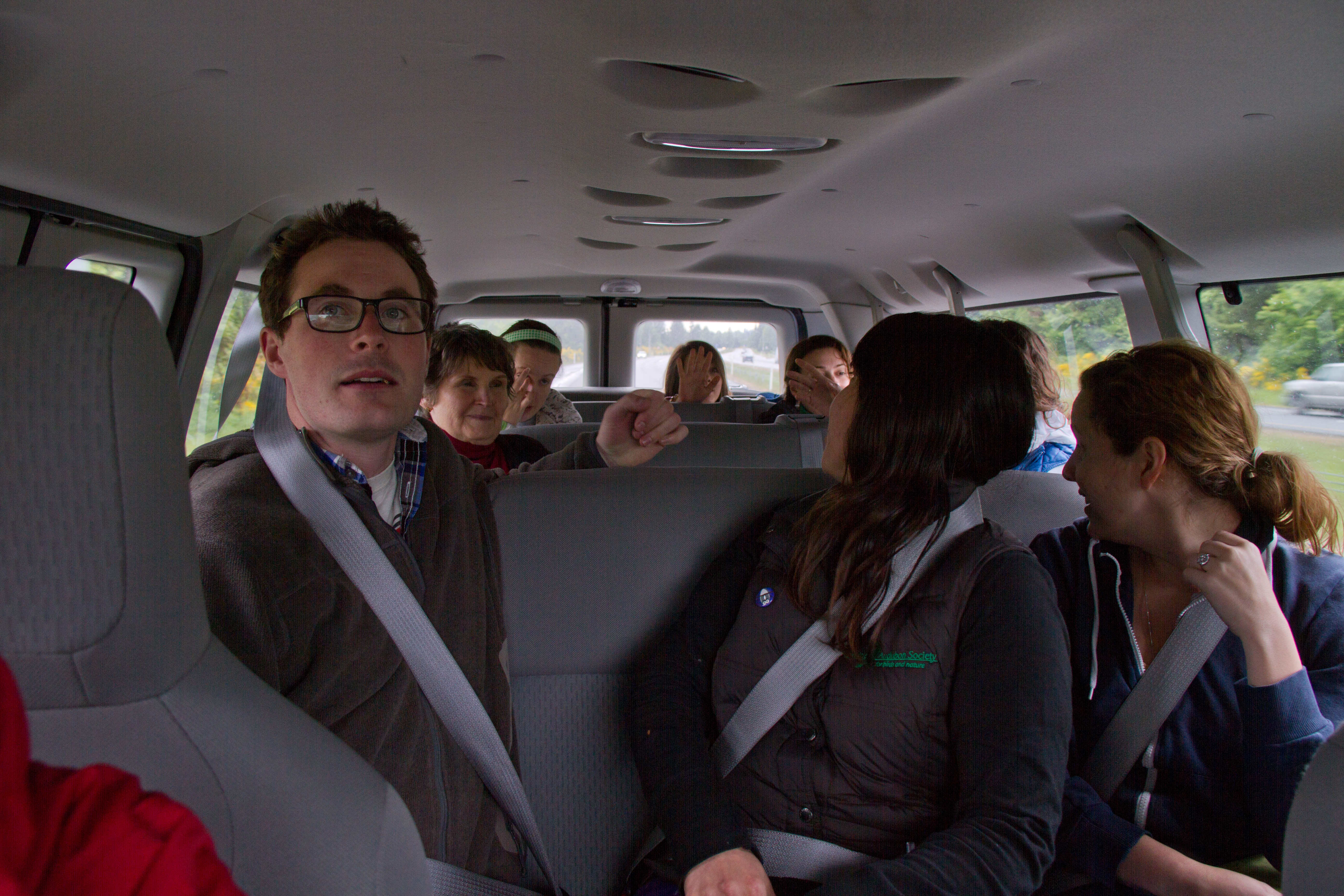
Both days began early but on different sides of the mountains.  My cohorts at Evergreen Escapes, Penny Rose and Tyler Davis, were driven by the idea of testing out a new route and making a potential bid for the Washington state record.  Species abundances be what they are, we started at 3 AM on the east side of the mountains in a little spot, well known to birders called Wenas Creek.  With the Seattle Audubon staff we began at 5 AM in the Wedgwood neighborhood.  These two hours made all the difference in my ability to function for the entire day and made my mood a bit more stable as the hours began to drag.


Owling will never be my favorite activity, especially when a simple bit of birding at daybreak in Seattle reveals nearly a dozen more species in than several hours of walking around in the dark.  That said, at Wenas we had flammulated, western screech, and great-horned owls with relative ease.  In Seattle we started our day with typical city birds, American robin and Bewick’s wren the most ebullient of the dawn songsters.  As many know, daybreak is the best time for birding, so neither of the early days involved sluggishness.  We had to nail down some species and that involves planning to be in places that host a variety of habitats in one go.  Wenas Creek was the eastside choice, Nisqually National Wildlife Refuge the west.  The Wenas creek and Umptanenum road areas rolled out every warbler we could expect, an early morning poorwill, veery, three species of vireos, flycatchers, white-headed and Lewis’s woodpeckers, but disappointed us on nuthatches.  Nisqually on the other hand was hopping with birds, despite being a chilly overcast morning.  We had great, but brief looks at a great-horned owl, plenty of warblers, flycatchers, black-headed grosbeaks, western tanagers, purple martins, and best of all Wilson’s phalarope, cinnamon teal, and yellow-headed blackbirds!  By 9 o’clock both days had over 60 species.

1

One of the hardest things I encounter on a big day is the waning of species and energy as the day goes on.  By noon things slow, with species additions perceptibly lacking.  This is why you attempt to enter different habitats as the day flows, but when you are in central Washington, it’s a game of jumping from one wetland area to the next hoping you’ll get more species.  In Western Washington it’s getting to the coast, where waterbird visibility is more linked to the tide than the time of day.  It starts to feel like hours are passing between one new species to the next.  I’m sure some mathematically capable person could develop an equation and graph to explain this phenomenon.

 2

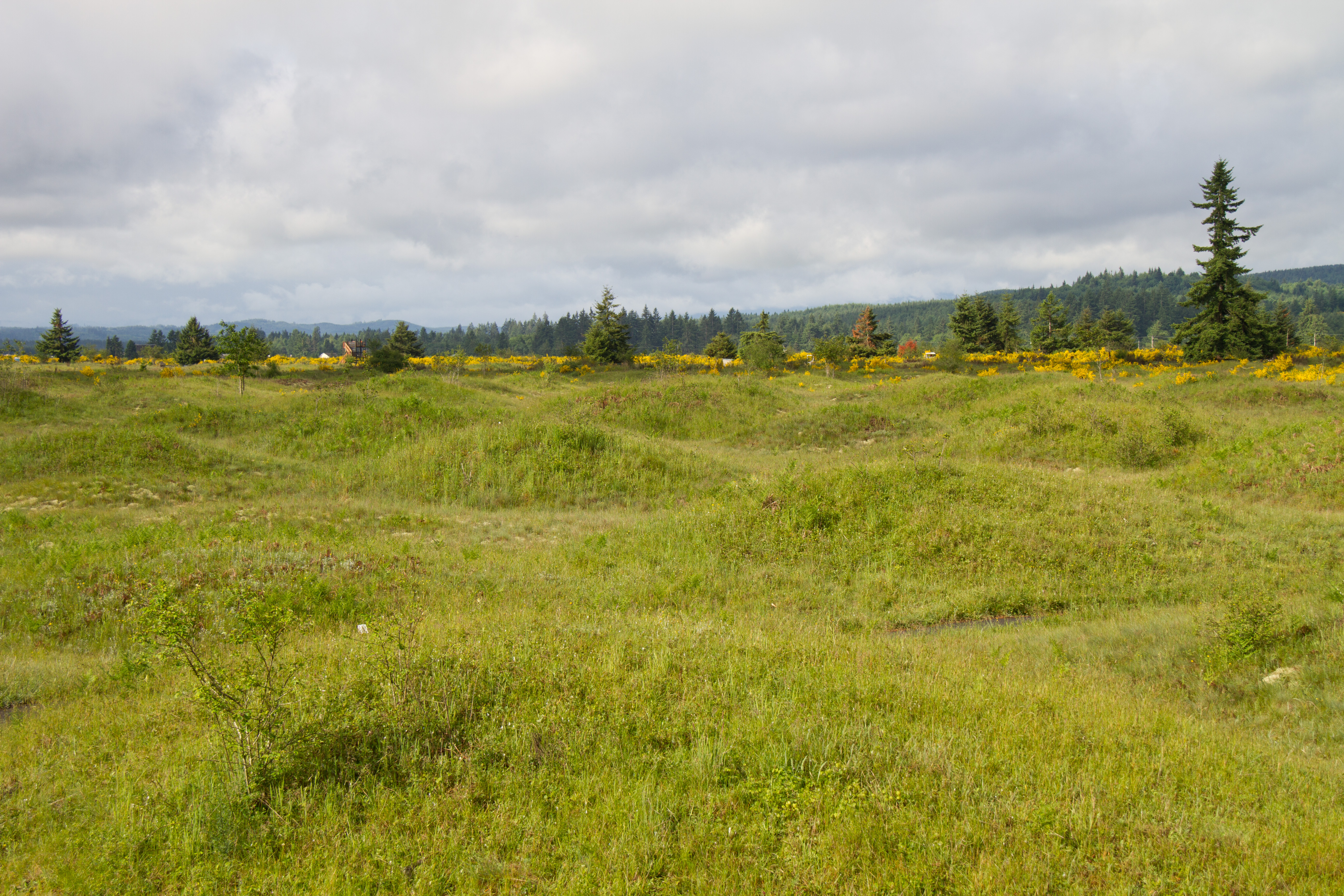
On the West side we continued to ramp up more species between Mima Mounds and Rainbow Falls State Park.  Western meadowlark and American kestrel are common species at Mima Mounds (though mostly locally occurring West of the Cascades) and we had hermit warbler, Hammond’s flycatcher, and pileated woodpecker in the contrastingly sodden Rainbow Falls State Park.  When we left and headed to the coast however the going was slow and heavy rains drilled the van and the optimism.

4

3

East of the Cascades we had some luck with sage sparrow along the Old Vantage Highway (I didn’t even have to get out of the car to see it) and picked up some waterbirds at Ginko State Park.  The great migrant trap the park provides however, wasn’t biting, only a few warbling vireos moved around the lush green trees which contrast markedly with the arid shrubbesteppe around it..  It was time to push east again

.

 5

Though we had some decent catches from Tokeland to the North, I was slightly disappointed.  Midway Beach provided blue-winged teal, long-billed dowitcher, and Virginia rail none of them given species considering the time of year, but we were missing marbled godwit and numerous waterbirds.  Thankfully Westport got us more gull species, rhinoceros auklets, and brown pelicans.  It also inspired a stop for soft serve ice cream and French fries when we saw the tourist restuarant signs.

7

Toiling away in the potholes and scouring the wetlands and ag land near Moses Lake, we did reasonably well on waterbirds we needed from the area.  The biggest surprise was a sandhill crane on Dodson road, but we felt like we were burning time when we made a side trip to Gloyd Seeps Wetland for white-faced ibis (which we did get).  We had other species there, including sora, but it was a major sidestep in our time budget.  It cost us, and despite expedited visits to Soap Lake and Dry Falls (also for Ice Cream), time was running out.  We’d planned to roll through the North Cascades and into Skagit County before the day was through.  We reached the mouth of the Methow Valley at nearly 5 and started to realize how little time we really had.

By six the Seattle Audubon staff was ready to head home and we beelined for Seattle.  Many of us were hovering close to 100 birds, which meant that the Montlake Fill (or Union Bay Natural Area) would likely be a good place to break that number.  Unlike the angst I was feeling on the Evergreen Escapes big day, I was pretty satisfied with the Seattle Audubon trip when crunch time came up.  As we dropped a few staff off at the office who were happy to call  it a day, most of the rest of us had a merlin fly over as well as Anna’s hummingbird before heading to the Fill.

Stopping a few places along the North Cascades Highway, back with Tyler and Penny, we were struggling for species.  The sun had gone down below the tall peaks, meaning it was quiet on the East slope.  A Townsend’s warbler sang for a moment, but we were striking out.  We didn’t get another new species until far downslope on Thunder Arm of Diablo Lake where Rufous hummingbirds and varied thrush were singing in the twilight.  The consolation was the strikingly beautiful Cascadian landscape before we decided to give in.  A Swainson’s thrush here, white-crowned sparrow there we were struggling and it was time to call it.  The final hours were tough considering how long the day was.  We finally called it at Rockport State Park, realizing we’d simply be running ourselves ragged with no hope of adding to our (relatively) middling list of 146. Besides it was dusk, owling (at least to me), sounded hellish.

The fill was windy and quiet, but the swallows and swifts were going nuts over gnats that were lekking around Center for Urban Horticulture.  Their spectacular show made up for slow birding.  It was nice to have everyone hear a Virginia rail again, but it was so late in the season that very few ducks were around.  We decided to call it at around 8:30 PM.  Staff had a variety of counts, but I had 105 species for the day.  Not bad for a late May big day.

No matter their length, big days are exhausting.  You are constantly on and I am always done with everything by the end of the day.  I’ve yet to beat my best big day of 188 in Washington State but then again, I’m still altogether unclear if I care all that much.  The fun part is challenging yourself to simply be aware enough to hear and see all the birds that are nearby.  You can plan all you want but you’ll miss birds you’d never expect to miss.  Penny, Tyler, and I had no black-capped chickadees, the Seattle Audubon Crew had no house finches.

Numbers aside, I’m glad I did both big days, but don’t ask me about doing one again until next year.

I’d like to thank Linda Carroll, Dennin M Conlon, Barbara Webster, Sharrie Shade, Virginia Morrison, Loren Tapia, Walter Oelwein, Jean Mills, Alison Wysong, Matthew Mega, Dianne Edmonds, David Harlow, Teri Martine, Rebecca Evans, Alex Ferkovich, George Johnson, and Vasiliki Demas for helping me raise a total $650 for Seattle Audubon.  Your support means that great programs like the high shool Birdwatch Program and the Puget Sound Seabird Survey, amongst much else, continue to run.