comment 0

A Natural History Lexicon | Samara

Welcome to Wingtrip’s Natural History Lexicon, a regular rundown of natural history terms, however varied and at random. To find future and past posts on this subject, simply search “natural history lexicon” or find it in the tags. Thanks for reading!

Samara
Noun

\ˈsamərə\

-A winged nut or achene containing one seed, as in ash and maple.

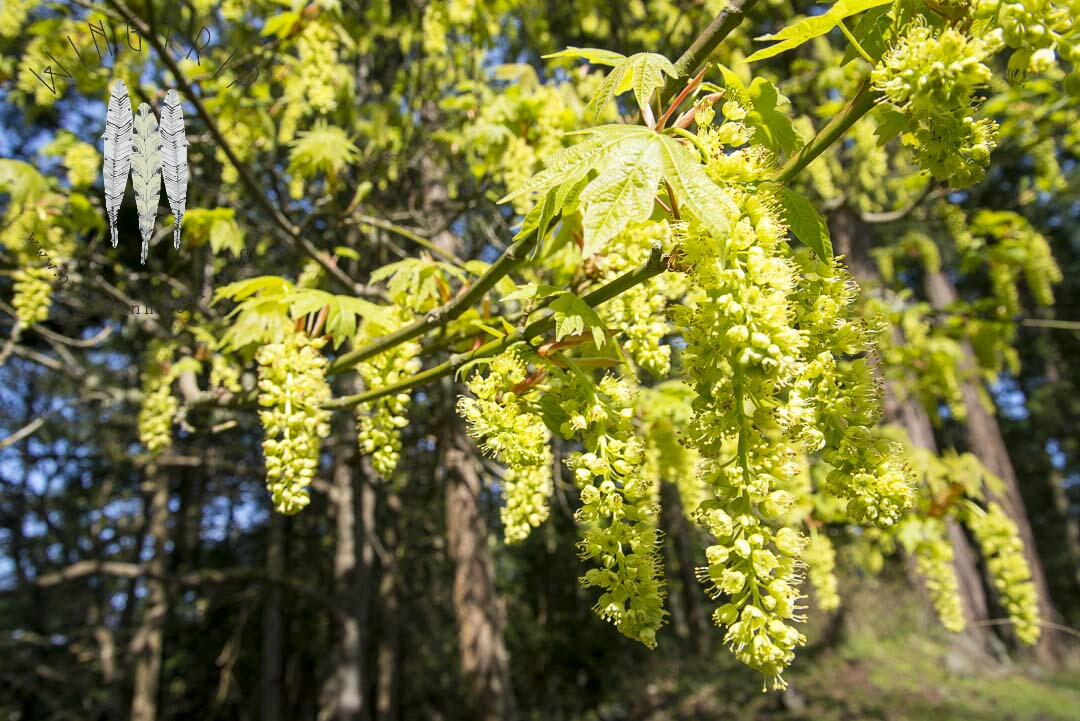
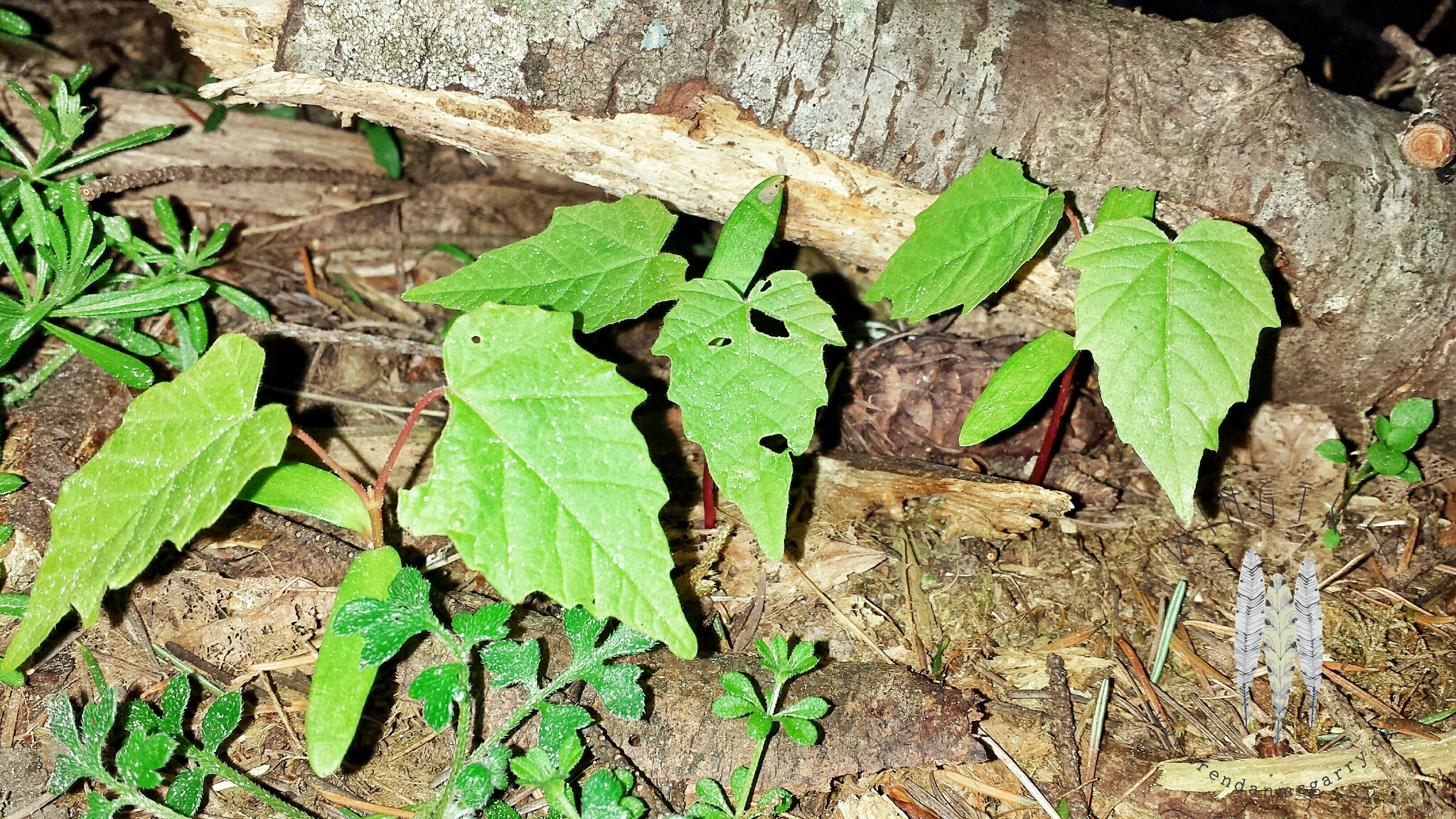
Walking around on Shaw Island, there’s life cropping up everywhere. Stepping outside I’m confronted with a vivid green that will fade to dreary browner tones sooner than I’d like. Out on boat in San Juan Channel I can see islands I know as tan in refreshing spring garb. Fresh growth and new seeds are bursting. Beneath the maples out my front door are the delicate seedlings of Big Leaf Maples (Acer macrophyllum). Most of the maples have sent off what spawned these miniatures, but a few retain samaras, that for this reason or that didn’t fall. These winged casings hold seeds.

wpid-picsart_1428028682964.jpg

Big Leaf Maple (Acer macrophyllum) in full bloom. Shaw Island, Washington.

Pollinated flowers lead to seeds and eventually all the maples nearby, which are in full bloom will be laden with fruit, but not the kind we’d eat. We may call them maple keys, wingnuts, helicopters, but a more technical term is samara. The term isn’t limited to just maple seeds, but any winged single seeded body like from an ash or an elm. However, in this area of the Pacific Northwest the only native plants bearing samaras are maples.

Big Leaf Maples in particular have large fibrous samaras, paired in two, that dropped lift airbourne and spin away from the parent tree. This auto-rotation creates lift, taking them even farther with the aid of wind. In extreme cases, up to a mile away.

Many of these seeds may germinate, but that’s no guarantee of their survival. One out of thousands will survive, because to a degree where samaras land is chance. Then they face shade, drought, and freezes, munching deer, invading insects, and plant competition. When we look out at the plant world, we don’t think in these terms because their struggle is largely silent, but every large tree is miraculous considering all it had to survive to become mature.

wpid-picsart_1428028741214.jpg

Big Leaf Maple (Acer macrophyllum) seedlings.


comment 1

A Natural History Lexicon | Speculum

Welcome to Wingtrip’s Natural History Lexicon, a regular rundown of natural history terms, however varied and at random. To find future and past posts on this subject, simply search “natural history lexicon” or find it in the tags. Thanks for reading!

Speculum
Noun

\ˈspəkyələm\

-A bright patch of plumage on the wings of certain birds, especially a strip of metallic sheen on the secondary flight feathers of many ducks.

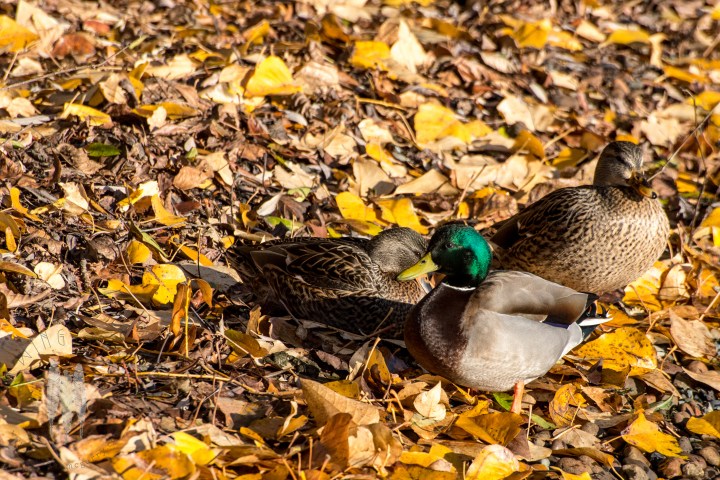
Mallard ducks are one of the most widespread species in their genus Anas (go ahead, get the laughs out of the way). They are so common, looking for handouts in parks, literally waddling across city streets in traffic, that we sometimes forget they are every bit as stunning as the rest of their colorful relatives. Males are truly stunning, with emerald green heads, a deep chestnut front, and a decorative twirl in their tail feathers. My favorite decoration of all, is a group of feathers that spend much of their time hidden, folded away, shared by both male and females of the genus: the speculum.

Feathers are many things to a duck. Weatherproof and water-shedding contour feathers on the outside, insulating down beneath, flight feathers allowing flight and steering. What about those colors though?Vision is a dominant sense in almost all birds, (a few notable exceptions exist, like food sniffing kiwis) and ducks are no different. They want to be able to distinguish their own species through coloration, display a threat or virility, or even blend into a specific environment.

Brendan_McGarry_141130_00039

The male Mallard doesn’t blend in very well, but his female companions don’t show up nearly as well.

Speculum is simply a fancy term for a vividly colored area of the secondaries, a part of the flight feathers. In Anas ducks speculum coloration is structural, not pigmentary. What this means is that the coloration comes from structural reflection (and interference) of light, not from pigments which absorb and reflect certain wavelengths of light (I’m not giving a physics lesson here, so that’s as far as I go). If you are a Latin wiz, you’ll see speculum as rooted in the Latin specere, “to mirror,” which makes sense as speculums are flashy reflective surfaces (note that not all structural coloration is iridescent). Other birds do have speculums, the ducks are simply most well-known for them.

So why have a speculum? Obviously being flashy in coloration is important to ducks, otherwise it wouldn’t be such a prominent, genus-wide trait. Both sexes have sepeculums, which could lead us to believe that this color wasn’t generated by sexual selection. And this would be a decent assumption, as it’s broadly accepted that speculums are there for signaling between birds in the air, aiding in important flocking behavior.

Birders and ornithologists know we don’t usually see Anas ducks on their own. Just think about it yourself, how often do you see a lone Mallard? Infrequently, as they are usually paired up, raising ducklings, or in flocks. These gregarious birds need to keep track of each other for a variety of reasons. Safety in numbers (and in homogeneity of flocks) during movements being paramount, the speculum is likely the ticket (along with vocalizations of course). In air it’s out there, flashing reflections all over the place for all to see. On the ground it’s tucked away, allowing mothers to stay hidden on nests and studly males to not be too conspicuous.

I’ve always loved ducks, because as a young birder, they were the easiest birds to get a grasp on. They were everywhere, were less hyperactive than say a kinglet, and were common on many a pond in the Seattle area. Mallards may be common, but a lot of interesting things that have led to their coloration. They are worth admiration, not the least of which for their speculums. After all, our ancestors found them personable and showy enough to be worth domesticating, which is why almost all our farm ducks are descended from the common, but not plain, Mallard.

wpid-picsart_1424902829440.jpg

The “Harlequin” variety of domestic mallard on a friend’s property on Shaw Island.


comment 1

A Shaw Island Big Day (or How Birders Support Conservation)

In the world of birding, most are familiar with big days. These all out 24 hour birding sprees often co-opted into a way to raise funds, similar to a jog-a-thon. Bird-a-thons, as they are so called, could be viewed as the bread and butter fundraisers of small non-profit organizations dealing with birds. They are a gilded tradition in bird conservation but ultimately they are plain fun, because of the goal: go out and see a lot of birds.

The Alamos Wildlands Alliance (AWA) is one such organization that runs an annual bird-a-thon. As they put together their bid to raise money for their Navopatia Field Station in Southern Sonora, Mexico this year, I figured this was a good excuse to have a big day on Shaw Island, where I currently reside. Unlike some organizations, large ones who’ve grown cumbersome and ambiguous in their roles as nature’s benefactors (by getting funding from say, Shell), I know for a fact that AWA is doing on the ground work. They actively work to save an endangered ecosystem, coastal thorn-scrub, while doing baseline monitoring of migrant and resident birds in the region. If I am going to put any effort into conservation efforts, I’d much rather have it be for organizations who I can track and see doing good work. While it’s true, I am 100% biased, AWA is run by friends, I don’t care. Besides I don’t need a plush animal or bird print umbrella made in china for contributing. And I’d rather pay for a magazine separately instead of paying to have it printed out of funds I want to go to real conservation work (yes, this is ironic for someone who believes in the power of words and images). But I digress and you aren’t here for complaints from a shoddily built soapbox. Let’s go birding.
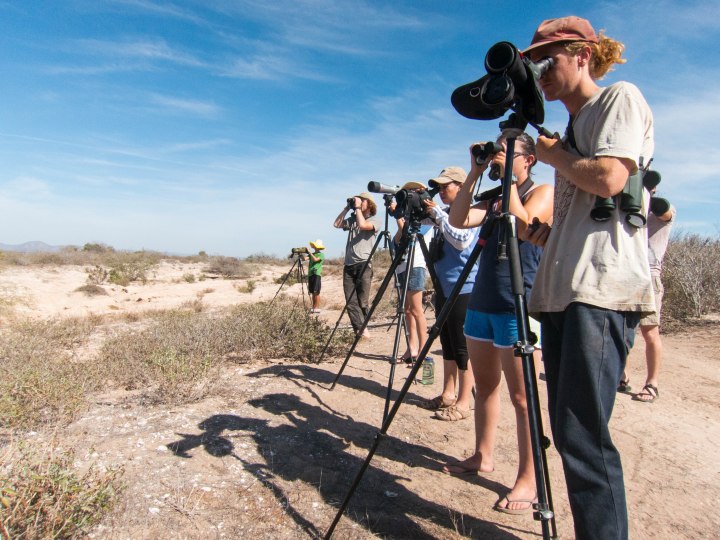
Brendan_McGarry_140220_00205

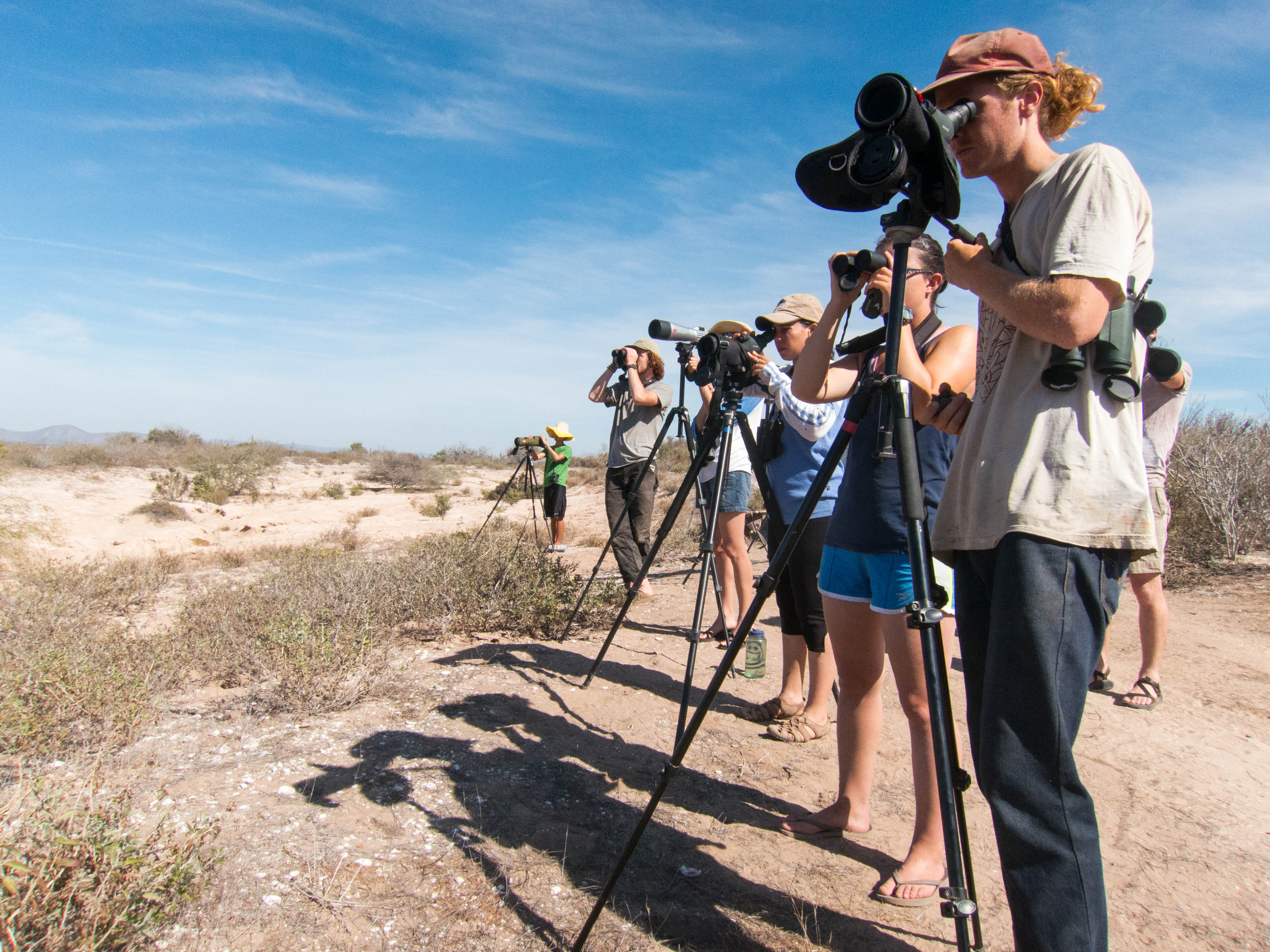
Interns conducting shorebird monitoring at the field station in 2014.


AWA’s bird-a-thon has no restrictions on location. I didn’t have to fly to Tucson, take an overnight bus to a small highway wayside in Sonora, and wait for a ride to the small village of Navopatia on the edge of the Agiabampo Estuary. There are teams in Oaxaca, Mexico, at the Field Station, and back in Washington, where most of the people who run AWA live at least part-time. I decided it would be a fun goal to get out on Shaw, Island and do a full day of birding. I knew I wouldn’t see as much as the folks in Mexico, or even those in other parts of Washington, but I knew I’d have fun and get some surprises.

As time has gone by as a birder, I’ve wrestled with the value of some aspects of birding. Competitive birding is a major one of them. However, I’ve come full circle to appreciate the value of a big day because it is a meditation on all species. You spend your day concentrating your best on any chance sighting while wielding an understanding of all which you plan to encounter, their habitat, behaviors, their essence as species. You take all this and you spend the day walking, driving, and sitting, listening and looking, in hopes of seeing them all.

My day started like this, sitting and meditating on the birds that I could hear from my doorstep. Between crunches of granola and slurps of coffee I heard nothing surprising, twinkling Golden-crowned Kinglets, croaking Common Ravens, and whistling Varied Thrushes. No bird is taken for granted, so as I readied the car and heard the echo of a Pileated Woodpecker and the pips of Red Crossbills, I was glad to have those species off the search cue.
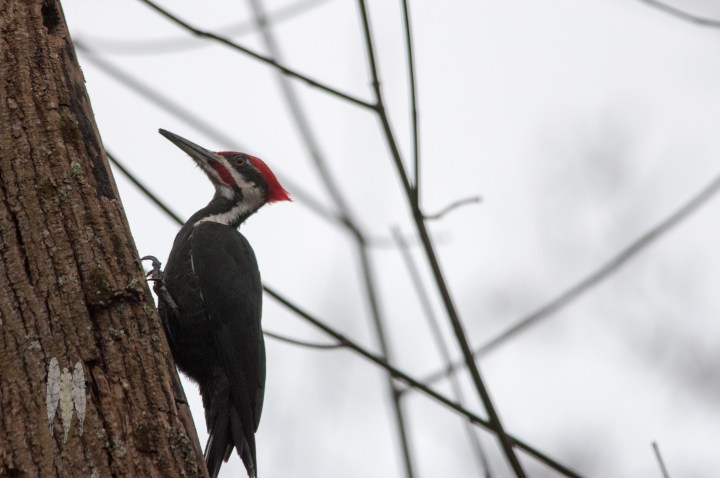
Brendan_McGarry_130316_00090

A Pileated Woodpecker. Common on the island, but not a gimme.

Shaw Island isn’t exactly overflowing with public land nor a huge variety of habitats. There’s only a few places to access the salt-water, a few forests to legally roam, and tons of homogenous second-growth Douglas fir stands to contend with. The island itself is only an area just over seven square miles. However, it still has open spaces, access to shorelines, and vantages to deep saltwater. Knowing of a place that had all these things, I headed to my favorite spot on the island, Cedar Rock Preserve.

The road to the preserve from my home is mostly through forests, with much of the same birds. All the same I had my head out the window and drove slowly enough to listen for any chance voice on the air. Past the school and the library, I headed down the slimy dirt road winding about chartreuse hills of moss. A steel sky threatened rain, but what did I expect in February?

A marsh area nearly to the preserve got me a bird I’d never noticed on Shaw, Marsh Wren. I wasn’t surprised that they were here, but more that I hadn’t seen them before. Ruby-crowned Kinglets chittered away in bare willow branches and I caught the zeet of a Lincoln’s Sparrow somewhere in the tall grass.
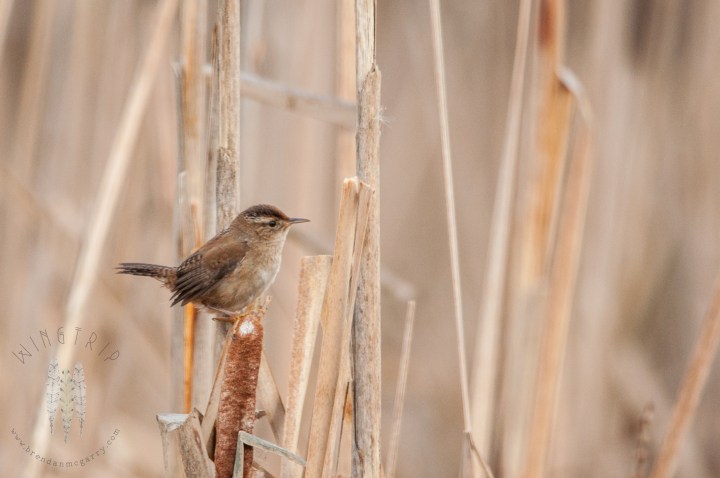
Brendan_McGarry_130329_00067

Marsh Wren was not a bird I expected during the day.
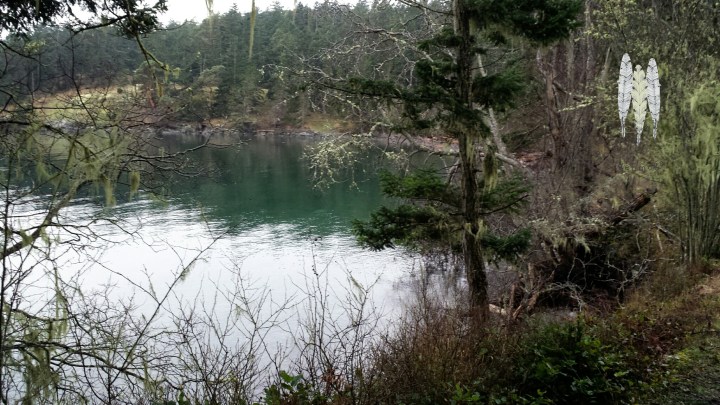
wpid-picsart_1424386432429.jpg

Cedar Rock Preserve.

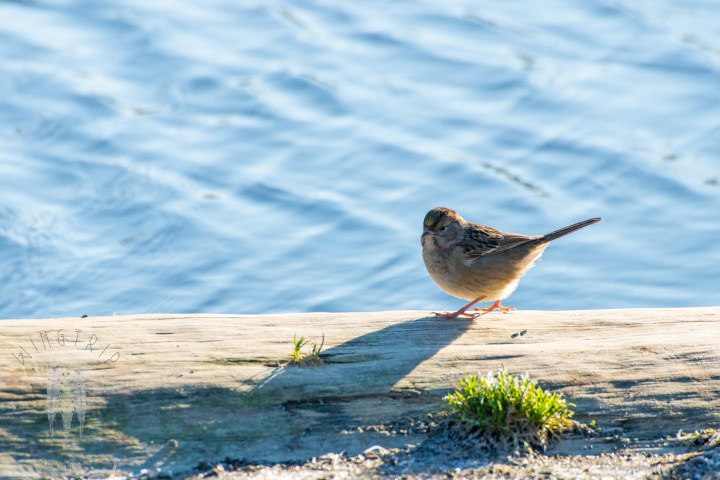
Cedar Rock Preserve preserve got me another wren I’d never had on Shaw, Bewick’s. I’d always assumed they weren’t around, but I assumed wrong. Fox Sparrow and Spotted Towhees were pished up from the Sitka rose patches that line the rocky shorelines, growing to the trunks of weathered Seaside Juniper and Pacific Madrone. The waterbirds came quickly at first, the most exciting were dozens of Ancient and Marbled Murrelets but there were scores of cormorants, goldeneyes, mergansers, buffleheads, murres, guilemots, and of course, gulls. I even managed to pick up a late Heerrmann’s Gull afloat on flotsam bobbing down San Juan Channel.

Heading back to Copper Farm (where I live) to take care of a quick chore, I found a Downy Woodpecker and Purple Finch near the house, both not guaranteed. Chore done, my next stop was the Ferry Landing, there I would scope more deep water. After several visits over the course of the day, this proved fruitful (Shaw is small enough to revisit anywhere repeatedly), as I finally found Harlequin Ducks and Surf Scoters. A lone Herring Gull was perched on the landing’s pilings with a group of Glaucuous-winged x Western Gull mutts. Strangely my only raptors of the day were two Bald Eagles at the landing.
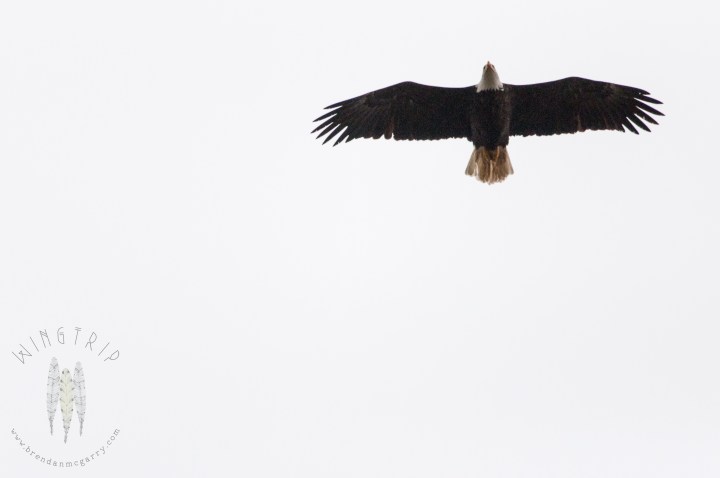
Brendan_McGarry_130316_00110

Bald Eagles are very common, so I wasn’t worried about seeing them.

Some birds that are incredibly common elsewhere aren’t that numerous on Shaw. American Crows are here but only in a few spots and I caught a few driving to and from the Ferry Landing, up to some mischief along Blind Bay. European Starlings are another scarce bird and I saw only two, flying over a field near the Community Center. Rock Pigeons are pretty much exclusively inhabitants of the Ferry Landing and thankfully this day was no different.
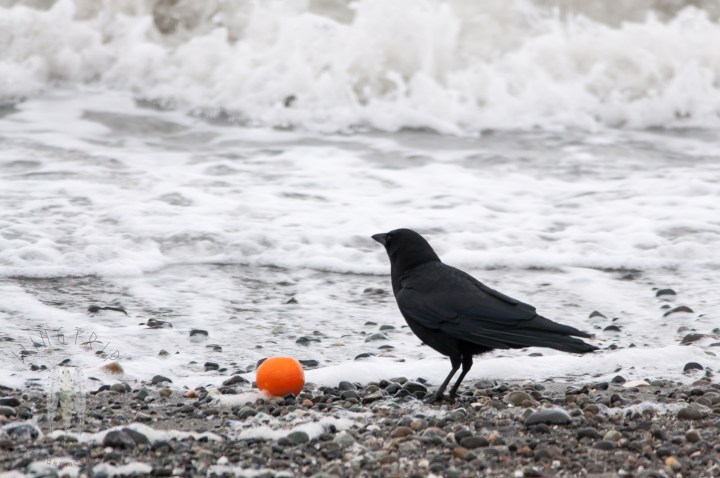
Brendan_McGarry_130316_00120

An American Crow up to mischief.

Shaw’s County Park is an expansive vantage, with the only long stretch of sandy beach on the island, but I didn’t have much hope for seeing any new birds there. Once again, I was proved wrong when almost immediately I found Long-tailed Ducks near shore and Pacific and Common Loons deeper out. I also noticed Pigeon Guilemots back in svelte black and Rhinocerous Auklets decorated in their comical tufts, both ready for breeding again.

wpid-picsart_1424386506903.jpg

The Shaw Island County Park.

There were two places I’d not yet visited that might be worthwhile, Neck Point on the Northwest corner of the island, and Reef Net Point on the South end. Neck Point was a dud, as I arrived, a thick veil of misty rain started in and visibility vanished. I managed a Red-necked Grebe, but couldn’t see enough to scope further out. Reef Net Point, bounding one side of Squaw Bay got me a bird that would have been an embarrassing miss, Mallard. I took some time to hide out from the rain in the forest, happening upon a Hairy Woodpecker and hearing a Western Grebe somewhere out on the water.

wpid-picsart_1424386462505.jpg

Looking North into the Wasp Islands from Neck Point.

On a big day you spend a lot of time hoping you’ll find something remarkable, in the sense of something out of place or unusual. This typically involves knowing possibilities and knowing where to look. I hoped to find a White-throated Sparrow would be amongst the Golden-crowneds, that a rare duck would be on one of the artificial ponds around the island, or that I’d spy an out-of-place alcid from Neck Point. None of these things came true, but typically they don’t and I was feeling pretty satisfied as my day wound down. I had one last bird to cap my day at 65. A Barred Owl, barking, whistling, and making otherwise creepy noises from the forest outside my front door. By then it was dark and time to call it quits, I’ve never seen another owl on the island and I hate owling enough to find most excuses to avoid it.

Brendan_McGarry_141130_00063

A Northern Harrier, an infrequent bird on Shaw I saw a couple days post big day.

At 65 birds, I had a pretty good run of things for living on small island and it being February. In May I think I’ll give it another go and see if I can break 100, I figure I might be able to. I missed a lot of birds: a plethora of hawks and falcons possible, Turkey Vulture (a winter holdout in the San Juans) Hutton’s Vireo, Black Oystercatcher, Bonaparte’s Gull, Red-breasted Sapsucker, Evening Grosbeak and Hermit Thrush among others. Yet you never see everything, no matter how much you plan, because seeking out birds is simply a difficult task. In doing so, you realize how much you really do take even common birds for granted.

In the following days I did see some of the misses. Evening Grosbeaks in the tops of a fir. A Merlin hunting in an alder bog. A ghostly male Northern Harrier flying over open fields. A Cooper’s Hawk flying low in pursuit of prey over a field. A Red-tailed Hawk soaring high overhead. In my laziest of moments, soaking up sun on the beach, I heard Black Oystercatchers, screaming away incessantly from Canoe Island and wondered how in the world I’d missed them. That’s what I like about birding: finding those birds out of the blue in everyday life, as often as seeking them out. Always being aware that a chance moment in your day could produce a beautiful encounter.
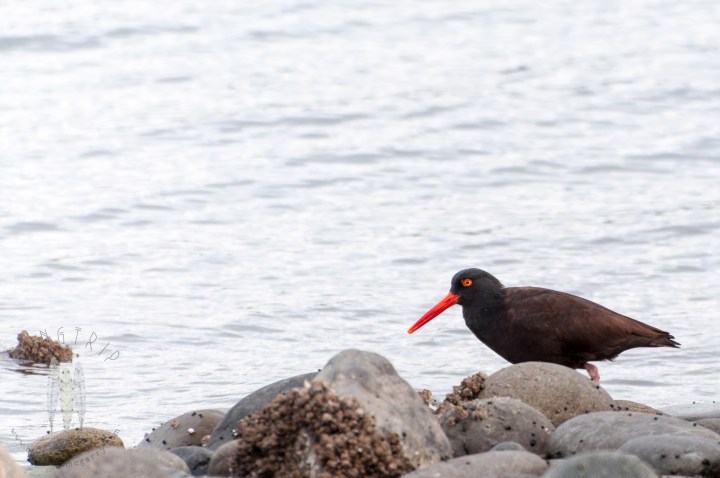
Brendan_McGarry_130408_00266

Black oystercatcher, a common bird that I totally missed.

We can’t take those things for granted, and if we really do love birds and nature, we need to put effort in to protect them because so much progress is not. That’s why I even went out on this charade in the first place, to support the Alamos Wildlands Alliance and their field station. If you enjoyed hearing my tale, enjoy birds, or simply appreciate seeing young people taking time to protect the natural world, go head and toss a few dollars towards their GoFundMe campaign. Every bit counts, just like every species does on a big day.
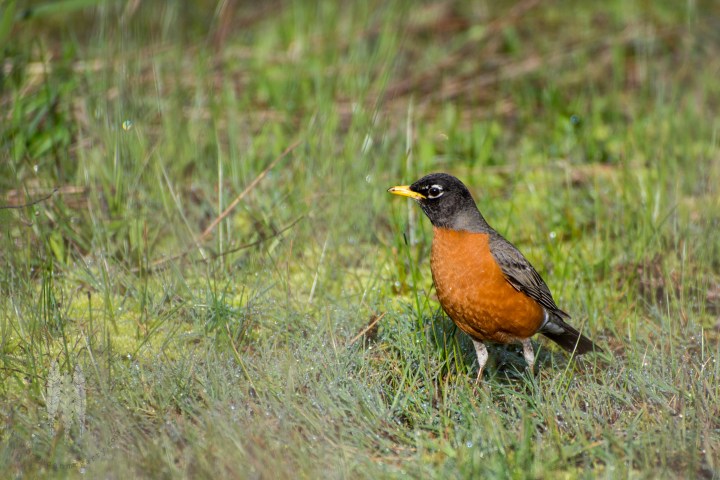
Brendan_McGarry_140414_00088

And thankfully, American Robins were numerous and obvious.


comment 0

Five Years with a DSLR

Five years ago, almost to the day, I finally broke down to the idea of buying a Digital Single Lens Reflex camera. A DSLR would give me better images, would get me closer to birds, and would ultimately give me more control, going back to the way I used to take images when I first used an SLR in high school photography classes.

Mentioning this to many friends, most of whom were owners of such gadgetry gave me dire warnings.

“You’ll spend lots of money on gear.”

Correct. I don’t even want to think about the amounts I’ve spent on my two bodies, two point and shoots, gopro, game camera, three tripods, two flashes, tangles of cables, piles of cards, and heaps of other miscellany. However I also know I have far less than a lot of professionals, despite occasionally thinking about selling it all and heading out with a simple camera to travel on all the proceeds.

“You can take great pictures with the camera I have.”

True. Case in point illustrated below. However, I wanted to do more. And I have.

This slideshow requires JavaScript.

“You won’t be in National Geographic immediately. You might not even make any money at it.”

True. But I didn’t expect to leap into that status, I’m happy with having images in High Country News and a lot of other places on the web. And I’ve made money, not a full income, but enough to be encouraged.

So what I did was ignore their advice and went through with it. I’m happy I did, because if I didn’t have an SLR I wouldn’t have been to some of the places I’ve visited nor would I have some of the art I’ve captured over the past five years.

The images I’ve lined up are my favorites from the past five years. They’re maybe not what would win contests, nor possibly my most technically perfect images, but they’re my personal favorites, the images I have the most emotional attachment to, the images I subjectively enjoy more than others. I don’t give a shit about objectivity in the case of deciding which are my favorite images from the past half a decade.

Why five years? It’s arbirtary seemed like a good period of time to examine. I’m still figuring out my photography style, learning new ways to take better photos, and making investments to be a better photographer. I’ve learned to be more patient and it’s paid off. After going through all these images, I feel both vindicated in my gear choices and excited about future work.

Five years is a short time, because it could take another five at least to get anywhere. Sure I’ll probably never be an Art Wolfe or some other powerhouse, but if I can make part of my income with photography, I think I’ll be doing pretty good. I maybe eventually decide to put down the camera for work or move on to purely writing or actually become a full-time biologist, but for now I’m happy taking pictures and writing and having an excuse to spend extended periods of time out in the natural world.

I feel as if I should have something sage to say about taking pictures, about waiting for the perfect moment, or meditating on the changing lightscape. At the moment I don’t except that I’ve gone from rank amateur to quasi professional with no initial intention of doing so. I’m incredibly proud of the images below, regardless of how they stack up against anyone else, largely because of the moments they describe in my life and what they’ve captured of nature.

Initially I included a lot of descriptions of these images, but I decided I’ll leave it brief. I invite you to ask me questions  and let me know what you think.

comment 0

A Natural History Lexicon | Spraint

Welcome to Wingtrip’s Natural History Lexicon, a regular rundown of natural history terms, however varied and at random. To find future and past posts on this subject, simply search “natural history lexicon” or find it in the tags. Thanks for reading!

Spraint
Noun

\spreɪnt\

-The droppings of an otter.

You smell it first. The aroma congears as viscous coating in the back of the throat and you want to be anywhere else, but in this fog of digested marine life squeezed out onto the dock. Then you see the dark wet plops of crushed shells and fish bones and want nothing more than to turn tail and never take in this horror of the senses again. But the spraint won’t disappear on its own and chances are it might build into a great festering dunghill of a midden if you don’t deal with it.

As you can guess, the scant times I’ve found myself cleaning up the leavings of a River Otter haven’t been pleasant. While them and their ilk, the mustelids, are far and away my favorite group of mammals I don’t wonder at why they are so openly despised. Among many traits, adept hunters (eating your chickens), sly intelligence (getting into your chicken fortress), fearlessness (confronting you in a confined space if you find them in your chicken fortress), playfulness (Ok, that’s just cute), they are so named for being musty, smelly creatures.

The word “scat” is actually how I can to the word “spraint,” because indeed a part of this lexicon is finding new vocabulary for myself as well, however criptic or fallen from use they may be. I had never heard this term before. Scat is a term typically used to describe a carnivores’ leavings, which being more heterogeneous than an herbivore and tend to be more scattered. Spraint, according to the Oxford Dictionary, comes from the Old French word espreintes, to squeeze out, with roots in the Latin exprimere, to express. When you find yourself enveloped in the fog of a fresh spraint (which in my neck of the woods always smells of concentrated, exhumed rotten fish), it does look as if it has been squeezed out of that brown sock of a weasel cavorting in the water nearby. When I see their heads poking from the water, little paws holding some mangled form while they gnash their teeth about it, I can practically smell the expression of a meal not yet digested.

https://www.youtube.com/watch?v=lKTsSwmiZIg

To avoid being accused of being juvenile or banner waving for the cause of potty humor, I should mention there are reason to want to know about spraints. Their presence is very useful in places where otter populations have declined which is unfortunately in many places, particularly in Western Europe. As with many mammal species their “signs” are easier to find than the animal itself and can help demonstrate presence or absence. Equally so their stench sheds light on their membership in the family Mustelidae. With a well developed anal scent gland, used for territorial and sexual signaling, which all but one member have (the Sea Otter, having little use for scents that would quickly dilute in the ocean), it makes sense spraint would smell bad, they’re a form of signaling. When you are trying to make your presence known, there’s no need to be inoffensive in your aroma.

People think poop is gross and I agree. But I’d be lying if said I’d never poked at a spraint with a stick to see what was in it.

comment 0

A 2014 (Photographic) Year in Review

Yet another year has passed and keeping with previous habits, I bring to you a 2014 Photographic Year in Review. My Lightroom catalog tells me I kept around 10K photos out an untold quantity destined for the photographic graveyard. Distilling my year into a short series of photos isn’t exactly easy, but it’s a worthy task which helps me reflect on a year past.

As a (frustratingly) varied artist and naturalist, I definitely haven’t chosen a typical path (not to suggest I am in any way unique), and can easily wander down a path of fretting over “progress.” However, in reviewing my images, I see I’ve improved and progressed. Besides acquiring new equipment over the past year, I’ve continued to refine the various crafts I’ve thrown myself to. Additionally, I’ve reinvigorated myself with reminders of what a year can and can’t accomplish, images of the places I visited, and projects left by the wayside.

Annually, come January, I start thinking that I haven’t done enough. My only life birds of the past year were in Mexico, largely because I didn’t have time, enthusiasm. or ability to chase rare birds in the Pacific Northwest. I didn’t hike trails I intended to. I didn’t write nearly as much as I wanted. Lots of disappointments brought on by too much ambition, too little time, and possibly Netflix.

However it’s also true I got to know the birds of my area much better, as time always reveals facets that curiosity and contemplation mine. There’s evidence I’m improving at my crafts. And let’s be honest, the trails are still there for a new year.

I had challenges of course. I moved three times. I worked excessively for months and then had little paying work. Things didn’t pan out in some professional capers. I found that not everyone appreciated what I had to say.

With hard work and challenges are often followed by rewards too. I learned about new marine invertebrates. I had close encounters with whales. I kayaked broad distances. I learned to respect the Salish Sea in a non-powered craft. I went to Mexico and traveled from the tropics to the temperate world in a day. I held sleepy boas. I crashed through cactus forests. I explored canyon bottoms lined with enigmatic tropical deciduous forest. I laughed riotously with all manner of people. I romped about an island I love with my best friends. My work found its way to magazines, newspapers, and individuals as art and information. I learned to accept the artistic compulsions I have as worthwhile endeavors. I read lots of books.

I did a lot; probably just enough. I’ll say it was a good year. Originally I wrote 3000 words describing these photos but scrapped them, another thing I got better at, brevity. Instead I decided to let the images (mostly) speak for themselves. What do you think?

comments 5

A Natural History Lexicon | Apothecium

Welcome to Wingtrip’s Natural History Lexicon, a regular rundown of natural history terms. To find future and past posts on this subject, simply search “natural history lexicon” or find it in the tags. Thanks for reading!


Apothecium
Noun

\a-pə-ˈthē-shē-əm\

-a spore-bearing structure in many lichens and fungi consisting of a discoid or cupped body bearing asci on the exposed flat or concave surface


There’s frequently times in life when we realize we haven’t been doing enough of something we love. While I’ve been birding plenty in the previous year, I was hunched over before a screen when I realized I could go watch Marbled Murrelets and Pacific Loons in a two minute drive instead of sorting photos. I almost reached for two tripods, several cameras, and a bevy lenses, but instead I reached for my spotting scope, my binoculars, a point and shoot camera, and my journal. This was supposed to be a fun outing, not a photoshoot.

“Leave the gadgetry behind and you’ll relax more, see more.” That’s what I told myself.

Heading South on Shaw Island from where I live, I pass by our small library and schoolhouse before hitting a muddy, potholed road past the nunnery. I wiggled down slippery hills in my car, glad I hadn’t biked instead. The road flattened out past an overgrown orchard and one of the San Juan’s many prodigious “homesteads for the non-mortal.” Just beyond was Cedar Rocks Preserve, owned by the University of Washington, but you’d work hard to see a single soul there on a Wednesday winter afternoon. Hardly anyone but Shaw folk know about it (and don’t you say a word to anyone).

Turning the circle of a small bay, lined with a Pacific Madrone and Seaside Juniper, I headed to a coastal outcrop overlooking San Juan Channel slipping South between Lopez and San Juan Islands. I set up my scope to the tickling squeals of piebald Pigeon Guillemots. Then stepping to the side for a brief binocular scan, I promptly slipped and fell.

wpid-picsart_1420743717905.jpg

The view from Cedar Rocks South.


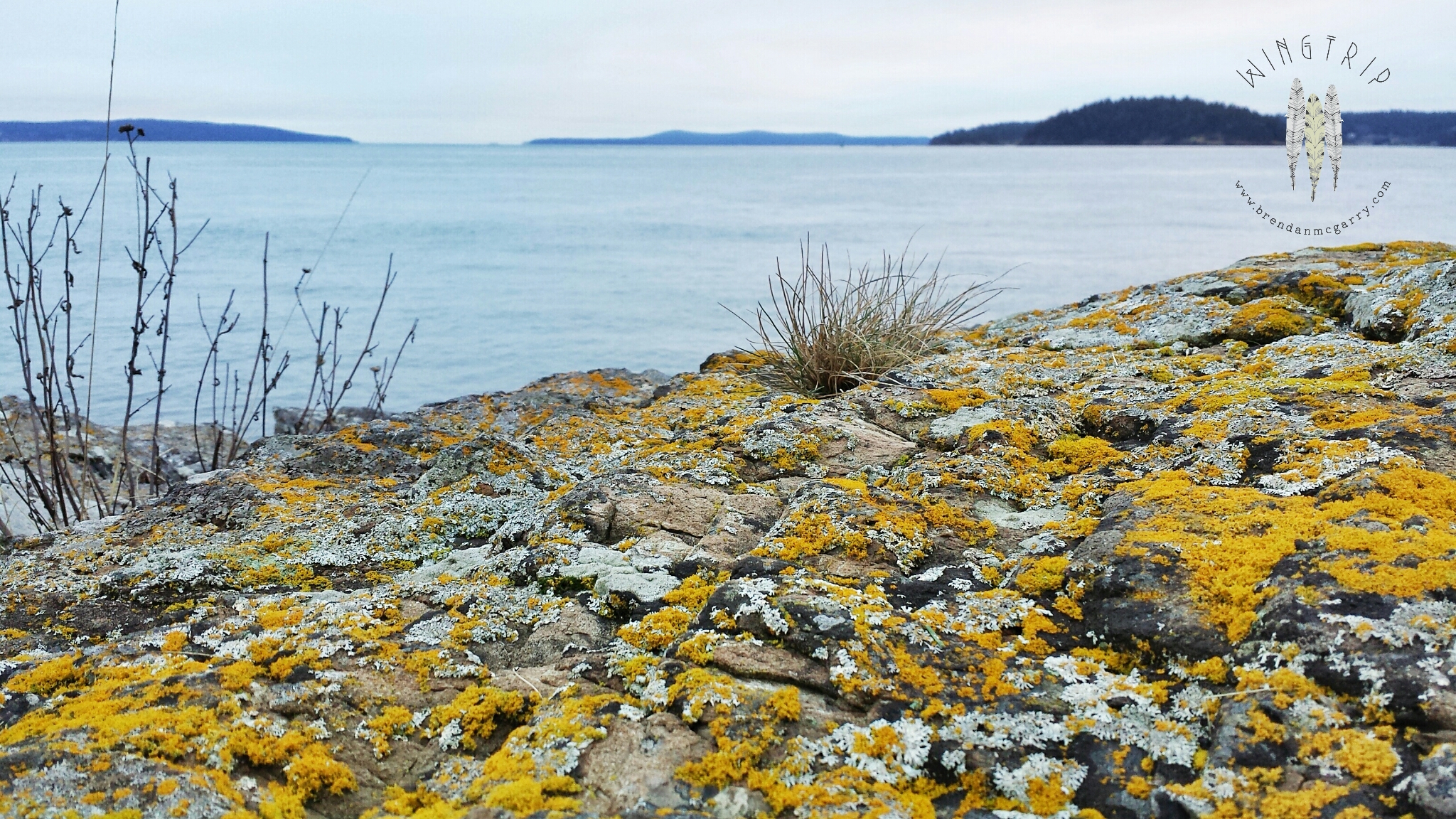
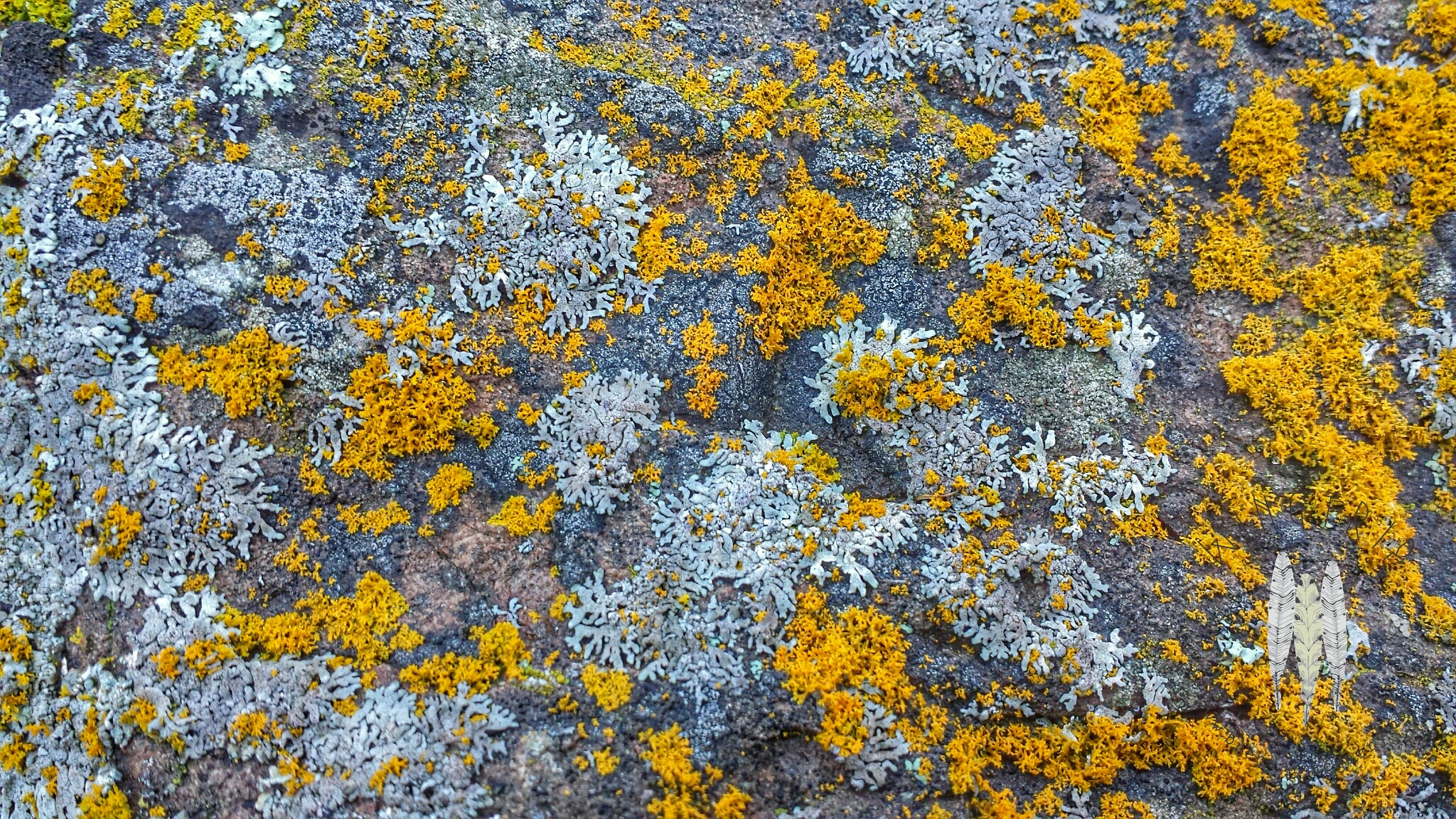
Thankfully I didn’t fall supine, but landed instead as if in downward momentum of a pushup with my chin resting on the slippery rocks. Sure, I’d noticed the floral array that coated all the rocks, but I hadn’t anticipated the lack of grip they’d provide. Momentarily flustered, I listened to the sound of waves slushing between the rocks and stared at the lichen offenders. Now I’m no lichen master, but in my ceaseless quest to explore the natural world and describe the things I see, I’ve made a brief pass at learning a bit. So when I found myself nosing these generally inoffensive amalgams, I took a moment to remind myself of what I was seeing.

wpid-picsart_1420743777160.jpg

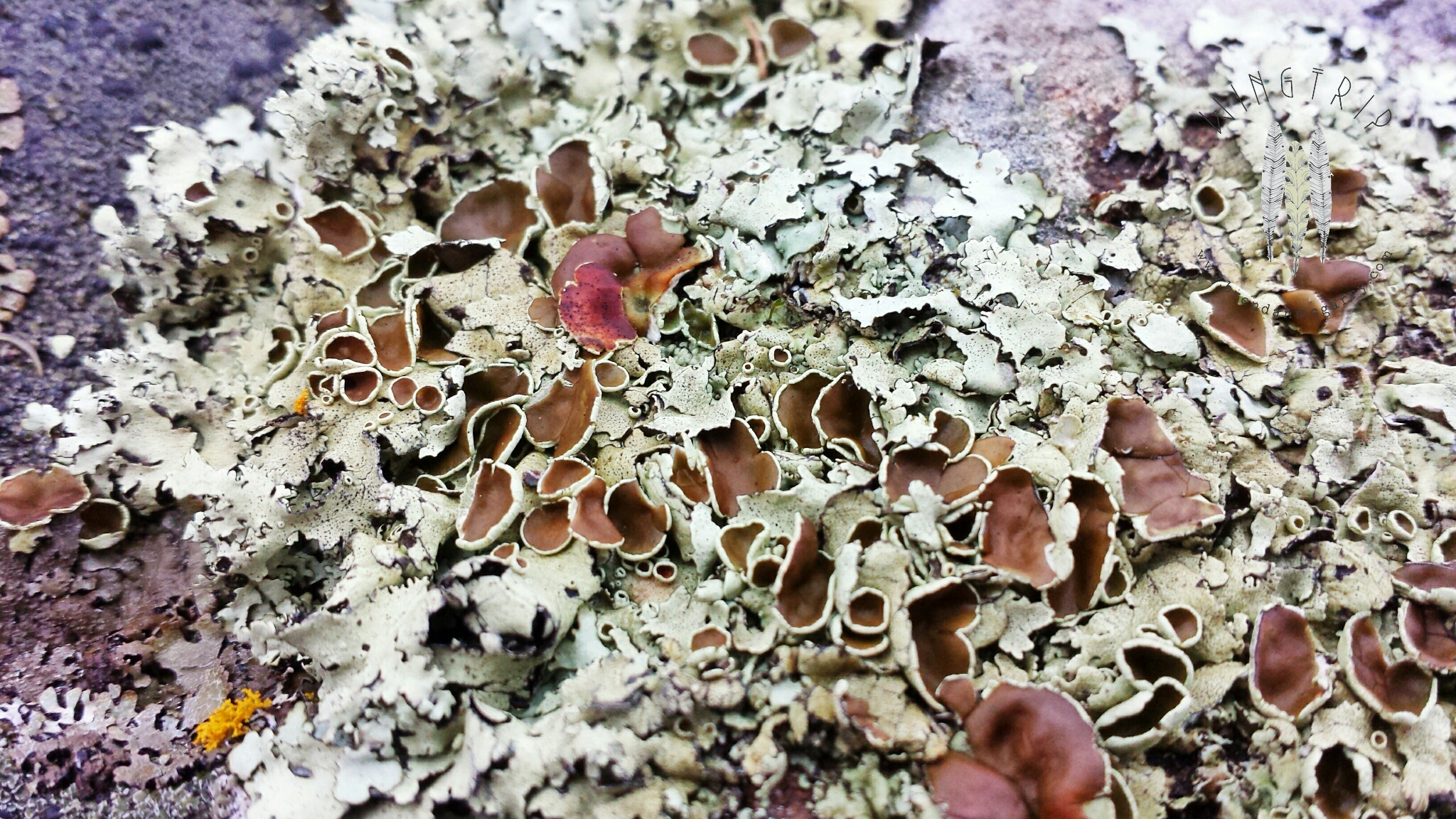
Like many multicellular fungi and plants, lichen reproduce via a fruiting body which pairs with a vegetative, non-reproductive body. Being a special blend of fungus (the mycobiont, generally providing structure, a home for their partner) and either algae or cyanobacteria (the photobiont, generally providing carbohydrates, ie nourishment) growing in a mutually beneficial handshake of symbiosis, lichen altered in appearance from either partner, even in their means of reproduction. What struck me in close encounter were the protruding apothecium of these specimens.

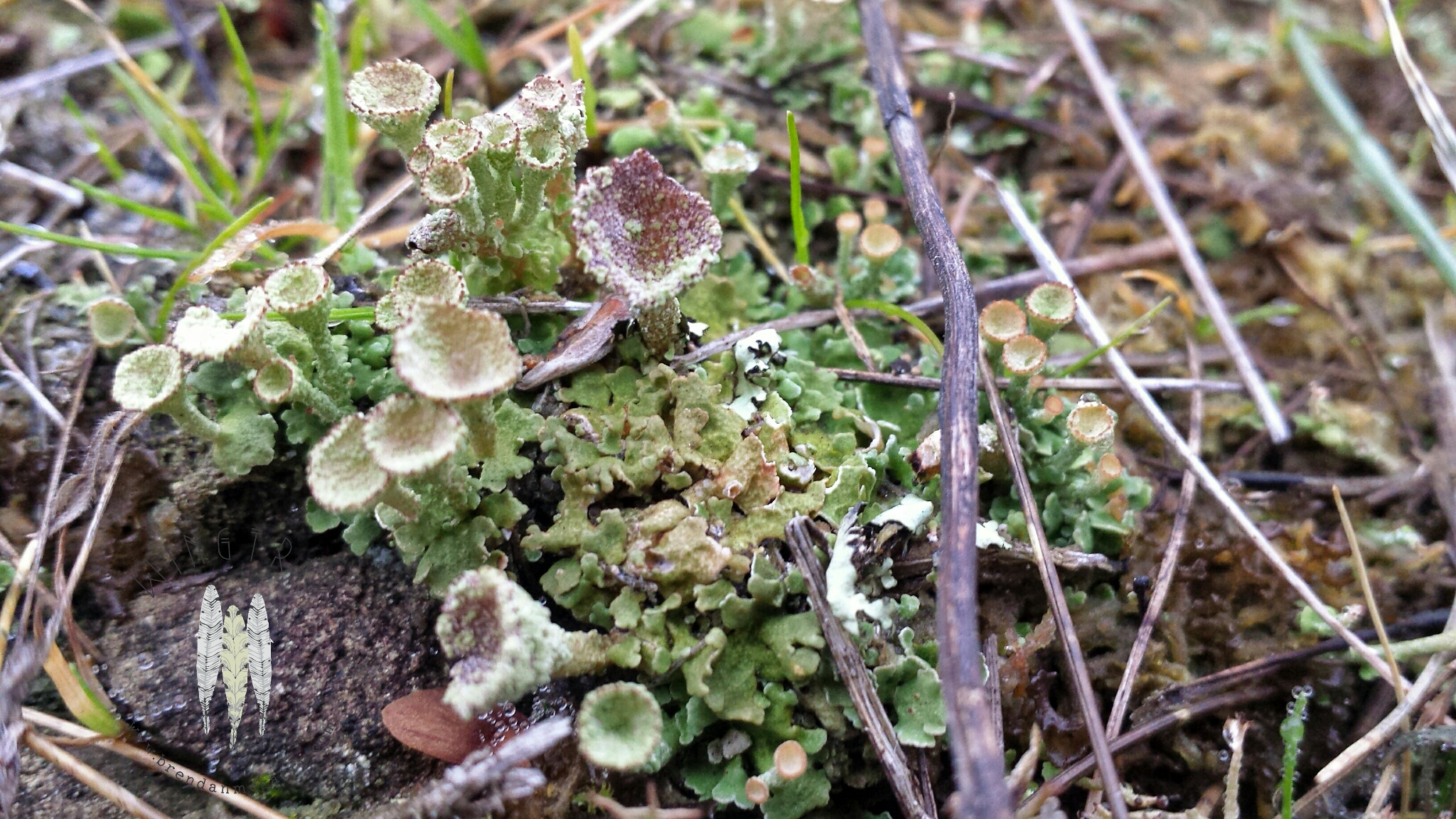
I’ll attempt to spare you words we don’t yet know or fill this page with jargonism: the apothecium is a form of reproductive structure in various species of ascomycete fungus (relax, that’s just the name of the organism). It just so happens these are the predominant group of fungus that are lichenized and the reproductive structure I was staring at, a common manifestation of the handshake I mentioned above. The apothecium is simply a cup that has an upper surface which produces spores, creating more fungus, which disperse and contact free agent algae or cyanobacteria, (or at least in theory this is what happens). Lichen also reproduce asexually by division or by creating tiny propagules of fungus and photobiont for dispersal. Some swing both ways.

wpid-picsart_1420743816508.jpg

Whoa. That got a little wordy.

If you live in the Pacific Northwest or a place that receives regular moisture, you likely live in a lichen rich environment. My chance face plant is a modicum of the information on these symbiots; people understandably devote their careers to them. Lichen are important as indicators of air quality, food for a huge variety of species, and of course as representatives of biodiversity. Some even provide natural dyes. I know very little about them overall but I do know I’ve seen them every place I’ve traveled to, in high points of the North Cascades and the desert coasts of Sonora. If you want to learn more and you live in my neck of the woods, check out Macrolichens of the Pacific Northwest by McCune and Geiser. While technical, with a little effort you’ll become fascinated by a new world of words and descriptions. Then look around. Lichen are there and if you look more closely you might see some cup-like apothecium stretching up to shoot off some spores. Gross.

I got back to birding. But I kept looking down and getting distracted.

wpid-picsart_1420743909886.jpg

comment 0

Seasonal Notes from the San Juans: September (and October)

9/8 – Though it’s still warm, there are less insects around, which I’ll miss. I hardly mention them in these journals, because I know so little about them; possibly I don’t want to admit my ignorance even to myself. Really I have little to say about most.

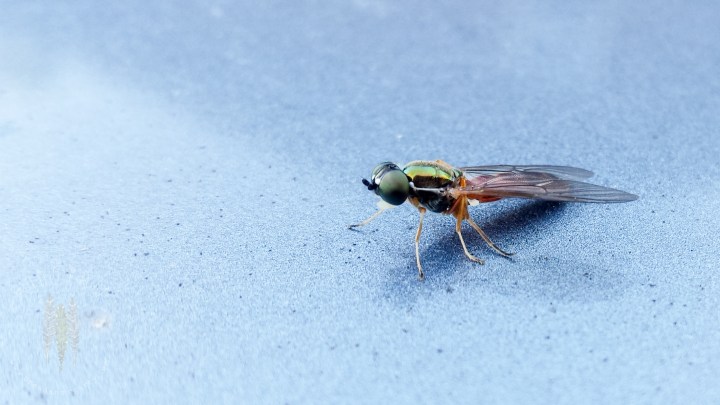
Today I did spend an hour trying to photograph insects in the field in front of the house. Some of the insects were recognizable, like the lady beetles, but others were fully alien. I likely spent more time bothering them than I did getting decent pictures. Then again, I bother them just as much when I waltz through for some purposeful human pursuit or to burrow into the aroma of dry grass and watch the seed-heads tilt across blue sky.

Brendan_McGarry_140912_00282

A fly, which I am yet to ID.


Resting in the grass there are hundreds of dragonflies above me. I know none of their names. They must love it here, with tadpole stocks ponds for their nymphs and quarry filled air for adults. Watching them cruise about brings me in total awe of their abilities, such concise acrobatics, some of the most efficient predators around. They almost never miss. Yet all the while they sport shimmering carapaces of emerald and azure, making no guises.

Giant Odonates in eons past? Sure, I’d like to see them, but overall I wouldn’t want them contemplating a flick of my finger as a tasty morsel.

I have two dragonfly guides. Maybe I should actually open them. I think of this at the end of summer.

Brendan_McGarry_140911_00062

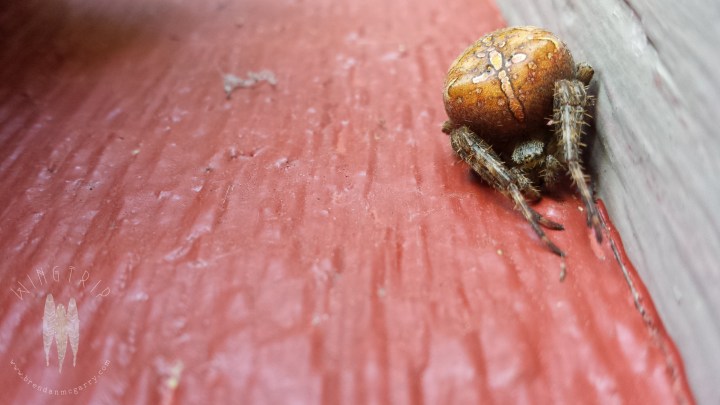
Another invertebrate from my summer in the San Juans. Again, I haven’t the slightest to it’s identity.


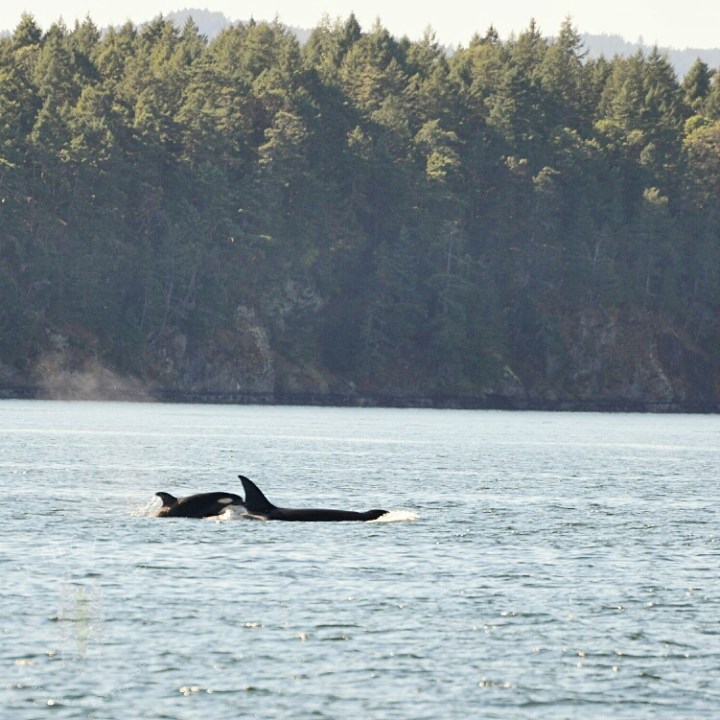
9/12 – I went out on our whale watching boat, the Sea Lion yesterday. Everyone on the boat was excited about the transient Killer Whales, the T65 group, which we followed North into the Gulf Islands of British Columbia. That was the point of the trip. However, I was far more excited about the quick glimpses of several bulky little Dahl’s Porpoise we left behind in boundary pass. We had to chase the transients.

Brendan_McGarry_140911_00023

Transient Killer Whales in Boundary Pass.


9/30 – In the last few days I’ve seen tons of bird life, probably a direct result of being able to slow down and relax a bit.

On a 5 hour kayak around Henry Island, there were hundreds of Common Murre fishing (I saw my first about 10 days ago). Young were in tow, calling for food from their fathers, almost superfluous to our boats. We drifted south through their numbers in the ebb. Off Kellet Bluff the fog moved in and all we could see were the bobbing murres and hear their echoes through the silence of a fall day. Marbled Murrelets are becoming even more common and I saw my first Western Grebes of the season. I wondered as we paddled past if the grebes were flightless yet.

My first Greater White-fronted Geese flew by in formation over Shaw on 9/26 while setting up for my friends’ wedding at the community center.

Brendan_McGarry_141003_00294

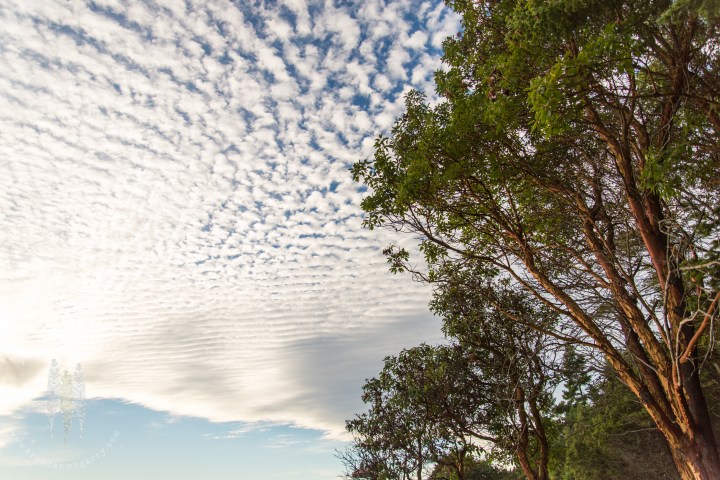
Pacific Madrone (Arbutus menziesii) and the fall sky of the San Juans.


Ferry rides now include many alcids, loons, scoters, and gulls. The Pacific Loons are still in their breeding plumage, a wonderful vibrating sheen of gray tones. At times in bright light they look mostly white, only to turn another direction and shift into graphite. I tried desperately to get close to one in my boat, but they’re too fast and wary; I stopped harassing it after a few (too many) attempts. Most birds care far less. I imagined that this bird had experienced a person in a kayak. Stalked in some far Northern locale while it tried to go about the day, constantly strafed by a bright yellow or red apparition and the hammering of a shutter.

Bonaparte’s gulls are possibly my favorite gull and I found myself entranced by their floating flight on the North side of Pearl Island during another trip. Dozens were winging about over the calm water, dropping to gracefully glean a morsel from the surface and in the same moment bouncing up into the air again. They’re everywhere now, a few still have a glaze of black feathers about their heads from the summer in the North. No one on my trips yet appreciate that this gull that weighs a little more than a baseball migrates from as far away as Alaska.

10/6 – If I don’t stop here, I never will, because the seasons are endless. Now it feels like winter. At least the time when we mossybacks curl up; the time when the hardier birds endure the endless gray. I’ll enjoy my last moments on the porch and listen to the siskins whirling about the tree tops, their numbers seem to have irrupted again after last winter when any finch was a much rarer thing. The kinglets were always there tinkling away but now they’re in flocks with creepers and nuthatches. The frogs croak, still with warmth enough to bother talking. The shrubs and few deciduous trees are mostly yellowing and losing their leaves, this shedding will accelerate with coming rain and soon the conifers will receive winter pruning as the winds pick up.

There’s a true fall chill in the air and I won’t be in a kayak again for some time. I’m glad to have these notes from a season on the water and in the San Juans. In a couple days I’m headed to the mainland, not for good but for a break from the silence. I have a feeling I’ll be eager to return shortly after leaving.

Brendan_McGarry_141009_00414

Stretching fields of the mainland.


comment 0

Seasonal Notes from the San Juans: August

Like many writers, I keep a (sometimes) daily journal about my life and the natural history events, largely bird related, that I experience. The following blog posts, organized by month are excerpts from my summer living and working the San Juan Islands of Washington State. Enjoy!

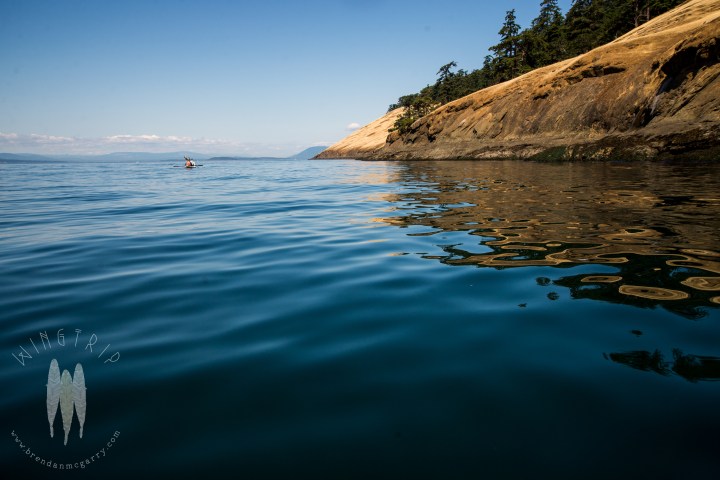
8/7 – It is looking as if I will be getting quite used to crossing Spieden Channel to Stewart Island. I’ve already gone six times since my first trip over. I still very much respect this open section of water as it rips between flood and ebb. The challenge of crossing is more on the clients’ end, but I still find myself in moments of nervousness, being carried to far this way or that as we paddle across. It’s hard to imagine the homesteaders who crossed in rowboats to Roche Harbor on a daily basis.

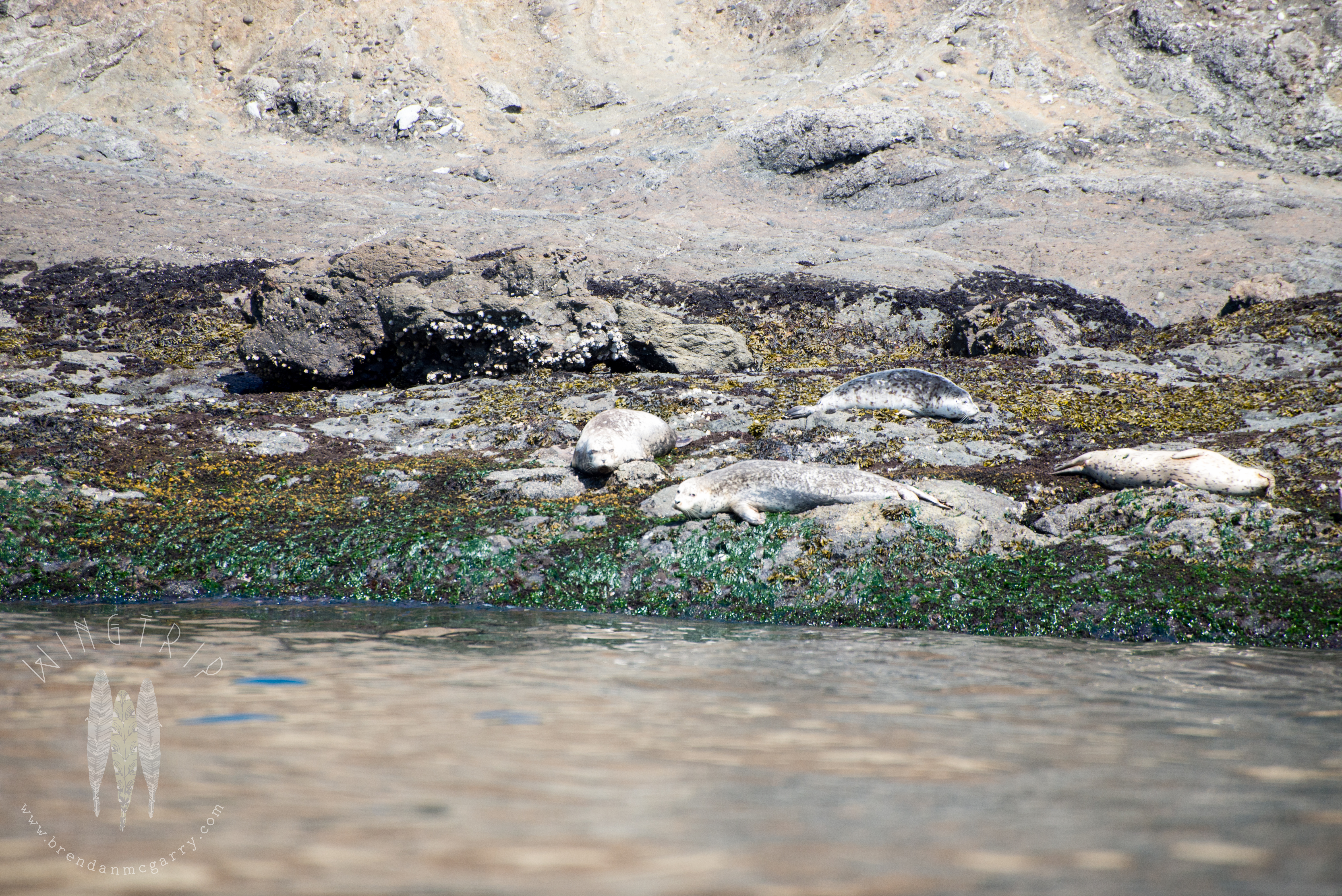
Spieden Island being a private island gets far less human traffic and is much more alive with animals. Seals are much more comfortable beaching here, protected by steep cliffs with good exposure to the sun. As we paddle by watching Harbor Seals, there’s also the chance of seeing the odd exotic ungulate, hallmarks of the days when this island was owned and operated by brothers who set up a safari company.

Brendan_McGarry_140726_00069

Harbor Seals (Phoca vitulina) on Spieden Island.

Bringing people to hunt foreign animals on a remote island proved not profitable, but the animals stayed and have wreaked unknown horrors on the local flora. What was once likely extensive prairie on the South side is now short grass lined with trails from deer and goats. They’ve also swam to other islands nearby. The Cactus Islands, John’s Island, and Stewart Island all now have these goats.

I think about this every time we cross, in the tandem with geological musings. The entire southern flank of this long, narrow island is evidence of the glacial power that pushed over these islands. Thin soils on a Southern exposure are less conducive to expansive Douglas Fir forests and there’s a good number Garry Oak dotting the hillside. My favorite thing about Spieden is that it’s an example of what all the San Juans look like in an extreme. Head to the North side of the Island and you are immediately in the shade and a wall of trees tower above you. There’s a notable hint moisture in the air when you round from the sunny side to the shady.

Brendan_McGarry_140726_00037

The South side of Spieden Island.


8/18 – I woke up on San Juan Island to the cacophony of geese and ravens near Roche Harbor. Red-crossbills still chirrup in the treetops and have been since my last entry in my journal (this is the longest I’ve gone without writing anything in five years, not a great thing).

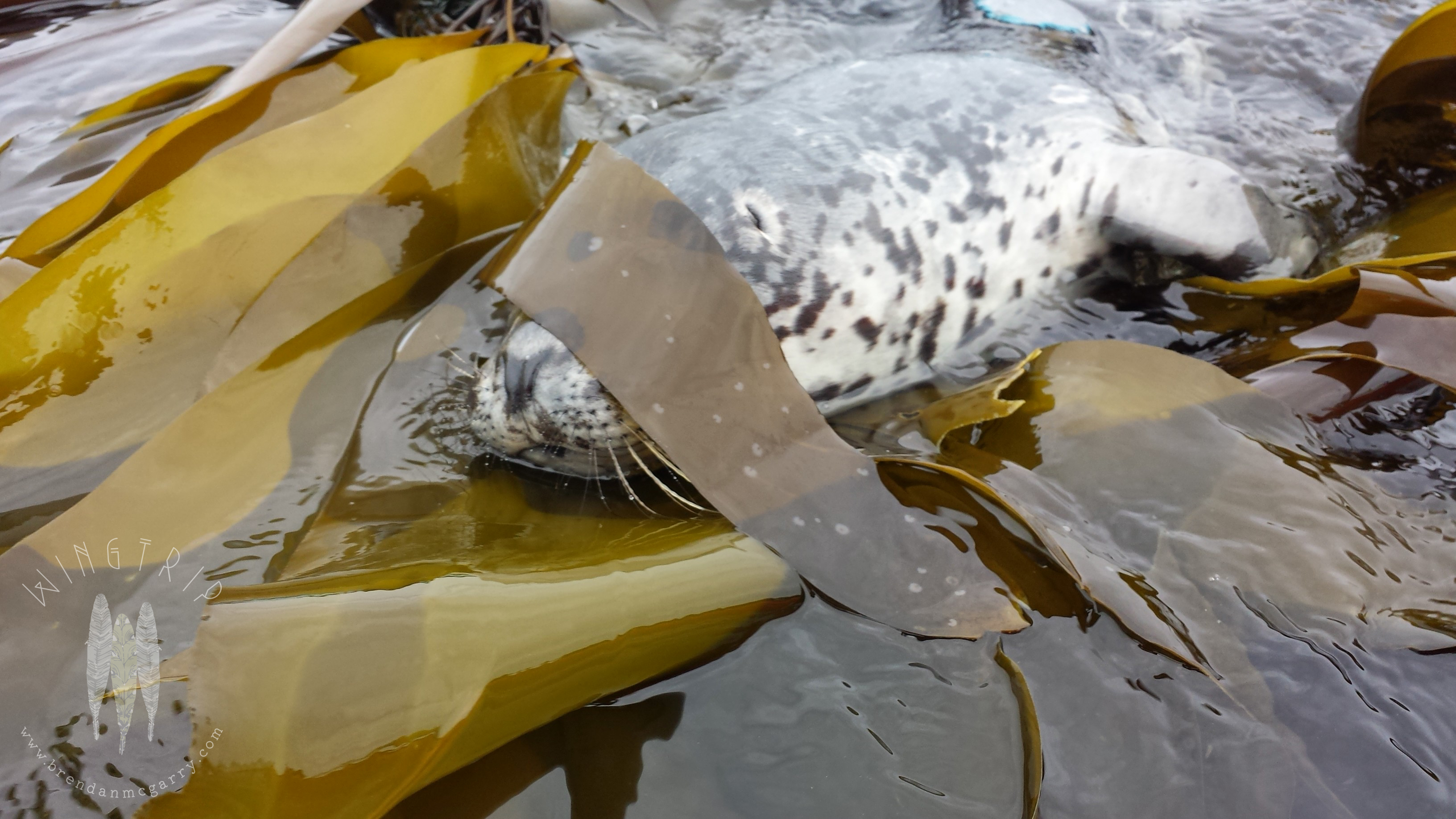
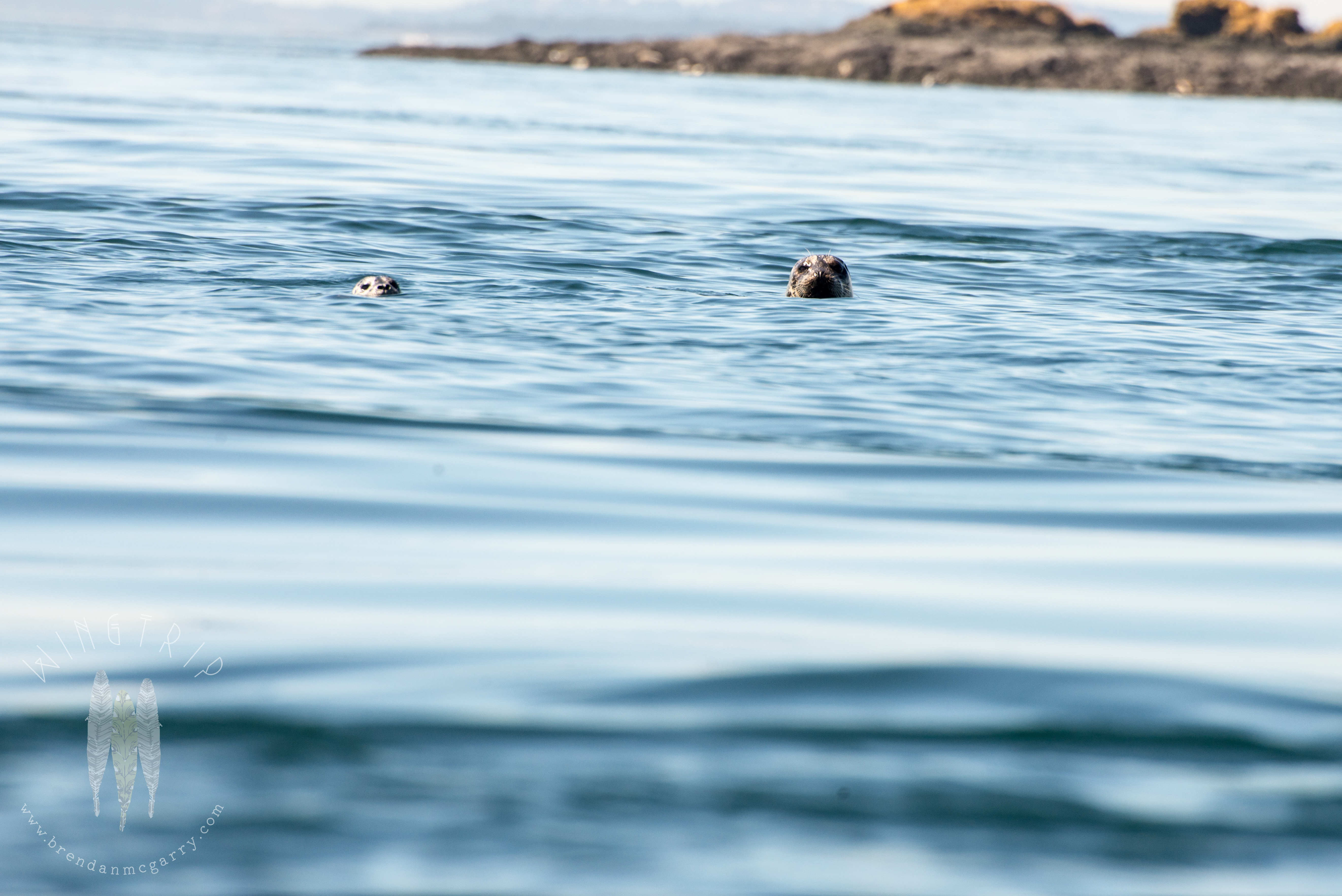
On the water, many more seal pups are weaned and still curious or looking for maternal companions. A lone individual has been greeting all the kayakers who visit the kelp beds off Battleship Island. He or she makes beeline for the first boats that stray into the kelp and plays with rudders and paddles. My first encounter I was astonished and we sat with this youngster for nearly an hour. It was so comfortable that it even took a nap on a clump of kelp.

Brendan_McGarry_140816_00001

A newly weaned Harbor Seal (Phoca vitulina) pup resting in kelp beds off Battleship Island.

There are few Heerman’s Gulls around but the alcids increase in numbers. Only Purple Martens and Barn Swallows are left of their kind. I haven’t seen a warbler besides Yellow-rumpeds in weeks. Mre and more Calidrissandpipers are around and I saw a large group twisting over the low points of Henry Island near Open Bay.

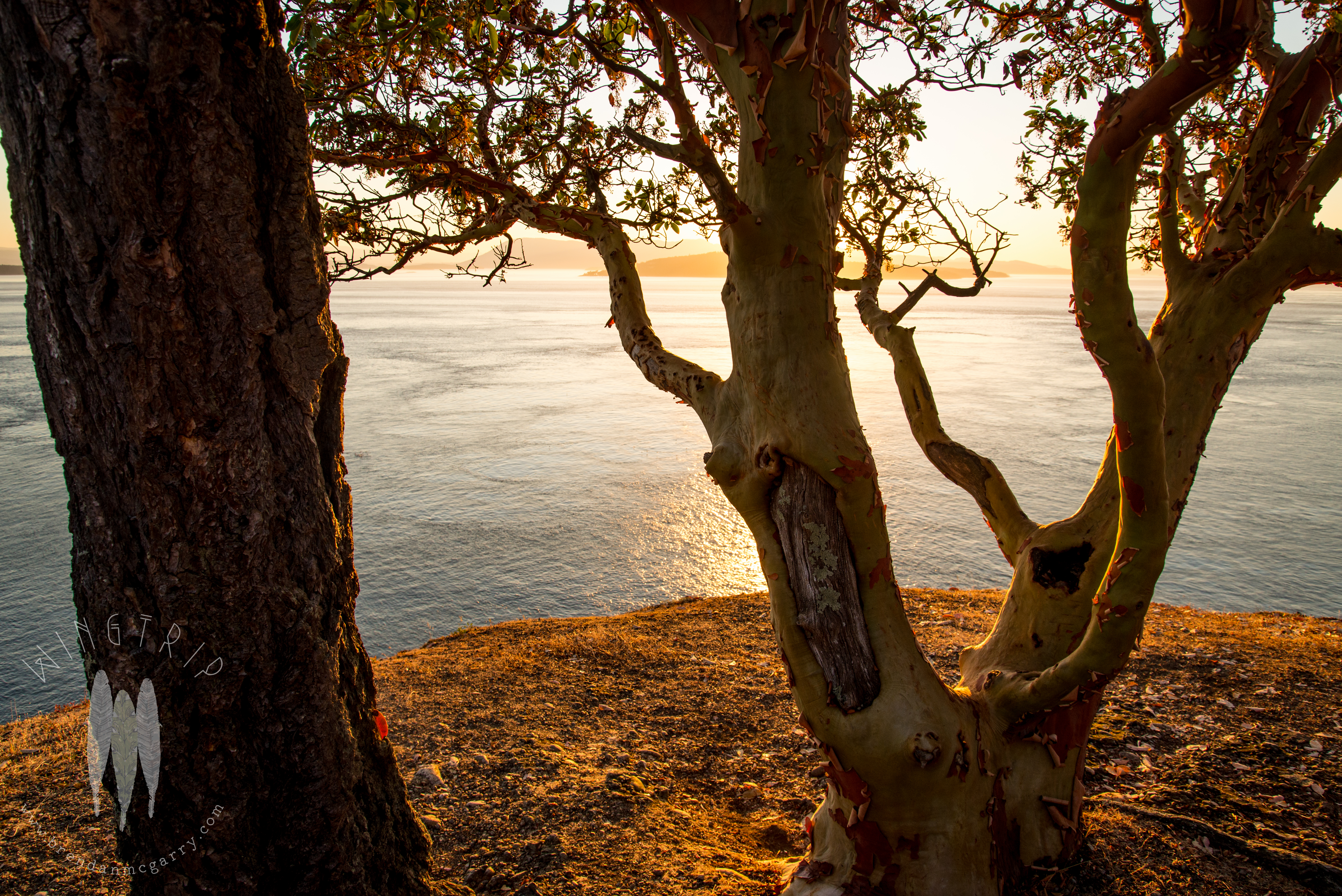
8/25 – As things slow in work I have more time to enjoy these islands and have more pleasant conversations with people while paddling (as opposed to herding cats). My favorite tree here is the Pacific Madrone and it catches everyone’s attention with peeling red bark exposing vibrant green within (an adaptation that allows them to endure periods of drought by photosynthesizing through their bark). They’re less showy in bark now, instead they are exploding with orange-red berries. These are pretty alone but they bring an aural element to their show. Birds love the fruit and robin along with many other birds including Northern Flickers are going nuts in the trees around Roche Harbor. It’s certainly a nice talking point because even the dullest of guests notices the cacophony coming from the trees.

Brendan_McGarry_140715_00437

A Pacific Madrone (Arbutus menziesii) at Lover’s Leap on Stewart Island.

8/29 – If you’ve got a dock in the San Juans, River Otters will likely visit. I’m glad I don’t one. I can remain a complete fan of their cavorting and avoid distaste in their weaselly funk and habit of using docks as a latrine for their fishy wastes. It’s foul to say the least and today I was rounding the corner of a dock on Pearl Island when I was pummeled with the scent and caught 9 otters as they scurried from an overturned skiff, surely left in preparation for the winter. Instead they created a home for stinky water weasels. I couldn’t help but laugh in applause; the house that belonged to the dock was particularly gaudy.

comment 0

Seasonal Notes from the San Juans: July

Like many writers, I keep a (sometimes) daily journal about my life and the natural history events, largely bird related, that I experience. The following blog posts, organized by month are excerpts from my summer living and working the San Juan Islands of Washington State. Enjoy!

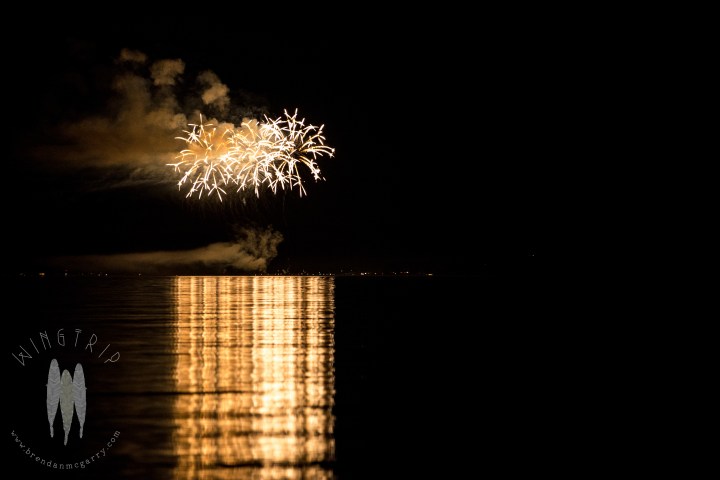
7/6 – I’m glad the 4th  of July, with all its engines and alcohol and explosions, is through. Usually I enjoy this holiday. This year I suppose dodging drunk motorists and erratic children captaining dinghies made for a different attitude. There’s always a malaise in the air afterward and there also seem to be less animals around for a few days too (the latter is probably an impression).

Brendan_McGarry_140704_00118

Fireworks on Lopez Island seen across San Juan Channel from San Juan Island.


Over the holiday “weekend” I held my first Sun Star. This nobly purple beast of a star was latched to the edge of Henry Island, but came away easily for us to admire it. One of its rays was regrowing, one of eight extending arms whose tube feet reached for traction upside down in the air.

As the kelp bed between Henry Island and Battleship grows, so the Heermann’s Gulls amass. There were at least 35 sitting on the beds when I paddled up this week. They sat still with several boats approaching, confident in familiar habitat; varieties of giant kelp grow in forest like colonies between here and Northern Mexico, the gull’s range. A Great Blue Heron felt otherwise and thrust off with a harrumph of a squawk.

Brendan_McGarry_141003_00281

Heermann’s Gulls (Larus heermannii) on a kelp bed.


7/19 – There’s so much to see out the windows of the ferry. I try so hard to be vigilant but it’s all too easy to get complacent in daily transportation across these broiling bodies of water. Just by trying to look out the window, I do better than many established locals commuting on the inter-island ferry, half of them just curl up to sleep. And sometimes I’m rewarded. I saw my first Marbled Murrelet of the season on July 15, just as we slipped through Wasp Passage into San Juan Channel.

7/28 – No more bird song, except the spare robin and other resident birds, which crow with a touch less exuberance still. On the flip side, the waterbirds are increasing.

More and more husky Rhinoceros Auklets bob in the straits and channels. I saw my first Spotted Sandpiper earlier this week, flitting along the West side of Stewart Island. The Pigeon Guillemots’ site fidelity has decreased and they wander further afield, they’ve finished breeding and are changing to their piebald winter plumage. Canada Geese are starting to arrive on the airfield at Roche Harbor. I’ve twice heard Black-belled Plover and Greater Yellowlegs somewhere overhead while stepping out to admire the stars, which they surely were using in their nocturnal navigation (what a wonder that both are cosmopolitan species, found all over the world).

The only songbird that seems to have increased are Red Crossbills. Their number I presume relate to the large cone crop all the conifers are sporting. Then again, not having lived in a Pacific Northwest locale quite so ensconced in conifers, I could merely be naïve to their profundity.

7/30 – I’ve been struggling with the concept of personal productivity (a decrease due to work) and decided it’s better to listen to waves and kingfishers and watch Greater Yellowlegs and Western Sandpipers than worry about dulling my eyes against the LCD. I’ll have all winter for that.

Yesterday was a long day, consisting of three, three-hour tours from morning till dusk. What lasts in my notes and memory are:

The snorting and cavorting baby seals and their attentive mothers, pressing noses and guiding their young.

Brendan_McGarry_140727_00228

A Harbor Seal (Phoca vitulina) mother and her pup curious about my boat.


The California Gulls, back en mass which I gave valiant effort to paint in an exciting light as they flipped about high overhead, catching the caste of termites winging off to reproduce (I had no takers finding either phenomenon interesting).

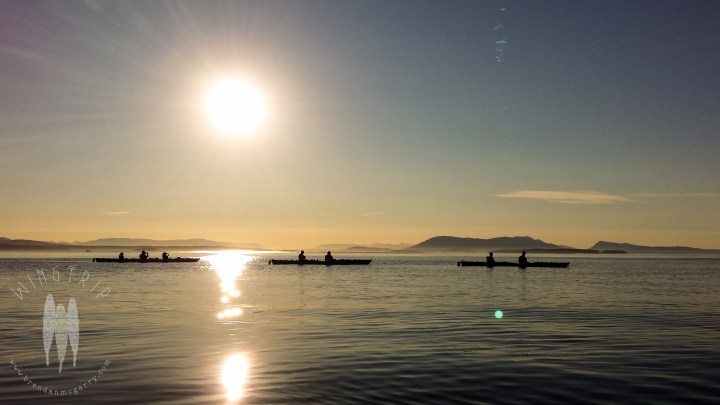
The moment when I realized my sunset tour was devoid of engines and I sat silent with my charges as family groups of Marbled Murrelets murmured back and forth between our boats diving for bait fish. Heerman’s Gulls laughed into the wind from their floating roost. If it was up to me, I would have stayed out there.

Brendan_McGarry_140729_00193

Sunset on the Haro Strait.