comment 0

Mexico Part 6 – Alamos

Heading east from Navajoa, Sonora, you face the prominent Sierra de Alamos, you’ll eventually find yourself in rolling hills. A visibly diverse canopy of a muted green develops and you are no longer in the flat coastal scrublands. Morning Glory trees, with pendulous white flowers appear irregularly along the roadside. You’ll pass through a large gateway, seemingly in the middle of nowhere, and you are in Alamos.

We arrived in Alamos late, missed rendezvous with Oliver and his parents. This got us off to a rocky start. But it was an absolute joy to sit as the town came to life, after the solitude of Navopatia. It took a second for me to relax in a new place without a plan, but everything worked out and we found a place to stay.

Alamos is a town of about 25,000, but when you sit in the main plaza it feels like much less populous. The municipality was founded in the late 17th century in the advent of silver mining in the area. Designed by the King of Spain’s personal architect at the time, it is known as ‘La Ciudad de los Portales” because of its many large doorways and walkways. As we explored the area in the next few days, Alamos’s age was apparent, although in recent years gringos have revamped the dilapidated mansions and tourists have begun to flock, bringing money for modern augments. There was still a large degree of historical charm.


One of the unique things about the town is the high sidewalks: they’re extremely tall, in some places coming up to my stomach (I’m 6’). The purpose is to accommodate for the monsoons that rage through in mid summer. Being in the mountains, they get the full brunt of run off from these storms and they literally flood the streets daily. In the off season, it made avoiding cars on the ubiquitous narrow streets difficult.

We ended up renting an amazing place up the hill from the main town. El Pedregal is run by Jennifer and David Mackay and is set on an amazing swath of undeveloped forest and scrub. Letting us dirt bags stay in their straw bail building was incredibly generous. It meant we got to wake up in a birding paradise, pick Dave’s brain for places to gallivant, and explore the town from a comfortable locale.

My excitement about finally being in Tropical Deciduous Forest was overwhelming and I didn’t get a good night’s sleep as a result. Anticipation of this new habitat was palpable in my peers as well, we were pretty much all up and birding around the property by a chilly, chilly daybreak. Jeff and I almost immediately found Black-throated Magpie-Jays because they flew by screaming their heads off. Though gorgeous birds, they look as if someone put them together fancifully (but masterfully) with feathers and glue. I was excited to put some studying to use and pick out a few white-crested juveniles among the bevy. Violet-crowned Hummingbirds were calling everywhere – a bird that I’d only seen singly in Patagonia, Arizona. They were squeaking their territorial claims throughout the loose sub-tropical forest.

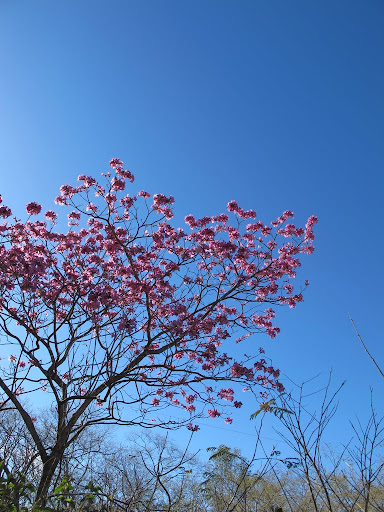
We’d explored the property fairly well, talking to a group from High and Lonesome Bird Tours about the birds they’d seen. We all sat patiently and watched a female Black-vented Oriole peruse a leafless but blooming Tree Morning Glory (Ipomoea arborescens ) along with other Orioles and the never-ending stream of Orange-crowned Warblers. The next day I found a Tropical Parula, a good bird for the region this time of year, enjoying the blooms.

Pulling a large group together, even excited birders, can take time. The time had finally come to head out to the Rio Cuchujaqui, but we had some stragglers (including a poodle and labradoodle whom I was not thrilled were coming along). Thankfully, while milling about waiting for the roundup, a group of Mexican Parrotlets flew in over us and landed right on the property. These sparrow-sized parrots hardly ever land in plain view and we got the best looks we could have hoped for. Chirping and preening, they sat happily in view just long enough for us to round-up everyone and hop in our vehicles.

comment 0

Mexico Part 5 – Bird Island


In case it hasn’t been clear just yet, Navopatia is a coastal locale. Let your imagination meander and I imagine you’ll arrive at common local vocation. Fishing.

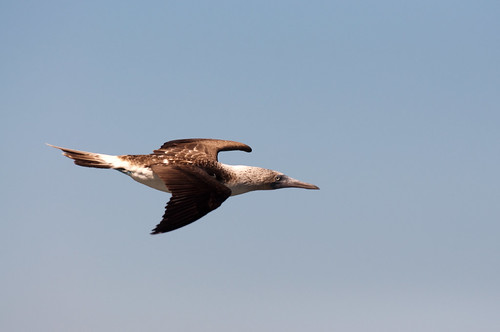
The fringe benefit for visiting naturalists and birders are the many boats ready for hire. Tino, who lives and works in the village and for the field station is happy to make money off taking visitors out to the aptly named Bird Island. With the going rate at $10/person and a full boat of 10 people, Tino makes a good wage (there’s plenty of people who don’t make that in a day in the US). And for us, ten bon-a-fide greenbacks was a deal to see breeding Blue-footed Boobies!

We’d been trying to make it out to the island before leaving for Alamos. The wind and Tino needing to accommodate other groups hadn’t allowed the venture until now. The morning of the afternoon departure to Alamos, we clambered on and coasted out to the open water.

In the wide channels that feed the estuary, mangroves and all their charismatic inhabitants flanked us as the boat crawled forth. Although my bouts with seasickness have been directly dependent on being in heavy waves and distance from shore, I was willfully avoiding being ill. Thankfully, as we broke into the open water, I had ample distraction.

As many times as I’ve watched boobies and gannets slice into water on film, it has never done them justice. At the risk of making evolution sound sentient, boobies are perfectly engineered for these stoops. Seeing their quarry from high above, boobies plummet and transform to spears thrust from Poseidon. They shed any resemblance to birds the split second before impact.

Blue-footed Boobies in most respects however, aren’t as graceful as they are when foraging. Well built for living at sea, they quickly diminish in elegance right when they try to land. Feet thrust forward and gangly wings stuck at awkward angles, like someone trying to brace their fall, many of the birds seemed elated in the simple miracle of coming to ground without mishap. Beaks clattering, they’d uttering bizarre noises on successful stops.

Bird Island itself isn’t horribly fascinating from a geological perspective – it’s just an eroding bit of sand. Hardly an island at all. But it was full of birds: both species of Pelicans, Brown and Blue-footed Boobies, cormorants, geese, ducks, shorebirds, pretty much every bird in the estuary. Tino brought the boat up close but to be respectful, we didn’t go to land.

Breeding bird colonies are not places of glamour either. Behaviorally, yes – very fascinating. But let’s not ignore that fact that this island was mostly bird shit from obligatory piscivores (we got a full whiff of this one the far side of the island). The excrement of birds that eat fish all day and exude it to bake in the sun, does not remind one of rose petals. Then there’s the noise and the complete lack of shade – you can probably assume I’m not destined to work with Nasca Boobies in the Galapagos.

But you don’t visit these places for the ambiance. You come because you get to see a White Pelican stretch its proboscis skyward, the absurdist yoga. To watch Blue-footed Boobies assume courtship displays, clownishly raising their latex gloved feet up and down in unison. To hear the excited whistling and humming of the birds as they go about lives that don’t include our own. And best of all, to admire the babes.

Baby boobies are the oddest baby birds I’ve ever seen. These fluffy white muppet like birds were few in numbers and easily missed amongst the whitewash, mainly because they were sprawled about like discarded feather boas. They didn’t look comfortable and I was reminded of two days earlier when I’d slept one off. This was probably akin to that, an inescapable, nauseating discomfort. However, I’d had the option of not baking in the sun (and not imbibing so lavishly).

I stared at one for about ten minutes, willing it to move. It didn’t. Even when an adult bird pummeled the ground adjacent during a particularly graceless landing, it stayed motionless. Finally it half-heartedly nibbled at the nearby adult’s chin. Not the penultimate of begging. But I’ll be damned if they weren’t deathly cute. You can take baby penguins, I’ll take these nonchalant albino Elmos over them any day. I’d probably suffer less hangovers if I spent a few months watching them valiantly avoid sun stoke.

(In reality, exposure is a huge hurtle for baby birds and it’s quite a testament to these and all birds that manage to work around this so they can live near their food source)

After looping to the west of the island and quickly retreating because it smelled like rotten fish guts, we started back. We were leaving Navopatia when we came to shore. I could have stayed; written some Steinbeck sluiced book and found a beautiful Mexican wife who could plump me on hand made tortillas and seviche.

But we had to meet the Mays in Alamos that evening and explore Tropical Deciduous Forest (TDF). Everyone was going to be glad to no longer hear me spout on about “TDF”. It sure was hard living this lavish life of natural history worship

Although I knew I’d be back, it was hard to leave our friends. We’d see all the people from Evergreen back in the Northwest but who knew when I’d see any of the locals again. I made a goal with myself to relearn Spanish and find my way back soon and actually communicate more than monosyllabically. My flailing attempts to do eloquent justice the Thornforest, Navopatia, and the Mangroves won’t suffice. Whoever is out there reading this will have to visit. Really that’s the point of all this laborious self-indulgent verbage – to inspire you to explore and care about our world.

“Probably every subject is interesting if an avenue into it can be found that has humanity and that an ordinary person can follow.” – William Zinsser, Writing to Learn

That about sums it up!

comment 0

Mexico Part 4 – The Big Labyrinth

Exploring mangroves is extremely dependent on the tides.  The water surrounding the island (which is plopped between the Sea of Cortes and Navopatia) is never too deep and you can see sandbars form daily in the channel.  In the less fast moving water, serious stands of mangroves have set up shop.  We’d explored the small labyrinth already, less a paddle through than a pulling and pushing on muddy trunks and stems covered in bird crap.  As our boats staged across the channel, we headed for the Big Labyrinth.

It wasn’t far fetched to imagine becoming  disoriented and experiencing labyrinthine wilderness down some lanes of the mangroves.  But the Big Labyrinth was tame.  Several of us could paddle side by side and a powered fishing boat even came up the channel to set a net.  I wasn’t ever nervous on previous explorations but it didn’t feel as secretive, more like a regular thoroughfare.

My friend Dan Maxwell had arrived the night before, after 32 hours on a bus from Tamaulipas.  He worked on Adam’s Northern Sierras point count crew and had done training with Simone and I in Chester, California.  Incessantly exuberant in a very Californian manner, he couldn’t help expressing his excitement at the Mangrove Warbler, the simplicity of paddling through this habitat.  I was enjoyed having someone to reengage my enthusiasm.

Though I’d only been at Navopatia a few days, I was beginning to slump into a lethargy of familiarity.  Sure there was a lot I’d never seen before but it’s easy to glaze your perception once you’ve come off the high of a new environment.  The energy of childish fascination for nature isn’t hard for me to attain, but it wears me out and I’ll realize I’m not actually observing anymore.  Sometimes I find myself overwhelmed by the questions I have about new places, in which case, for survival’s sake my brain backs me away from the edge of perpetual inquiry.  For better or for worse.

We caught glimpses of what turned out to be a Northern Waterthrush.  All I managed was a dark shape flying across my bow, which landed in the mud bobbing it’s tail before  secreting away into the endless trunks.  Simone and others caught a better glimpse and confirmed.

Attempting to find animals once they’ve  melded into the mangroves was impossible.  I was leading our flotilla when we broke out into a large lagoon.  Startled at seeing a bright monstrous red thing appear inexplicably, every bird within sight fled.  The only Green Heron of the trip skidded into a mangrove, looked back, and silently climbed deeper into the folds.  Seeing this disappearing act reawakened the mystery of these trees.  Anything could be out there.

We all paddled lazily through the shallow lagoon, spreading out and drifting aimlessly.  This was certainly a good life to be have, one to aspire to.  As my boat was turned around in a circle by the flow of water, I counted a Spotted Sandpiper, a Long-billed Curlew, a Marbled Godwit, Willet, Whimbrel, White Ibis, Reddish Egrets, and numerous Yellow-crowned Night Herons.  I didn’t even have to turn my head, I just held my binoculars aloft let the tide pan  for me.

The Night Herons were particularly hysterical.  Apparently the exposed flats were highly covetable.   One bird would look up and see another, distantly going about foraging, and leap into action.  He or she would swoop in to furiously chase the other off, even following them to a new expanse.  In the meantime another bird would have fill the vacant space of the squabbling pair.  The air was filled with the perturbed croaking of herons that appeared to not be doing much in the way of feeding.  Possibly this wasn’t as simple as food and was more lodged in an expanse of territory. However, having watched herons forage in the past,  no one appeared to be despot of a stretch of mud.  Again the tide made sure of that.

Brown Pelicans eyed us as we made our way back.  One pair was particularly calm as Danner floated nearby and I followed.  I suddenly realized that we were at the mercy of this huge bird, not the other way around.  On the slog back to camp, I pondered how much I took being a human for granted.

That night we had some guests arrive that everyone sort of expected.  They’d tried to keep it secret, but Steve Herman and Drew Whellan were personalities too big to try to ferret away.  I had already sleuthed out their arrival but that made me no less excited to have them with us.  Steve had a lot to do with Navopatia, especially seeing that Sallie was his daughter and Adam his son in law.  Dr. Herman also happened to be the Ornithology professor in whose classes we all became friends, joining a colorful and gregarious group of former students dubbed Hermanites.  Normally I don’t buy into idol worship but if I’ve ever met anyone who deserves it, Steve certainly does.   Equally as colorful and enjoyable was Drew, a good friend and fellow Hermanite, was just as stoked to be there as we were.

We finished the night with a rip roarer of a party.  Fire, libation aplenty, and Ranchero music for dancing under the stars.  To say they least, the following day didn’t start early.

comment 1

Mexico Part 3 – The Ranch

Danner’s truck skidded through a huge mud puddle and we all held on for dear life.  Speeding through the Pitayal at 7am I couldn’t have felt more contented.  A behemoth above the desert landscape, the fig tree of the ranch loomed ahead.

As AWA began to explore the region in the early days, they found a nearby cattle ranch that was fine with a buncha geeky gringos sneaking around and shouting about “los pajaros.”  With considerable stands of mesquite scrub, a small freshwater creek, a squared man made lake, and the aforementioned fig tree, there were of birds aplenty.  They were chattering away as we made our way towards the lush creek banks sloughing warblers and the fruit heavy fig.

Kiskadees and Gila Woodpeckers were making a ruckus gorging fruit.  Behaving much more respectably and frustratingly cryptic was a species I’d long wanted to see, the Rufous-backed Robin.  For a millisecond birds would pop into view and stuff their faces, before disappearing behind the shroud of leaves.  Someone said something about them “just being robins,” as I sat patiently enduring their infuriating shyness.

Along the lakeshore we found masses of Lark Sparrows.  I’d never seen so many in my life; they were in small flocks of six or eight birds and seemingly everywhere.  Seeing huge amounts of migrant birds was surprisingly one of my favorite things about Mexico, (considering that I enjoy birds largely because of their ecology and not for the baseball aspects of birding, this actually isn’t a surprise at all).  Imagining the odyssey rivaling journeys that these birds endured to arrive at Navopatia, knowing that possibly they’d even be from Washington State boggles the mind (which end of their migration are they actually from anyway?).  Seeing clouds of Orange-crowned Warblers of the same subspecies that breed in the Northwest continued to enliven imaginative drifting on avian life.  It certainly put the rest of us humans in our place.  As if to keep reminding me that we were still in North America and that, yes most of these birds could be seen within 100 miles of where I live, a male Bufflehead screamed down to land.

Neotropic Cormorants bobbed up and disappeared beneath the murky surface of the lake.  At the far end, Least Grebes sat nicely along with Pied-billed Grebes accommodating those who were new to them.  Mexican Mallards floated together like any other mallard pair would, despite their practically imperceptible dimorphism.

Vermilion Flycatchers are so stunning that I think they overwhelm people.  Danner and I followed a male around snapping shots as he patiently went about his day. It was too easy to see these birds everywhere and get dulled to their stunning red and black plumage – but being a pale, color starved Northerner I couldn’t get enough.  People may balk at that statement and suggest some notable birds that display the shade, but no I’m sorry, there’s nothing so brilliantly crimson in Washington.   After probably 80 photos of this little gentleman, I got distracted and went off to find a Harris Hawk that had flown by with nest material clutched in it’s talons.

A couple ranch hands rode by on horses, friendly enough but seeming a bit suspicious of the bunch of us.  I couldn’t blame them.  Despite the natural wealth of the land here, everyone living on this ejido (land made communal by the government) was poor.  Here we were, a bunch of kids running around with binoculars, scopes, cameras, things that would cost many people here more than a years salary.  It reminded me of a time in Ecuador when our group stood watching some gaudy, extraterrestrial bird in awe of the exquisiteness of nature, when a group of cattle ranchers drove their cows past our group.  Wearing torn clothes, their cows visibly infested with bot fly larvae, it was immediately hard to feel happy about this place.  These Mexicans weren’t unhappy and probably weren’t starving but I couldn’t help but feel a wash of guilt about my luck.

It was easy enough to slip back into my astonishment of birds and nature almost as a remedy for such feelings.  A Bell’s Vireo sang in a clump of mesquite and I succumbed to my excitement once again.   But I didn’t want to completely forget about the disparity of the world and the fact that this is not only horrible for people but the environment as well.  I used to think that we couldn’t help the environment without first helping people.  While that is conditionally true the simplicity of that view doesn’t permit a holistic approach.  Considering people and place separate, animals apart from people, won’t solve problems but more likely than not actively promote the downward spiral.  Health of the environment means health of the people.  While I’m not suggesting a Utopian ideal, it’s obvious that when the air is clean and the water clear, people are better off.  What makes me ashamed of my economic status more than anything is knowing that it is built on the backs of people like this and that companies knowingly continue to callously ruin people and place for things like Pop Tarts and TV Dinners.

I continued to think about this as we headed back to Navopatia.  Ahead, six Harris Hawks started from some particularly tall pitaya and my mood lightened a bit.  Life strode on in the face of everything people thrust upon it and ultimately no matter what happens to us, nature will get through the human hiccup.  That doesn’t meant can sit back and watch it all fall down but it’s comfort knowing that people are still part of a system we neither control or completely understand.  My awe of this planet will never cease and neither will my drive to make it a better place for all considered.  Face to face with biodiversity and environmental strife in the pitayal, we slowed to watch an immature Gray Hawk just before returning camp ward.

comment 0

Mexico Part 2 – Desert Banding

Once I’ve found a routine for early mornings, I happily adhere to them, especially to see some birds close!  Bird banding dictates early mornings for several reasons.  Birds are more active on cool mornings in hot clines.  Setting up nets at daybreak means birds don’t see nets being set up by loud clumsy apes and can avoid them. Finally banding birds in the heat of the day is dangerous for them because they are put in a stressful situation without food or water.  This final reason is the calculated risk taken to gather important data and responsible banders will cancel readily.

Our first foggy morning the crew was supposed to be out netting birds near the road into Navopatia.  But heavy fog soddens nets, which will soak birds.  Deserts aren’t even vaguely warm before the sun is of sufficient height and this combination can kill.  Nothing makes a bander more upset than losing birds unnecessarily (except maybe cows walking through your expensive mist nets).  Life is always in the balance and I’m not unduly sentimental about natural death.  But being the hand that dealt or even a part of any operation where a mistake happens (this is very rare) is devastating.

Some people might have objections to handling birds, suggesting that it’s an unnecessary stress on birds and that we can learn through passive observation.  While I agree there is still plenty of extrapolation from point counts and area searches to be had, banding provides a massively in-depth look into the life of birds and accurate population samples.  According to USGS and the National Bird Banding Laboratory approximately 1.1 million birds were banded in 2001, with 689,019 being non-game birds.  Of those birds only 8057 were recovered and reported (ie found dead, collected for a museum, etc.).

Now I’m not saying 8,057 dead birds is completely trivial especially when they were all banded but this is only .1% of the total caught.  This also doesn’t mean banding was the  source of mortality.  More birds than that probably die but I’ve never seen any good evidence that responsible operations are a major stress on avian survivorship.  On the contrary the research of the Monitoring Avian Productivity and Survivorship (MAPS) and Monitoreo de Sobrevivencia Invernal (MoSI, the program AWA bands for) lead to significant knowledge on population health.

Although I wanted to see some good banding action, vacation was still on the forefront of my mind.  Rising at a late 7:30AM and strolling to the banding site was just fine for me.  Because the capture rates were typically low, I wasn’t going to band anything myself anyway.  The experience of handling birds is magical and since it was at a premium, I knew the students/field workers were eager for as much as possible.  I decided I’d just join the bird paparazzi, photographing birds in the hand is tons of fun.

Simone and Oliver had gotten in late the night before, having traveled down with Oliver’s parents separately.  We weaved down the road, distracted by every little thing along the way.  It was already starting to heat up.

When we got to the banding tent, Mandy, one of the interns, already had a Streak-backed Oriole.  This was a bird I’d actually never seen before and although it was beautiful, it made me anxious to try to find one out of the hand (I’d eventually see a pair of them auspiciously close while sitting on the open air toilet in camp!).  Like many birds, you get a real grasp of actual size when their necks are clasped between your middle and pointer fingers.  Such colorful animals appear literally larger than life when they are drinking nectar from a Pitaya bloom.

A female Northern Cardinal came in shortly after, along with its cousin a female Pyrrhuloxia.  For congeners, their resemblance close up isn’t cut and dry.  A Pyrrhuloxia has its parrot-like orangish bill, giving them a subdued expression.  Cardinals (forgetting the obvious difference that males are painfully crimson in comparison to the only red highlighted male Pyrrholoxia) have a broader and longer pointed red bill.  The difference in bill size and shape eludes me because I know both are well adapted to crushing seeds and both have similar feeding habits.  A guess might be that the Pyrrhuloxia due to arid obligation uses the likely more fierce leverage of a parrot-like bill on thicker husked desert seeds and more heavily armored desert insects (making an assumption that desert seeds and insects layer against desiccation).  And maybe I am just exaggerating the differences of their bills.  I admit that in silhouette, these birds are almost inseparable.

More birds continued to come in.  It looked like this wasn’t a slow morning.  Another potential lifer, a Black-capped Gnatcatcher was quickly processed.  A bird that couldn’t be banded with AWA’s federal bands (because each state separately administers their populations), a female Gambel’s Quail got caught in the net.  Offering a unique looks at it’s captivating blood-red eye and extensive patterning a Cactus Wren was brought in.

The final bird before I decided to head back for breakfast (I’d already been feasting on leftover tamales from the night before) was a male Gila Woodpecker.  You could hear this bird from moment it came into earshot and the screaming didn’t cease till we released it.  Most people thought Adam was joking when he said he hated them but having banded plenty of talkative woodpeckers, I could relate.  Still I couldn’t help but admire the smooth cream-colored head and underside in comparison to a heavily pied topside.  A tarantula-hawk that had been following me around unnervingly had thankfully switched interest to this hysterical bird as it buzzed close.

In retrospect I am kicking myself for not joining the banding operations everyday during the trip. The MoSI program isn’t run like MAPS, whose banding stations I have worked in since high school.  They run pulses of 2-3 days in a row, with 16 nets set.  MAPS will typically make regular single day samples of various regional sites or a continuous period of banding in one location.  MoSI is essential because it connects data from breeding grounds in the US and Canada with wintering sites in the Neotropics.  Not understanding winter grounds would be very short-sighted considering that half of the bird the bread in temperate North America winter in Mexico and beyond.  This was a great opportunity to see birds I’d never handled before or even seen in the hand.  As soon as I left they caught a male Varied Bunting a bird exhibiting a glory of both structural and pigmented coloration.  The next day they had a Greater Roadrunner and Black and White Warblers!

comment 0

Mexico Part 1 – Into the Magrove Labyrinth

Drops of water kept falling on my face.  I tried to roll over and cover up with my sleeping bag but instead nuzzled a pool collected at a low spot on the floor of my tent.  Cactus Wrens churred away and Curve-billed Thrashers whistled their double note call mere paces away and Whimbrels screamed incessantly only a bit further off.  Here I was rolling around in a soppy tent.  The sun was up, time to rise.

After driving nearly 700 miles – from Madera Canyon in Southern Arizona to within a short hike of the coastal Sonoran-Sinaloan border, I wasn’t quite expecting this.  Sore from the slog south, squeezed into various seats with my friends Alison, Jeff, and Jenny in my friend Danner’s truck, I was ready for some sunshine and lots of birds.  Somehow there was enough fog that I couldn’t see past the two tall cacti next to my tent.

We’d gotten to Navopatia late the night before after braving some seriously boggy roads.  Apparently our friends at the field station had endured epic rainfalls unusual in duration and frequency.  The field station was far from running water and a truck delivered non-potable uses.  Trucks hadn’t been able to get in and they’d not been able to leave to get drinking water either.  Things were actually looking a bit serious.

Fog and a weeklong bout of torrential rain in the Sonoran Desert?  This wasn’t the winter Mexico I’d expected.  I needn’t have worried; we weren’t in for anything but spectacularly pleasant sunshine.

Almost everyone else was up wandering about.  The other vehicle in our convoy included my friends Sarah and Alex, the latter of whom was still sleeping off a jetlag from a flight back from New Zealand.  Those of us who’d never visited before stumbled about wide-eyed.  Several mystical looking White Ibis flew by, pink faces glowing in the ethereal light.

Everyone was dumbstruck by the fog, truthfully quite beautiful, creating dew on all the vegetation and casting a wonderful glow about everything.  I noticed lichen growing on all the tall plants nearby apparently thriving off coastal moisture, a floral arrangement quite unexpected.  The horizon was like nothing I’d ever seen, cactus crowns towering above all else.  A jumble of skyward spires lined my scope in all directions except over the water to the west.

I had already seen two new birds – Mangrove Swallow and Yellow-footed Gull.  The bird life just at the beach of the field station was astounding.  Several species of Terns, large numbers wading birds from over wintering shorebirds to resident herons and egrets, and oh the songbirds.  Pyrroloxia, Orioles, Gnatcatchers, Towhees – a surprising number of songbirds wintering from the north.

Our friends Adam and Sallie soon found their way down from camp to greet us.  They have been doing research here at the Navopatia Field Station through their non-profit, which they founded with several others, the Alamos Wildlands Alliance (AWA).  Along with Heather (and others I will get to), my friend Oliver’s elder sister, they are currently running the field station and working toward the goal of preserving this fascinating and important landscape.

Adam’s master’s thesis is on the importance of Costal Thornscrub (the gringo name for the habitat) for over wintering migrants.  The local name is the Pitayal, from the physically dominant, organ pipe cactus or Pitaya (Stenocereus thurberi).  With several other species of cacti and multiple decidedly thorny shrubs all typically never growing higher than 20 feet, Thornscrub is appropriately descriptive.  I still think “scrub” is a drab descriptor for a landscape so immediately alien and exciting.

As the fog lifted a bit, I couldn’t help but break into a shit-eating grin at the glory of it all.

We weren’t going to waste any time sitting around just yet either.  There were the mangroves and here were some kayaks.  Time to explore.  We paddled across the water to the bank of the saline forest surrounding the main island in the Agiabampo Estuary.  Reflecting that this was a habitat I’d seen so often in my travels but I knew so little about except some cursory facts, I reminded myself to steady my excited pulse and to try to observe more effectively.  Into the labyrinth our throng of boats went.

Clams clapped closed and we paddled through the narrow waterway.  Crabs painted stunning blue and red clung to the mangrove roots and scuttled to the opposite side and out of sight as we passed.  Tidal fluctuations obviously dictate the ecosystem and there was a different feeling of fluidity about everything, nothing like landlocked habitats.  Filtered sunlight crept through the low canopy of yellow-green leaves, giving one the impression that many secrets were held deep in the trees.

I could hear Mangrove Warblers; a decidedly recognizable subspecies of Yellow Warbler that is so different with its reddish head, distinct song, and specialized habitat that I swear it deserves splitting.  And I’m not saying this just because I want another bird to have on my life list.  Sure they’d breed with other Yellow Warblers (females are largely the same) but can you really deny the separation their obligation creates?  I suppose now I need to look at the research!

Another lifer I never did see was a Mangrove Vireo, though I heard them a couple times as we pushed and pulled through the aptly named little labyrinth.  It eventually opened up and I had spectacular views of male Mangrove Warblers singing from the highest points they could find.  It didn’t matter that I’d forgotten sunscreen (winter in the Pacific Northwest leaves me cadaver pale) and that my butt was sloshing about in the brackish bottom of my self-bailing boat.  Day one certainly wasn’t a bust.

comment 0

Wingtrip goes to Mexico

This may be the last you hear from me.  There’s a distinct chance I’ll drift away into el sierra madre and never come back.  Hopefully of my own free will.

Being a less roundabout, I’m headed to Mexico today.  Well I’m headed to Arizona and then crossing the border tomorrow.  Then it is to the far Southern edge of Sonora.  To Alamos for the Tropical Dry Forest (TDF) and to the coast to visit Navopatia the field station run by friends of mine on the Agiabampo estuary.  And finally it’s up into the Barranca del Cobre – Copper Canyon for high mountains and deep canyons that best the Grand Canyon.

I don’t think  I’ll have any chances to update while I am gone.  Internet Access isn’t too hard to come by, but it’s not worthwhile to spend time on blogging when I only have two weeks.  I’ll benefit from ignoring the computer for a bit and so will readers when my reflections surface.

So – wish me luck and I’ll return with words, photos, and hopefully some video of the magical land of Mexico.  Cheers!

comment 1

Ok. Okanogan Observations.

We didn’t have nearly enough snow this year.  Driving through the Okanogan Valley, that’s about all I could think of.  I could follow the trunks of apple trunks groundward with no obstructing snow.  It could have been an early autumnal foray.  But it was January.

That’s the problem with chronology, it’s bound to let you down, especially when in search of birds.  Last year my friends and I spent a glorious weekend drooling over beautiful animals.  A dozen Northern Pygmy-owls perched in reckless adjacency to gawking humans.  Sharp-tailed grouse browsing the willow and birch trees that keep them alive during the winter.  Bohemian Waxwings in abandon.  Two hundred Pine Grosbeak – a probable record for the lower forty-eight.  It was a shit show.

This year we didn’t hit real snow till we climbed out of the valley into the Okanogan Highlands.  With a few exceptions, the species mentioned above are perfectly happy higher up, as long as it doesn’t get too hoary.  And I wasn’t too optimistic because I hadn’t worn gloves all day and we’d hardly seen any birds (well we had a fleeting view of a immature Northern Goshawk).  The pessimism of past experience.

Of course, as I was starting to get discouraged, we chugged up a random dell to find the first Northern Pygmy-Owl of the  day.  My friend Drew called it immediately as we broached the hill.  Seeing that Danner (our gracious driver/vehicle owner), Oliver, Drew and I all had big lenses lustily primed for bird – our approach was cautious.  First we all got a look – then we moved in for exposures.

At first we tip toed about, largely because this little guy was about 10 meters away.  Shutters slammed down, we were harried by the inherent suspicion of humans we’d been familiarized with as ardent nature observers.  Pygmy-owls, as it turns, out are wholly undeterred by idiots dancing about making clicking noises.  This bird was so relaxed that it decided to barrel into the snow bank opposite us and having missed it’s intended goal – landed two meters from me on the icy road.  I subsequently lost all control of rational photographic thought and hammered away, getting only mediocre pictures of this demon eyed bird with oversized, harbinger talons.  My command of expressing my passion for this pipsqueak of an owl left me with the flush of adrenaline and all I could talk about was exuding bricks out of unholy orifices.  Even now I forgot to mention the three Ruffed Grouse, just below us as we poised for evidence of the encounter.

To say the least it was a heroically lit day.  The kind of day that makes you want to exact vengeance upon your foes after striding through numerous and untold snowfields.  A few more birds were seen but it was simply a pleasure to slide about this blanket of white in relative solitude.  Clark’s Nutcrackers cavorted as only corvids can.  Several Gray-crowned Rosy Finches were to be had.  We counted twelve Northern Shrikes.  We enjoyed our unrivaled company in an overcrowded truck.

This is a place I intend to settle.  Not only is it one of the more wild places in Washington but it’s full of magical birds.  Seeing past the frozen crust, I can imagine the indulgence of summer in the high country.  As the sun dipped below a bank of clouds we were treated with the deep navy of sparsely lit snow and the pale orange of refracted light.

We explored the glorious Methow Valley the next morning, lucky to have the help of our champion Drew.  Being a bit older (and wiser), he secured places for us sleep both nights and private places to explore.  The most magical place was a homestead we visited in hopes of a Northern Hawk-owl, which had been seen earlier in the winter.  Although we dipped on the owl, we got to see pretty much my ideal vision of an off the grid home.  I couldn’t have dreamt up a more ideal spread, tucked away in the hills with land a plenty and an unobstructed view south into wilderness.

We ended out trip beyond Winthrop with a good find.  As we walked around Pearrygin Lake State Park, I wandered off to try to find some Pine Grosbeaks feasting on the ash seeds we’d seen them gulping down previously.  As luck would have it, I heard a few chuckling away to each other through beakfulls of seed.  Eight grosbeaks in total finished off our sortie into the Methow and we watched them merrily munch away for quite some time.

comment 0

Winter Musings

The life of an aspiring naturalist, artist, and writer is essentially feast or famine and when you’ve got work, you make the most of it.  If only someone paid me to write this blog, it would be updated in a much more regular fashion.  Winter stymies the urge to be outside as well – waking up at 5am to bird in horizontal rain ain’t my cup of tea unless there’s an absolutely heretical rarity to pursue.

As I sit in my office and ponder the passing wings I realize how punctuated a quick view can be with fascinating behavior.

A sun break and the robins find the recessed areas of the parking lot for a much needed bath (Do robins ever start to smell from not showering enough?).  I’ll be honest that I’m unsure why they need a break in the rain to do this but it’s fun to see the silhouettes of twenty robins in a reflective puddle.

Droves of Golden-crowned Kinglets twitter past my window.  They are absolutely on the brink this time of year, it’s not freezing but they are small and have to eat constantly.  I wonder if their hovering and cleaning are that sucessful.  Obviously it gets them by, but how many of their speculative jabs equal a morsel?  They move so fast you’d need to film them and slow it down to be able to tell.

The holly trees on the back lot of our building are full of fruit.  The American Robins are gorging on as of late.  This I expect, but as I sit working on various tasks I’ll hear the alarm squeal of a robin as it flees the scene.  Every time I expect to see a devastating kill in progress – my gorge rises and I want blood.  But I just see robins in random abandon.  After a few reiterations, it’s clear that they may not even be avoiding an actual predator – no Sharp-shinned or Cooper’s Hawk.  Their flights are non-linear and give me the impression of zigzagging – it’s as if they are just covering their butts and when they decide to leave the scene, they leave in a flustered hurry and act as if death is in tow.  Doesn’t sound like too bad of a stratagey – I recall the giddy feeling of running into enemy territory during a game of capture the flag.  Of course with the birds life and death are near at hand.

The crows cavort all over my little view.  High above they harass a Great-blue Heron as it pushes by.  I make a point of acknowledging them when I’m outside in our back stock.  It seems a bit bucolic – a silly nod to a time past when people had a deeper connection with animals – but when I do say “hello,” I get the distinct impression they aren’t as hasty in retreat.  It’s a twisted person that hunts crows but apparently it’s something of a pastime in more rural areas.

With my odd assortment of thoughts I’ll leave with this video I made recently – it’s an entry I made for a Nikon contest but I think it reflects my pondering bird life in a winter scale.

comments 3

Crying Wolf


Wolves are one of the most controversial animals in the world.  They are recognized as intelligent, complex animals with which we have a distinctly multifaceted past.  While our best and probably first companions are their descendants, people have long feared and been in awe of their prowess as top predators.  Fear accentuated through myth, has allowed eradication from much of their range.  Wolves are animals that captured my imagination and passion for nature as a child.  As Grey Wolves have been making a comeback in the Northwestern US, they’ve become the topic of intense debate.  With Wolves beginning to move back into Washington under the thin protection of federal and state listing it’s been on the forefront of conservation discussions.


The minority, both ranchers and stockmen, are fueled by prejudice and have ill-founded fear that wolves will destroy their cattle (read profits) and terrorize their homes and family.  There are cases of wolves taking stock animals but that doesn’t warrant the extreme reaction (and the one wolf already killed in Washington), especially considering these heavily subsidized stockmen even get compensated for losses by organizations like Defenders of Wildlife.  There are a myriad of methods for further decreasing predation on stock. And in all honesty I’ve never heard a convincing story from a rancher who actually had a serious problem with wolves.  Typically wolves don’t want to have anything to do with us and in places where wolves have learned to prey on sheep and cattle – coyotes, weather, and disease are of much higher concern.


The only cases of wolves attacking people typically involve sick animals or human habituated wolves.  In North America, there are only 18 reports of wolf aggression against people in the past 40 years – 11 involved human habituated wolves and 6 domestic dogs (which wolves see as direct competitors and will attack).  In 60 years there has only been one fatality in all of North America.  Compared to almost any other large mammal (including people). This is basically a non-issue in regard to reestablishment.  Attacks in other parts of the world are impossible to disentangle from myth and lies fueled by intolerance, rabies infected animals, and much more convoluted interactions because of longer histories of interspecies interactions.  They aren’t really worth comparing to our plans and thoughts about wolves.


Some hunters fear there will be fewer animals to hunt, despite Fish and Wildlife data from areas where wolves have permanently reestablished showing no effect on stable populations of elk and deer.  The Washington Department of Fish and Wildlife makes an estimate that a population of 200 wolves in Washington would take about 2,520 elk and 4,180 deer per year when average recreational hunters take 7,390 elk and 38,100 deer.  It’s simply inconsequential.


About a week ago I went to a public comment meeting about Wolves in Washington held by Washington Fish and Wildlife.  It laid out the various potential plans for “dealing” with Washington populations to lead them down the path to delisting.  As it stands there are two packs in Washington, one in the Okanogan and the other in Pend Oreille County with reports of wolves in the Blue Mountains.  A typical pack contains 6 wolves with only two individuals actually breeding – at least you can see why wolves are still on the endangered species list.


This meeting was well attended.  Most of our numbers were liberals – environmentalists, scientists, and the like.  We obviously want these canids back in the state.  But the Ranchers and Hunters also came out of their rightwing holes to voice their opinions, as heated, reactionary, and devoid of fact as they are. A favorite quote of the evening was in response to one portly fellow in Western garb who informed us of the horrors of a wolf kill: “I’m sure a kill isn’t a pretty sight but neither is a slaughter house.”  It was an interesting meeting to attend but my point in all this isn’t to tell you all the great quotes of my lefty comrades – I want to present the issue*.


A Working Group of citizens with various backgrounds was established last year to come up with four potential solutions for wolf management for Washington Fish and Wildlife (WDFW).  While WDFW will take their suggestions into consideration, it’s up to them to actually put plans into action and public comment is necessary to truly find the right solution.  It’s obvious minority ranchers with heavy lobbying power lean toward less protection for wolves.


The general idea of all these plans if that the WDFW wants to get populations to a point where they are stable enough to be de-listed and then managed like any other species.  I take issue with this idea that we’ll get a healthy population and then start blasting away at it. But I suspect it will help to alleviate stress from ranchers because there will be straightforward means of management instead of heavily state and federally regulated approach.


I’m not going to describe all the alternatives because like any public, bureaucratic plan – the document is verbose. Of the four alternatives only one has anything approaching a potential for a genetically stable population, Alternative 3.  It is also the most expensive and has the least plans for wolf management.  The Rancher preferred Alternative 1, as you can guess has a heavy focus on management allowances and recuperation of stock value from kills.  It wouldn’t help wolves at all and doesn’t rest heavily on science.  The state prefers the most moderate and middle ground, Alternative 2.  This is not quite as expensive and doesn’t have provisions for Olympic National Forest reintroduction and falls short of allowing a viable population to establish.  At 15 breeding pairs of wolves, that leaves approximately 90 wolves in Washington at the time of de-listing.  Not only that but to be considered a competent breeding pair, the pups from that year would only need to survive to December 31st (probably about when things start getting hard). Should say a rabies outbreak occur, we could find ourselves without a population again.


I’ve started to wade through this 300-page document of plans, but I won’t make public comment until I’ve read it all.  I do want to encourage people to read the plans and make comment – tell WDFW that you care about wolves and think they are important.


So why are wolves important, beyond seeing value in the animal simply as an entity (which is perfectly valid I might add)?  As WDFW puts it, they are a part of our ecological heritage and belong in our state.  They used to live all over the West and now they are confined to very small regions south of the Canadian border.  In places where wolves have reentered the ecosystem they do a great deal to equate the system.  Through taking the least fit prey, wolves help keep ungulate populations healthy – a well established, undeniable fact.  With the presence of wolves biodiversity flourishes as well.  Because Wolves actively eliminate the Coyote competition, numbers normalize, leaving birds and small mammals able to regain footholds.  Elk don’t live the sedate lifestyle so many of us are used to seeing them in, they can’t sit at a riparian area for days on end, playing the role that cattle also do in destroying these zones.  Wolves force them to move, to act like they should and the balance of the riparian area is stable again.


Ok, so that’s my LONG two cents on the matter.  But hey – I’m just some liberal who loves wolves and wants a healthy environment.  I’ve never seen wolves in the wild and one day I’d like to be able to see them in Washington.  Check out the WDFW site, their plan, and submit your public comment by the deadline January 8th.  Do some research yourself and educate your friends and family.  That’s where meaningful change really happens.


Some important resources:

Wolf Haven International a non-profit working for wolf conservation.

International Wolf Center a non-profit focusing on public education.

Of Wolves and Men by Barry Lopez an informative chronicle of humans and wolves.


*BUT as you can see, I bristle at anti-wolf sentiment almost as much as human discrimination – in fact it’s worse because this is not a socially unacceptable viewpoint – I simply cannot ignore blatant willful ignorance and be politically correct in addressing it.


A final note: both photos of wolves were provided via the creative commons license generously added to these wonderful shots found on Flickr.