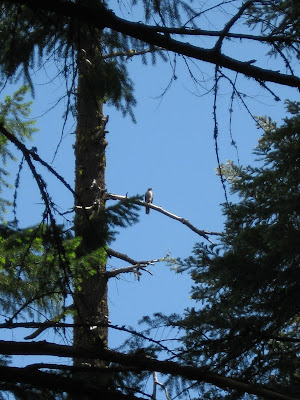
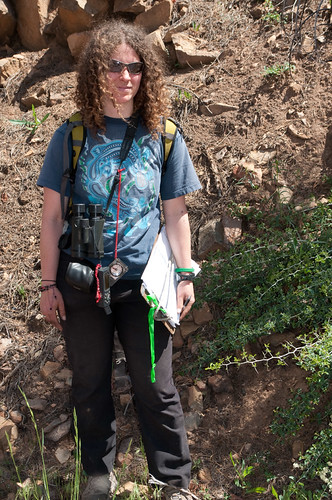
comment 0

The Montlake Fill

There’s something about the garbage heap I am strolling over.  It’s in the middle of the city yet it holds the fascination of so many people, birders and otherwise.  The contrast of ecologically bleak city of cement to the even vaguely wild is enough to get the blandest of mind churning about nature.  I’ll admit it – I love the Montlake Fill.

The Union Bay Natural Area is the proper title for this little drop of land.  From 1926 to 1965 it was actually a dump that the City of Seattle graciously pushed over with soil (hence the “Fill” part of the name) and attempted to landscape.  I don’t know about calling it a natural area.  Between the covered over refuse (I’m sure there is some nasty crap down there) and the exposure of more land with the lowering of Lake Washington’s water table as the Ballard Locks were constructed, it doesn’t seem the pinnacle of natural acreage.  Then there’s the many invasive plant species that the University of Washington is valiantly attempting to eradicate.  In all honestly the places they’ve quote on quote “restored” seem to have the least amount of birds.

But regardless of the seemingly pointless tampering or silly new names, the Fill is spectacular for seeing a bit of nature in the city.  Even on a rainy, early November day, I got the urge to bike down the hill from my house to see what I could stir up.  It turned out pretty well.

Bald Eagles aren’t my favorite birds but the pair that nests nearby don’t bother me.  They fly around twittering and scaring the ducks, but for the most part they actually behave like birds of prey and find their own food.  The gregarious American Widgeon seemed to get particularly anxious about this prospect and were in a frenzy of rubber ducky squeaking as I began my circuit of the main lot.  I’d somehow forgotten how beautiful the cream-colored cheeks of a male Widgeon are as the birds clambered back down to the lake.

Mount Rainier was half visible behind a veil of clouds on the other side of the water and I took a quick inventory of the ducks on the lake.  The usual culprits Scaup, Ruddy Ducks, Gadwall, Mallard, and Buffleheads were all floating about in the bay, tranquil after their scare earlier.  A few Northern Pintail were also about along with some Ring-necked Ducks.  Marsh Wrens rattled from the cattails and a Great Blue Heron sat sentinel over a patch of shoreline.  The smell of fresh rain and lakeside decay is a smell I envy these animals who live it.

The beauty of birding in the city is that it can relieve so much tension from your day.  It’s an escape you begin to relish on a normal schedule.  A quick duck off from work (like my lunch break at a hotel I used to work at) and the sights and sounds brought tranquility.  Everything melted away.  I think there is a great deal of wisdom in this.  Although so much is going on in a nature setting, the grind of the desk or of driving in traffic so much less eloquent.  After all people go on retreats to the country not Los Angeles.

A group of joggers crushed by on the gravel trail as I stood pishing at a willow.  To them it looked like I was making odd noises at a tree.  From my perspective I was imitating a avian alarm call to excite the Audubon’s Warblers into coming to take a look at me.  Who knows, maybe there was a Palm Warbler with them.  I wouldn’t scoff at a bit of color on this dreary day.

Speaking of color there was the potential for Wood Ducks at the cut of water across from University of Washington’s Husky Stadium.  No such luck, but the male Green-winged Teal preening on the shore were certainly nice too – so tiny but so full of pattern.  A Merlin zoomed past, probably after starlings in the UW parking lot.

Some birds were flying over and one in particular caught my attention.  Its undulating flight wasn’t quite right for a woodpecker and I followed the black and white bird to a small shrub.  A nice looking first year Northern Shrike!  I’d heard about this bird but it’d stayed an enigma in recent visits.  Two more birds flew over, calling as they did – Horned Larks!  Things were starting to get a bit more interesting, just as I needed to get going.

Another wonderful thing about urban birding is that it fits in with our busy schedules.  While I don’t condone the anxiety-ridden existence of the harried suit clad modern society aspires to, I still have to pretend to function coherently alongside.  A quick dip into the Fill is doable from a busy urbanite’s perspective (I cringe at even offhandedly calling myself a blasted urbanite).

Walking back to my bike I peeked at some Hooded Mergansers and Pied-billed Grebe on the final pond of the loop.  Cedar Waxwings called overhead, their masses growing with the changing of the season.  Rain began to drive down as I got on my bike and peddled away from my streak of daily nature.  Every spot at the fill holds special memories of my formative years as a birder, naturalist, and person of inspiration.   These sorts of places are a blessing and I wish every kid had a place like this growing up.  It may not be so “natural” but it sure is full of nature.

comments 2

Birding East of the Mountains: Chasing birds?

(a quick preface – things have been busy and trying – moving back to the city, finding a place to live, and getting settled at new jobs has pushed things back by months, I promise it won’t happen again.  Thanks for reading!)

No light, cascades of rain, and a car occupied by the mumbling, weary.  I would probably be sleeping but the anxiety of the nearly invisible, discarded tire between lanes thrust me into full lucidity.  The rain tore through the foothills.

My two friends Ryan Merril, Charlie Wright and I were headed to Eastern Washington.  That’s a very vague term that I place upon anything east of the Cascade crest.  Really it’s the central part of the state that will occupy our day.  We are out birding.

The sky began to lighten after we crossed Snoqualmie Pass on I-90 and we escaped the dirge of rain slamming into the car.  Our first stop was to be a quick peruse of the Cle Ellum area.  A Northern Mockingbird had been staying at the Sauk Prairie Grange.  The bird was easily located, looking chilled on the damp morning.  I could tell it wasn’t going to live much longer, with frayed tail feathers.  No molt is a bad omen for a bird in the wrong place this time of year.

Hawks still grounded by the chill, we passed through the beginning of sage country.  Charlie and Ryan gossiped about their places on the Rare Bird Committee of Washington.  About county records, state records, dates, people, and what they perceived as unforgivable ignorance.  I had to stay my eyes and mouth, both easily rolled in the presence of what I really felt crude refining of ornithology.  Don’t get me wrong, these two are highly knowledgeable, expert observers but I felt like I was sitting with baseball fans more than bird lovers at times.  They are still far and above better birding companions than many!

Kittitas, the current county we were in was difficult to find shorebirds in being land locked and directly east of the Cascades.  Long-billed Curlews were summer residents, breeding in the fields and the ubiquitous Killdeer was difficult to ignore but beyond that shorebirding was tenuous.  A friend had reported a field with a Golden Plover and thousands of Killdeer.  Worth a look but unfortunately it wasn’t as fruitful for us.

Our real pursuit (apart from escaping Westside rain) was to examine the songbirds that were surely moving along the migratory luge the Columbia River creates.  Vantage, a favorite spot of mine, lays on the west shore and turned up a few birds on interested.  Through the pishing of my companions we heard a Western Screech Owl, who murmured groggily, in response.  Four Townsend’s Solitaire peered at us curiously, three with the last vestiges of their immature plumage peaking through their mantle.  A Rock Wren clattered away in the basalt cliffs.  The sun shone through the bluster of high clouds.

We observed the clutter of coots and other waterfowl, likely in the tens of thousands south of the I-90 bridge crossing.  Joking that there was probably a Tufted Duck amongst them, I at least didn’t have the patience to pick apart every Scaup I saw.  Time to head across the water and start looking for more songbirds.

On the other side of the mighty Columbia we teased apart every group of songbirds we could.  A few late Orange-crowned warblers were at the Sentinel Bluffs (a new, strangely eerie spot for me).  Both a ‘Taiga” race and a typical “Pacific” present were noteworthy.  An odd chip that was very much a Waterthrush piqued our interest but we couldn’t get the bird to call again.

More dissection of spots that only bums and local fishermen visited.  Loads of White-crowed Sparrows, the ever-present Audubon’s Warbler and a few of their components the Myrtle were sallying forth.  A lone Wilson’s Warbler was siphoned through the dense willow stand.

Our day ended and my friends were still talking about records, I also couldn’t help but join in a bit.  Of course this wasn’t about the birds themselves but the numbers and dates.  It makes me question my devotion to this thing called birding.  I’ve drifted from the kid that began with birds through competition and listing.  Counting birds is useful but it’s not the end all to my avian adventures.  Although I find it useful to enjoy the uniqueness of a bird showing up in the wrong place at the wrong time, I no longer celebrate it’s arrival.  That lonely Mockingbird, made me sad.

So I tend to want to tear myself away from the people that preach the record.  Do they actually like birds?  I know Ryan and Charlie do, although their obsessions for numbers tend to veil their passion for the animal.  And there are people I know don’t actually like the birds, just the sport.  I question the validity of constantly chasing birds.  I bore of scanning the flocks for the errant.  Why not scan to understand their habits?  Although the knowledge of distribution is a valid part comprehension that I build on, it isn’t the total.  I found myself laughing at a Ruby-crowed Kinglet as it hovers, gleaning branches while my companions glower about a misidentified rare bird they had to go over on their committee.

I suppose my point is that I don’t know where I stand.  Their intellectual pursuits can seem pretty hollow to me, like baseball analytics. It doesn’t typically preach sustainability, conservation, or helping spread the dogma of proper science in the public.  In fact the way they talk about birds, birders, and birding makes me think they could actively discourage people from starting out (but I also know those quips are in confidence and are not aired publicly and I certainly share them often as well).  Understanding distribution can help shape population studies and push conservation from a citizen science perspective certainly.  That is worthy, but is that the goal of most birders?

My uncertainty is staid by the fact that I love going birding (amongst the million other things I proclaim I love).  Ryan and Charlie are great companions in the field and are people that share a common love, despite seemingly different implications.  The joy I get from watching beautiful birds going about their day, these epic realizations of evolutionary trend, I’ll be out there getting wet, cold, and yes – chasing birds!

comment 0

The Chase (Simone)

The sound of my alarm jostled me awake in the predawn quiet at camp. My room was cold and I could think of nothing more dreadful than getting out of my warm sleeping bag at this ungodly hour. But we had transects to complete in the Storrie Fire and it would be a long drive to get there. I readied quickly and we were on the road before I even felt fully awake. We bumped along the Forest Service road and were gaining elevation fast. As we neared my transect we could all tell it wouldn’t be doable, at least with the coordinates given. I would have to move the transect and the road looked like the only way to do it. That was ok with me; I had just had a few days of intense hiking.

Doug and Brendan dropped me off and I started my point counts. It would be an understatement to say there were birds everywhere. There were snags but they were not dense. The ground was so thick with White Thorn and Deer Brush that you were lucky to see patches of soil anywhere. The morning was crisp and bird song was everywhere. Fox Sparrows, Spotted Towhees, Black-headed Grosbeaks, Lazuli Buntings and House Wrens made up the majority of the chorus. As I made my way down the road Orange-crowned Warblers literally dripped out of the Deer Brush flanking the road. I’ve noticed that moths and their caterpillars heavily favor Deer Brush and one can quickly make the connection that this is why the warblers (and other species) rely on fields of Deer Brush as well. At one point I counted over 10 Orange-crowned Warblers come out of one bush with others appearing all around as well. I’ve really never seen anything like it.

After my point counts I started my woodpecker surveys. It wasn’t long before I found an active Northern Flicker nest with almost ready-to-fledge chicks. I sat below the nest and immediately the White Thorn and Deer Brush concealed most of me. The flickers weren’t oblivious of course and were wary of coming to the nest but eventually made their way there to feed the raucous chicks. As I scribbled notes about the nest I heard a jet in the valley that lay in front of me. I almost ignored it. What was a jet doing up here anyway? It seemed like a strange place for a jet-there was forest, ravines, rivers and mountains for as far as the eye could see and it seemed like a dangerous place for a jet to be maneuvering.

As I looked to the sky in front of me it took my brain a few seconds to process what exactly was going on. There, perhaps 500 feet in front of me (above the slope that ran towards the river) was a Peregrine Falcon stooping at break-neck speed. She was going so fast that I could barely keep my eyes on her. Seconds later a second and then third bird appeared in my vision. Again it took me a few seconds to process the scene as the three birds dove, twisted and turned. Soon it was apparent that the second bird was the male peregrine and he was chasing a Rock Dove right under his mate! I lost them for a second in the binos. I worried I would miss all the action but lucked out as I caught them in the binos again just as the female Peregrine Falcon slammed into the pigeon with the force of a freight train hitting a VW Bug at full speed. The sound of the falcon hitting the pigeon mirrored that of a loud gunshot over the valley and was quickly followed by an explosion of feathers. The female falcon leveled out and as she zoomed off down the valley I could see her bring the pigeon to her chest with both feet, break its neck with her notched bill and disappear. The male was small and sleek, built just like a feathered missile and he zoomed up almost over me, did what seemed like a victory loop and disappeared to follow his mate.

Again, as I seem to be finding quite frequently in the Sierra Nevada, I was left completely speechless. No one else had witnessed this, would they even believe me? Would I ever see such a sight again in such a beautiful and remote setting? I doubted it.

comment 0

What’s a Point Count? (Brendan)

Over our past posts we mentioned our employment is watching birds or specifically that we are “point counting”.  However there has been scant attention paid to what a point count actually is.  I suppose for those of you actually following along yet unsure what this means, it might be helpful for me to diminish those uncertainties.

Six agonizing days a week we wake up before dawn, shove and drain various edibles into our gullets and swerve our ways down treacherous forest service roads to the given transect for the day.  This can involve anywhere from a 15 minute drive to a two and a half hour slog to a distant treatment unit.  When your GPS gets it through it’s dense plastic case that you actually want to find your first point of the day and not stumble about in the dawn light – you start counting birds.

Point counting is a general survey technique that demonstrates the diversity and population size of each species of bird in our area.  We walk the transect (read: imaginary line in the forest) and stop at specific points dictated by our GPS (and the previous jackasses who were supposed to make the point easy to find with ample flagging).  At each point our protocol specifies that we count for five minutes and record the exact distance of every bird (within 300 meters) and our first means of noticing them (song, call, visual, etc.).  This is all well and good until you get out there and realize you can’t see every bird to estimate its distance.

So, yes, really we get paid to listen to birds.  But we honestly don’t see all that many birds walking a count.  If you know what a bird is by song or call, that’s the end of it and you don’t chase it down.  I for one have developed quite the profundity at estimating (making up a number) how far a bird is from me.

There are two pieces of a larger project we are working on this season.  One has been going on for around 12 years and the other, which is now in its infancy, has been ushered it into life as with us acting proverbial midwives.  The Plumas point counts are going into a larger management plan of the Plumas and Lassen National Forests (PLAS) with surveys of birds, mammals, and plants going into their decisions.  It generally is trying to give proper information to restore the Sierras into an ecologically sound mosaic of varied age diverse forests, meadows, and shrublands.  Often there is a focus on old growth only, which only supports a handful the native species in the area.  The “Burn Project” started this year and we are setting up all the transects for it.  It is an addition to the overall Plumas forest plan and intends to address how the various fires have affected the landscape and how future fire management can be enacted responsibly.  While the Plumas point counts are fairly straight forward there’s a little more involved in the Burn work.  This is of course work for Point Reyes Bird Observatory who contracts  for the Forest Service.

Our goal as point counters in burns is to sample the species in the three fires in our area:  The Moonlight Burn (2 years old), the Storrie Burn (8 years old), and the Cub Burn (1 year old).  Despite the physical difficulties that burns can present, there are often birds you don’t see anywhere in high numbers like Lazuli Buntings, Lewis’s Woodpeckers, and even the odd Ash-throated Flycatcher. We do shorter point counts however to leave time for a cavity search within 100 meters on either side of our transect seeking out active cavities.  Woodpeckers most often use (and make) these but other birds secondarily use cavities being ill-equipped to excavate themselves and will invade burn areas as well.  Various owls, both Western and Mountain Bluebirds, and Kestrels are birds we expect to find living in burnt areas – often where, I might add, they normally wouldn’t reside.  Burns are FULL of insects for good eats and the decaying wood provides easier excavation.

So there you have it: a brief view of our work this season.  We will also be writing a three part series on our abhorrence and/or enjoyment of surveying these fires.  Each. Due to age, intensity of, and the landscape that the fire engulfed has unique qualities.  Fire ecology is an integral part of the Western North American landscape and I at least feel lucky to have an opportunity to see first hand how some of it works.  Humans are ever struggling to understand and appreciate fires but it’s hard to not vilify something we are just beginning to grasp and which can blindly erase whole swaths of humanity and wilderness.

comment 0

Accipiter Magic (Simone)

After my transect at Slate Creek I took a long drink of water at my last point and checked my topo map for the quickest way to the road where I was to meet Brendan. Southwest is where the map and compass pointed me and I headed down the hill towards a small creek. I noticed that there was a steep hill on the other side of the creek and winced because my calves still screamed in protest when I hiked uphill due to our earlier death-march hike to (as we found out at the top) some un-reachable transects. But I digress.

Making my way down the hill I was suddenly being screamed at VERY loudly by an extremely pissed off adult goshawk! What?! Another one of those I-cannot-believe-this-is-happening moments.  I knew immediately that I was very close to a nest. A goshawk that didn’t have a nest to defend would most likely flee a human immediately. But mothering instincts take over during the late spring and she was going to make sure she made it very clear to me that she was not happy and made it even more clear by stooping at me. I stood still and watched as she dove at me, pulled up and landed across the stream and farther away. I looked around but didn’t see a nest.

Female Northern Goshawk

After she had calmed down a bit I walked farther upstream by only about 50 feet. There, in a mature Doug Fir, sat a nest in a gnarled branch about 30 feet up. I knew that goshawks build multiple nests and don’t use the same one every season so I was not positive this one was active. Upon closer inspection however I could see a down feather blowing in the breeze from the branches and noted that some of the nest was made up of live Doug Fir branches-definitely a good sign! I had been looking up at the bird and nest for some time before I realized there was even more evidence of activity at my feet. Droppings were splattered all around the ground below the nest! Now I was excited beyond anything I can really describe accurately.

The Nest

The nest was so low…would I be able to see chicks or eggs if I climbed the hill across the creek? I took some video and photos and the adult goshawk tolerated it surprisingly well although she did cuss me out once more as I lingered below the nest before heading up the hill. As I clambered up the hill, the intense pain in my calves long since forgotten, I could tell I was going to be able to see into the nest!

I made it halfway up the hill and stopped and turned around, barely able to balance because of the slope and my excitement. There before my eyes across the creek in the nest were two white, fluffy goshawk chicks!! I could not believe my luck. It would have been enough to just see an adult goshawk as close as she had just been to me. And of course the nest and nesting area was a bonus. Even just knowing that there were probably eggs or chicks in the nest would have been enough. But to be able to look into the nest and see two healthy approximately two week old chicks was almost more than I could handle.

Two Chicks!

I checked to see what the female was up to as I hadn’t heard her in a while. She was perched on a tree next to me on the hill and seemed way less concerned with me-she even had her back to me. I watched the chicks in complete admiration and grinned to myself-I had just found the best goshawk nest EVER!

I couldn’t wait to tell Brendan and the rest of the crew. After I had watched the chicks and female long enough to register that it was all really true I continued up the hill. I didn’t want to bother them too much and wasn’t sure if the male was hanging back with a food delivery. This was truly unbelievable and a wonderful discovery. A chance of a lifetime even. Usually you have to climb an adjacent tree to see into a goshawk nest and risk life and limb because of the wrath of the female goshawk that most often has no mercy. When Brendan picked me up I of course could not contain myself and we agreed to come back soon and film the chicks and hopefully adults. I spent the rest of the day thinking about my luck in stumbling upon a perfect goshawk nest and wondered if there was really anything that could beat something as special and precious as that.

Mom

comment 0

Glimpses of Grey Ghosts (Simone)

After finishing my transect this morning I wandered the road watching a Steller’s Jay that was obviously up to something sneaky (stealing nestlings?), tried to find a drumming Pileated Woodpecker and although I heard a Hutton’s Vireo quite close (“tree! tree! tree! tree!”) I knew it would be next to impossible to catch a glimpse of it. Soon I heard a vehicle approaching. Although I may sound like a paranoid freak in the next sentence I suppose you can never be too careful. I knew it wasn’t Joe (who was due to pick me up) so I started up the small hill above the road where I wouldn’t be seen and stood behind a tree. A white Volkswagen rumbled up the winding road, leaving a trail of dust behind it as it went. Probably just some Hippies looking for adventure.

Now that I was up on the hill I thought perhaps I could finally catch sight of the Hutton’s Vireo still shouting “tree! tree! tree! tree!” at the top of the conifers across the road. After counting the rings on a cut stump of over 100 years and marveling at what this forest must have looked like back then I wandered a bit and settled below a live Sugar Pine on the small hill over-looking the road. Now the road was about 15 feet below me. It curved sharply to the left and out of sight but I had a view of about 20-30ft to the right down the road. I figured this way at least I would be out of sight but still able to spot Joe if he came down the road. Across the road was a dense line of young Douglas Firs, probably relishing the disturbance the road had created. Farther on beyond the young firs the forest opened up to mature firs, pines and cedars. Yet farther on a small stream picked its way through boulders, berms and downed trees.

The radio crackled again and Joe said he was fighting his way through a manzanita field and was still two points out. I didn’t mind at all as it was starting to get nice out and there were many birds around. As I sat on the hill I decided to do some goshawk calls, as I do whenever I’m waiting around and think the habitat looks right or even marginal. You just never know. I called a few times and thought it sounded pretty good! “Kak kak kak kak KAK KAK KAK” I then thought to myself how perfect it would be if a Mountain Lion would walk down the road right now, never sensing me but I would have the perfect view. The same with a goshawk or even a bear. Soon I noticed a neat piece of Sugar Pine bark laying next to me and picked it up. It looked exactly like a thick layer of puzzle pieces. I picked it apart and made a few more rounds of goshawk calls. Soon the bark was in little pieces everywhere and I brushed them off my pants.

At that moment something made me look up and straight ahead even though I didn’t hear anything. No more than 10 seconds later a gorgeous/stunning/striking/beautiful/perfect/red-eyes-glowing adult Northern Goshawk came barreling out of the woods, straight though the young Doug Firs without so much as displacing a needle from its resting place. She was coming right at me but below eye level, I don’t think she ever saw me. Once she hit the road she was perhaps 10-12 feet from me and banking to her left to head down the road. As she silently glided down the road, with wing beats so fast I didn’t even register them, she glanced back over her left shoulder as if checking one more time for where the goshawk-like sound had come from. Not sensing anything (I suppose) she disappeared down the road and as suddenly and starling as she had appeared she was gone. It was then that I realized I had not been breathing.

Did that just really happen? The bird was so beautiful, so graceful and exactly what I had been hoping for that I couldn’t believe my luck. I called again after she had disappeared thinking maybe she would turn around and come check out the sound now that she was closer but if she did, I didn’t see her. I contemplated getting up and walking down the road to try and see if she had landed. But the moment had been so perfect already that I stayed right where I was. What happened in a span of 10 seconds had just been a highlight of my summer.

comment 0

The Book and the Bear (Brendan)

I have a bit of advice for those of you spending your days out in the forest.  Don’t read anything about any sort of animal attack the night before you venture out for a jaunt.  If it’s an excursion for pleasure you’ll quickly depart for the safety of your vehicle.  But some of us don’t have a choice because our work happens to coincide with being alone in the woods.

If you’ve been following the more recent chronicles on Wingtrip you know that Simone and I have voluntarily entered this situation.  In fact we coveted the opportunity to waltz about the wilderness.  But although the Sierra Nevada are fairly mundane say when compared to mountains of the Democratic Republic of the Congo, that’s not to say they aren’t without their dangers.

I myself tend to be a worrywart and I’ve spent countless nights recently biting my nails over Hantavirus.  Crying myself to sleep at the thought of dying from mouse droppings auspiciously near my food or nose (No – I didn’t see any mice or droppings – but I might be a hypochondriac).  I suspect I’ve kept my roommates up with my whimpering.  But in all honesty, while Black Bears were certainly within my range of concerns before beginning to read Bill Bryson’s A Walk in the Woods, they weren’t particularly high on the list.*

Bryson’s blasted book, which like all his books is hysterical (to the point of laughing out loud so much that you wet your bet at four in the afternoon) and a great read, has ruined bears for me.  Now when I hear a branch crack in my vicinity I start squirting adrenaline out of every orifice and suffer massive seizures.  His regaling of the merry and multiple bear attacks in his book have made it impossible for me to concentrate on my point counts.  Now when I see scat heavily laden with the remains of an omnivorous diet or that distinctive paw mark, my heart starts to beat like an obese 80 year old trying to run the new york marathon.  I rather think I prefer Cougars now – at least they just out right go for the kill.**

So my advice – from Simone and myself – is to avoid such whimsical stories of delight.  Ursus and el Oso can stay locked away in your subconscious for when you actually encounter one.  If you read A Walk in the Woods you’ll promptly defecate yourself to death just like Bryson would have.

*Since writing this Simone and I have both encountered bears.  They’ve all ran away as if we were firing mortar shells at them.

**I don’t want to add to any predjudice against bears or any other predators.  In the majority of cases they want little to do with you and Black Bears aren’t all out for your jugular.

comment 1

How (Not) to Do a Point Count (Simone)

It was chilly and grey out when Mel, Joe, and I left camp this morning, but the birds near our cabin were singing their hearts out…as per normal for around here. As we turned on some tunes to wake us up the rain started in earnest and the three of us started to have misgivings about the day. We do not do point counts when any “significant” amount of rain is falling and right now there was a “significant” amount of rain. A decision was made that we would go to my drop off point and see what the weather was doing by then.  Arriving at an intersection with my transect nearby (or so I thought), we waited about 10 minutes and the rain stopped pretty much all together. The concensus was that it was probably ok to start point counts now. I hopped out with the agreement that we would quit and come back to this intersection if the rain really started up again. I headed off down an old road.

My first point was 2.71km away! At least I didn’t have to crash through the woods to find it. However, it had been raining steadily before I arrived so all the shrubbery was soaking wet, dripping wet, and very attracted to my clothing. As I meandered (aka walked briskly) down the road I could see that this road was a favorite of bears. There was scat everywhere and it didn’t look very old either. The road was not completely overgrown but it was pretty darn close and even in the places where it wasn’t, the shrubs bent over into the road from the weight of the water. It was obvious that I was going to have to go straight through these soaking wet shrubs. At least they were –somewhat- easy to push aside. I figured I was making enough noise walking to scare away any bears in the vicinity. But I whistled and yelled here and there just in case. As I crashed through the brush all I could think about was coming face to face with a bear in the overgrown road. Who would be more scared? Would the bear run away in fright or try to smack me in the face with a huge, sharp-clawed paw? It would be quite comical to watch this unfold from far away but I wasn’t really in the mood to find out in reality. Then or ever.
I was pretty wet even before I got to my first point (at the end of the road, down the hill, in the middle of nowhere, probably surrounded by bears with no cell phone service). That’s just when the rain decided to pick up. At first it was a sprinkle but then it was pretty much a downpour. I decided to do the point anyway and see what the bird numbers looked like. I was pleased to see that I was still getting a good number of species (around 12 per point) so I decided to press on. I had been quite thoughtless and was wearing cotton pants and a tee-shirt and sweatshirt. I was thoroughly soaked by the time I was done with about a third of my points. Back up the road I went and it was harder to hike now because the water felt like it had added about 183 pounds of weight. But the area was quite birdy and I decided to focus on that rather than the fact that I was (probably) surrounded by bears, (definitely) soaking wet and (definitely) at least two miles from a drivable road. I decided to grab a big stick to ward off predators and to shake the water off the brush before I attempted to swim through it, most likely narrowly avoiding angry bears. By now I had been hiking for about 2 hours in the rain and rain-covered foliage. I wasn’t cold yet (I was always moving) but it was a bit uncomfortable. At one point as I attempted to push though the thick, soaking wet willows and other shrubs I just closed my eyes and barreled through. The long, thin branches smacked me in the face and a bug was flung into my mouth in the process. As I emerged spitting from the tangle of overgrowth my hair was stuck in all kinds of strange ways to my face and I marveled at the fact that my hair hadn’t taken one of the entire willow plants with it.

I finally made it through to the open part of the road again and thought to myself how silly I must look. I had a large stick, a GPS, a soaking wet backpack, crazy hair and to top it off – drenched pants and a sweatshirt that was peppered with willow inflorescences, dead bugs, leaves, and small sticks. I was beginning to think perhaps a bear would be way more afraid of me than me of him due to my insane appearance that had taken very little effort to achieve. Even so, during these transects that are surrounded by thick brush and/or are impossible to see more 20 feet into diameter around, the adrenalin is coursing through your body. Not so much as it would be if you came face to face with a bear or other large predator but enough that when you hear a train in the distance, Blue Grouse drumming, branch snap, raindrop hit a Big Leaf Maple, or Anna’s Hummingbird whiz by your head you stop breathing for a moment to get a better handle on the noise. Thus I thought, “What exactly am I doing out here?” Oh right, I’m getting paid to look at birds!

Say it like that and it sounds easy, way too easy. Now if you add to “look at birds” with: clamber up and down mountains, battle sword-like dead manzanitas, camp in the blowing wind and rain on the top of a ridge, watch for bears and mountain lions, navigate in the wilderness with a compass and a sometimes working GPS, fall face first into streams, stumble down shale-covered hills, get completely turned around and head away from the road on accident because every tree and meadow looks like every other tree and meadow, hike in the blazing sun with no cover, hike in the steady rain with no cover, battle through shrub fields that make you feel as though someone is trying to play a horrible trick on you or has perhaps thrown you into a video game where the end has already been decided and no, you don’t win, try to concentrate on listening to birds with heavy machinery, loud streams, trains, Cassin’s Vireos that won’t shut up, scolding Steller’s Jays, Wild Turkeys making a ruckus that sounds like a turkey riding a donkey with a harmonica down a mountain in the background, oh yes, did I mention this all starts between 5 and 6am?

What do you say? This all sounds quite stressful and hard, maybe not worth it? Well, no, of course not! To all this there must be added the endless array of wildflowers emerging with such a burst of colors that you can hardly stand to look at them sometimes, the male songbirds perched on their favorite branches, beak to the sky and chests puffed out, singing their hearts out for all they’re worth, the sunrise breaking over the hills of unbroken forest, the mist-shrouded hills and rocky cliffs where you know a mountain lion must make its home, the tightly woven and perfectly round nest of the Dusky Flycatcher nest in a dead manzanita in a severely burned forest that shows you that life goes on no matter what the circumstances, the Steller’s Jay chicks growing so fast you can barely believe, the countless number of streams flowing slowly but steadily towards their final place. All of these things make the terrain in the Sierra stunning, dangerous, breath-taking, unique, unforgiving and pretty unbelievable anyway you look at it. So yes, I get paid to look at birds but there are a few other things I get paid to do as well and the birds are just the beginning…

comment 0

This Day Won’t Come Again (Simone)

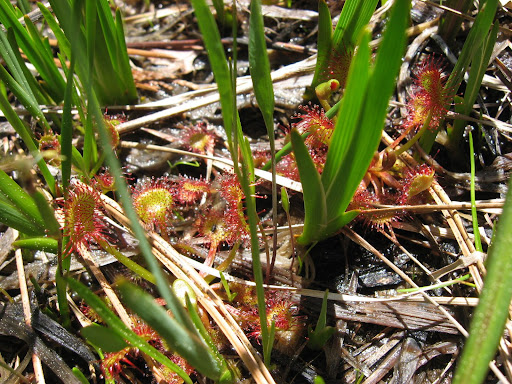
This morning Brendan, Mel and I headed to Butterfly Valley Road to check out the Darlingtonia and sundews. The habitat was quite rocky and dry at first and I wasn’t sure if we were really in the right place. However, after a couple of miles up the hill I spotted some Darlingtonia on the side of the road in a very small and slow moving stream. We jumped out. It was already in the 90’s probably. The Darlingtonia were EVERYWHERE! I was in heaven. I feel fortunate that I can get excited about a single plant or bird or tree. I suppose it might sound silly to some (though not most of my friends). Why are some people so moved by the natural world and others could care less? I’m not sure if it has to do mostly with upbringing or just a certain spark that moves them. Who knows?

I was so excited to see these Darlingtonias because I wasn’t expecting them in this part of California or to be this close to our home base. The pitchers were huge. Most were about 2’ and flowering! It was heaven! Among the Darlingtonias, Camas were growing and some were getting ready to bloom. Labrador Tea (a relative of Rhododendron) and a species of Iris were also growing among the carnivorous plants. The Darlingtonia made their way up the hill where a spring was seeping although the ones in the sun (and it was SUNNY out!) did not look as healthy and were not as big. I did not realize how much shade they obviously prefer.

Farther down the road on the other side a valley opened up with yet MORE Darlingtonias. We hopped out again to investigate. I knew the sundews wouldn’t be in the shade or growing where the Darlingtonia were so thick, so we were hoping they were at this sunnier and more open location. We followed a small trail down to the valley and I noticed a few Sundews almost immediately! There were actually not that many so perhaps there was a hot spot somewhere else but we were happy to find these few. The dew sparkled in the sun and the plants looked healthy. The Darlingtonias here were also shorter and more weathered because of the intense sun. I noticed that the pines (will have to check on species but a species of yellow?) in the Darlingtonia area looked like what I am used to seeing in the Pine Barrens. The soil nutrients are constantly on the move because of the spring and don’t have a chance to settle. This is why the Darlingtonias have evolved a system of trapping their own nutrients. The pines were stunted by the lack of nutrients and until they figure out how to be carnivorous I guess they’ll just have to stay that way!

All in all it was a wonderful morning-midday exploration. I cannot believe my luck landing a job surrounded by birds, great people, stunning landscapes and some of my favorite wacky plants and wildflowers. In all honesty I feel a bit guilty because I can safely say right at this very moment that life is pretty perfect. But I know that the outside world and its problems hover ever so close and this won’t last forever. Sometimes it’s hard for me to slow down and live in the moment, soak up the experience as it is happening and take it in for what it is. I’m trying harder to do this here and it isn’t difficult. I know that I’ll go back to Seattle and long for the experiences and feelings I have here with relatively no news from the outside world, no traffic, no TVs, nothing to distract me from what I truly love – the outdoors, the birds, fungi, plants, streams with all of it woven together in an amazing, constantly changing and moving yet stable tapestry of life. I know, I know, sounds corny but there is nothing that makes me happier than finding that bird nest with four blue, beautifully speckled eggs, the Darlingtonia leaf arched perfectly in the sun ray though the woods waiting for the next insect, the leafless orchid stem shooting through the leaf litter to open it’s intricate but often overlooked flowers, the busy colony of ants moving up and down a tree trunk unnoticed, the pile of soft blue feathers left by a stealthy top predator (can you say goshawk?) or the Dipper standing on one leg on a stone in the rushing stream singing his heart out as his fledglings explore their new world nearby and under his watchful eye.

You can find these things almost anywhere but a relatively intact ecosystem is where it all really shines though. I try to get to these places more often than not. What else do we have? Why not enjoy, appreciate and protect it while we can. This day won’t come again.

comment 0

Day Four on the Road to Chester (Brendan)

We had been toying with the idea of going through Lassen National Park enroute to Chester, where our job training would start.  I was a bit anxious to just get there because Simone had lost her confidence in driving stick during a mishap a couple year ago, leaving me to pilot the entire trip.  We rose at sunrise and crammed back into the truck for the final leg of our journey.

Birding along the way south didn’t prove all that fruitful but we did find a large group of Elk bedded down along 101.  It was an unfamiliar oddity to see them in a field nex to horses, adjacent to the highway, and completely unconcerned.  I couldn’t help but fret a little bit about an accidental collision with a bull elk.

Aracata came and went as we headed up into the Coast Ranges.  The climb was putting some serious stress on the overloaded vehicle, which made for a white-knuckle drive until we crested and headed into the rain shadow.  A landscape thriving off ocean driven moisture transformed rapidly into pine dominated red soil with the amethyst Redbud dotting the hillsides.  The Trinity River follows highway 299 most of the way into Redding and once you’ve slid down lower its teal waters combined with the blooming Redbud were eye-catching to say the least.

Before we knew it we were down into Redding and back on I-5 South through the upper Valley.  It was a bit of a shock going from the cool winding mountain lanes to a huge freeway in the hot lowlands.  I was anxious to get back into the mountains and we soon were.

Highway 36 took us through open fields with Oak woodlands on either side.  Giant rocks stood alone in the middle of fields, a reminder that a volcano was nearby and had once flung these erratics 60some miles away during eruption.  Western Kingbirds and Bluebirds abound in the open areas and soon we were climbing again.  Worrying about my aging truck, I had to remind myself to enjoy the landscape as Lassen came into view.  The woodlands transitioned into tall pines and fir with the occasional mountain meadow.  This was going to be an amazing place to work for the summer!

Chester was only ten miles away when we hit the cabins we’d be staying at initially.  Although it seemed like it should be open, ready to live in, the place was apparently deserted.  The only cabin open was a trailer in disrepair and full of mouse droppings.  Fearing hanta virus, we vowed to sleep outside and went into Chester for dinner.

Back at the cabins, there was still no sign of anyone and we started to get a little anxious.  Two friends alone with deserted cabins and a lonely highway – it sounded like the premise of some horror movie.  It was then that I remembered I had seen Cougar tracks on the property and thoughtlessly mentioned this to Simone.  The look of horror on her face was hastened me to offer to let her sleep in the truck and to take the edge off we watched some of Attenborough’s Life in Cold Blood before a restless, worrisome night of sleep.  I kept waking up expecting to find some deranged mountain man asking why we were sleeping in yard.