comment 1

The Boeing Creek Mystery

The dogs charged ahead of me. Switch backing down to Boeing creek, tearing through end of summer dust, leaving me a dirt curtain to huff. The creek itself pushes eventually down to hidden lake, carrying any available urban effluvia with it. Several weeks without rain hasn’t staid the flow and the lake has warnings about high levels of potentially harmful chemicals. Moisture crept about me as I descended to the bed, following a trail of growls and barks and splashes.

Despite all the dog noise, I felt the calm of a quiet place. Set aside by William Boeing when he purchased and built his mansion here in 1913, the habitat escaped some typical developments. Relict old growth Douglas fir and western hemlock plodded the slopes through the park. I twisted by them, looking up in childish awe, following redirected water over culverts. I kicked up glacial silt which the Puget Lobe ground into hills surrounding the current day Salish Sea, our Puget Sound. Fifteen thousand years ago, there would have been at least a couple thousand feet of ice over my head. A river would have been where the sound was before the continental ice sheet intruded and carved out the contemporary topography.

Lost in thought, enjoying lime sunlight filtered through devil’s club leaves, I realized I’d not heard the dogs in awhile. You may have misgivings about my dogs being off leash in a park. Sometimes I do too. Yet, there are greater evils in the world to worry about than dogs running loose in a half-wild city park. I agree with leashing dogs in true wilderness, but I enjoy the happy freedom of walking trails here with them bounding ahead. That said, they occasionally get into trouble, in the form of things not intended for consumption or things rubbed into fur that clashed with human olfactory sensitivities. When there wasn’t barking or jingling tags, I became worried.

Behind an indian plum, beneath a western red cedar, the dogs stood still snuffling. Something had caught their interest. Their noses directed at a pile of feathers. My first concern was that they’d killed something. However, sticks had been crossed atop a splayed corpse, alleviating my fears but also piquing my curiosity.

“Get. Go on, get. Lobo. Lilly. Get.”

Subservient glances, dropped wagging tails and ears, unsure backing away. I’d caught them before they’d rolled in whatever it was. Flies were swarming, their larvae writhed over dusky, brown and tan mottled feathers. Prodding with a stick, I uncovered identity. This wasn’t just any dead bird my canid friends had found, this was a great-horned owl (bubo virginianus).

How did it get here?

My extensive forensic training told me at least one thing, someone else had found this bird and put sticks over it, likely to deter future dog investigators. Another thing was obvious, this wasn’t a fresh kill. The body was slumped, pungent with decay, feathers soiled in rancid grease. It was in such a low, enclosed area that I could hardly see it having sat there in a weakened state, died, and fell to the ground.

Quite the mystery.

Did a person kill it? Was it sick?

I’ve got a theory. There’s been barred owls about the park. While I wasn’t around for their breeding season, I have reason to believe that they did breed there, based off what my parents told me. Barred owls can be extremely aggressive and while I’ve never heard of one killing a great-horned owl, I wouldn’t put it past them.

I’ll never really know. Yet, I like that it highlights how much nature can be in a small city park (at least two species of owls!).


Surreptitiously scooping up the body into a bag (to take to the Burke Museum or Seattle Audubon), I walked down to Hidden Lake. In November, bufflehead join the constant flock of mallards here. Stern warnings kept Lilly from trying to catch mallards in eclipse plumage, lacking flight to properly escape.

Sword ferns crashed aside as the dogs skittered up the hill, away from the lake. Distant lawn mowers hummed, a symptom of a dry day in Seattle. The disturbed land adjacent a playing field, now overtaken with invasive plants, was full of flickers, cedar waxwings, and house finches after seeds, fruits, and insects. Budlea, butterfly bushes, pleasant but still invasive, perfumed the narrow path. A Cooper’s hawk flew over with strong, rapid beats and the birds scattered for cover, unconcerned if the plants were native or not.

The dogs disappeared into the scotch broom. The leguminous seed pods popped in the heat, ready to disperse. People might then decide they needed to be pulled up, creating a perfect disturbed substrate for more reseeding and spreading. A feedback loop of failed attempts to control our mistakes. Scotch broom was great for stabilizing hillsides during road construction, but it’s a menace to those desiring the contrived purity of a native landscape. I can’t say I like it or want it choking out other plants, but sometimes I think we should focus time and attention on places that haven’t been spoiled. The area around Boeing creek is never going to be “pristine” again.

The bag of bones and feathers swung at my side. Inside it was a perspiring mess, fogging the plastic. As stomach churning as it was to think about a decomposing body fogging up a plastic bag, it also masked the occupant quite nicely. I didn’t really feel like explaining myself.

Lilly perked up as we entered a nice stand of second growth. She’s a hunter and while I don’t really mind her catching the occasional rat or gray squirrel, I always like to make sure it isn’t something else. A large black bird jumped from one truck to another, thankfully out of reach of my mongrel. A male pileated woodpecker. He flew off into the forest with an echoing call.

Skipping a cut back through the official off-leash area (because I had an owl in a bag), I took a side trail. We trod down again, through a glade of indian plum and hazelnut, mixed with non-native Hawthorne, cherry, and holly. We scared a hairy woodpecker up off a fallen log. Besides the scuttling and occasional playful snarl of a dog, it was a quiet afternoon.

Just before reaching the parking lot, we crested a hill with a clear view of the glacier carved, west side of the Olympic mountains. In several months they’d be constantly veiled by low slung clouds. In winter I typically only see the peaks. They stand higher than weather over the sound.

Disliking being pulled away from tasty blackberries, I leashed the mutts and got back into the car. The owl sat passenger, curled talons catching my eye. Maybe people killed this owl, a regrettable thing. Maybe they didn’t and it fell to something else altogether. People can’t control everything, trying to is how we create problems. Might as well make the best of it as is and protect what’s left.

comments 3

Post Fire, Post Season

Seasons are built to move fast. Drag yourself through the early mornings for months, but one day wake to realize you’ve missed beating the sunrises, standing in still, frosty mornings, trunks towering, grass glistening. Nothing envelops being like the quiet of a morning chorus with humanity pulled into the forgotten depths by nature.

The Northern Sierras came and went for me. The flash and chortle of a half recognized woodpecker, gone before I could acknowledge or even take the time to appreciate it. Some of us drift off to another adventure, perpetuating our desire to never step off the path. The foolhardiest drift back to flip-side of their duality, almost immediately longing for the woods. To the sweat. To the bugs. To the endless summer.

There are plenty of unfortunate aspects of being a field biologist. Few jobs have benefits or pay a reliable, constant, livable wage. Most involve exertion at indecent hours of the day in unpleasant conditions. Those of us who love being outdoors can easily forget all of this when something momentous happens. Three years ago I came upon a Coyote and her den; two pups eying me with the thinly veiled curiosity of domestic puppies. Everything I could ever dream up to complain about became irrevocably inconsequential for weeks.

So, it was a good season, it was a bad season. The weather was shit for a month, we battled late snow, worried about endless salvage logging, washed out roads, and illegal pot farms. Getting home, I can easily forgive and forget. This was a good job, benign, well paying. Unlike the multitude of projects out there that never make a dent despite the funds they wield, we collected data that actually contributes to the guidance of forest management. Without sounding too sentimental or jingoistic, the Western forests are one of America’s best renewable resources. Being a part of something like this is plain sensible, as opposed to helping a graduate student study something that might soon become a forgotten paper or deemed superfluous by a body of their peers or superiors. (A myriad of valuable studies exists and I’m lucky to know some fine young scientists driving them, but that said, there’s a lot of crap too. Sorry, it’s true).

Eight species of woodpeckers were focal to our work in these burnt Sierra peaks and valleys. Two more were occasionally noted. This is astounding when you recognize there are only twenty-one (extant) woodpeckers in the entire United States and Canada. Seen regularly in appropriate habitats, one begins to maneuver alongside their behaviors. Taciturn parents on eggs, wildly frenetic when feeding young. Some birds you never figure out or before you’ve realized it, they give you the slip.

The two Red-breasted Sapsuckers quarreling in stubborn willows, cut by a derelict skid road, seemingly with nothing better to do besides play chicken on narrow branches and gape absurdly at one another for thirty minutes. The White-headed Woodpeckers that carried food away but always avoided my careful observations. As soon as I learned something I was humbled by how little I’d gathered.

I wasn’t the best out there. One of our goals was to find cavity use, more data points are better. I found the least nests in use this year. During a second time around most self-respecting individuals look to improve. This wasn’t all for lack of effort (don’t believe a damned word they tell you), maybe I’m just not good at finding nests. Yet, I understand fires, the Northern Sierras, woodpeckers, and forest management better than ever.

Seasons run their course and at the end you half wish they’d continue. I probably won’t go back and live in Meadow Valley, California despite my admiration for this sleepy town. Before the season began, I crouched in the murky depths of springtime in the Pacific Northwest and plotted all the things I would do. Half of those things never happened, surprise events irrupting instead, one’s that I’ll cherish. Look at me, I’m so bloody sentimental that I’m thinking about going back in ten years to see what the burns all look like.

A seasonal study terminates when you can no longer collect good data on the focus of your study. In our case, once the male birds have provided their paternal input, via a cuckolding copulation or a devoted pair bond, they have no need for those heavy gonads and they dissapate. No hormones flowing and cock AMRO (American Robin) ceases the demented singing in the inky hours before other sensible diurnal animals believe in consciousness. What I’m saying in so many words, is that most birds cannot afford to sing year round. In temperate climes most don’t need to continue to hold a territory because they are snowbirding in the tropics, the land of plenty. The few that stick around are generally a reasonable lot and don’t bother. The MacGillivray’s Warblers I saw in desperate struggle for their adjoining territories stop caring once they’ve cemented their parental deals with a cloacal kiss, squirted out some nestlings of dubious patrilineage, and fattened up to fly to Guatemala.

Eventually we can’t find any active nests. We don’t know what birds are about because half of them aren’t making a peep. If we waited too long, the ones around might not be resident birds anyway, but ones in post breeding dispersal leaving the breeding grounds. Outliers exist and some birds keep singing even when we’ve stopped listening, but the real silence sets by the mid August. I returned home to Seattle only to the resident Bewick’s Wrens and Steller’s Jays hacking up over their lilac bush dynasties, their post forest slums, keeping them perpetually intact.

To finish up we banded those dispersing birds for a week. Verdant high meadows usher the birds of Western lands on their way to maturity and to the off season. Gathered with some of our nomadic ilk on the way to our off season, we touched some birds, gave them jewelery, and sent them on their way. Ring em and fling em.

Don’t believe what a satisfied field technician spouts about enjoying being a scientist or practicing method. That’s all a big hog’s wallow of nonsense. Sure we may be competent, some may even become visionaries for the future of their fields. The best of the best still are just curious, relishing the smell of sun baked Ponderosa while they spy on a Pileated Woodpecker grubbing away rectangular scars in a great decaying snag. Don’t be fooled. We’re all just a bunch of kids that couldn’t wait for our parents to kick us outside. No, no, they couldn’t find us because we’d already stole off to the bushes, watching the world turn.

comments 2

The Art of Blending

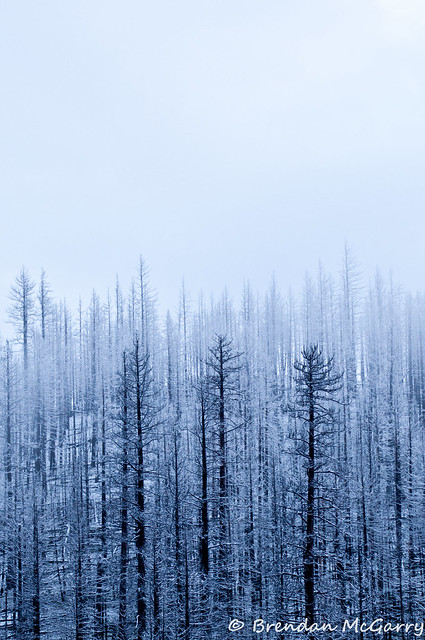
Two years ago this stand was all dark trunks and loose soil, dusty with soot. The canopy here seems even more diminished, sun rays more harsh on my stubbornly and blindingly untanned appendages. Some things are the same as before, when I trip and catch myself from hurdling downslope on a tree trunk, my hand comes away black, which later I unknowingly smear about my face warding off thirsty mosquitoes.

An untrained eye might have seen a ravaged, sterile hill of trees marching into darkened oblivion. The reality is that life is abundant here, with equal or greater diversity to the nearby green forest. Seasons past have sprouted shrubs and a formidable herbaceous layer, keeping my nostrils clear of aerosolized charcoal, but more importantly providing nesting habitat for a bevy of sparrows, warblers, buntings, and flycatchers. Flowers are everywhere, Calliope Hummingbirds flourish. Woodpeckers rattle about in high numbers, more flycatchers and warblers, tanagers, and grosbeaks dine on the smorgasbord of insect delights. Snags have continued to deteriorate providing homes for woodpeckers, in turn coop-ted by bluebirds, American Kestrels, and potentially a few owls. To say the least, the dawn chorus is only rivaled by that of a riparian meadow in the profusion of varied voices.

Before Europeans flooded west of the Rocky Mountains, fire, high intensity or otherwise, was the predominant form of disturbance here. Some fires were set by aboriginal peoples to their hunting and gathering advantage, some sparked without human influence. I’d hazard that all should be considered natural. Science would have to work hard to find many climax forests that haven’t felt a few blistering licks of flame at some point in their history. From conifer cones that only bare seeds with heat, to the sporadic and profuse ecological communities taking purchase on a burn, the significance of fire in the natural Western landscape cannot be denied.

A bird of particular interest to those who study burns seems to be everywhere this year, clucking and squawking about the char. I felt especially lucky at such frequency two seasons ago. I still did, standing meters from of an apparently oblivious woodpecker, chiseling murderously and pointedly into a particular charred, decayed mast. They’ve expanded to take temporary advantage of the trees that are in a slow downward spiral. Debilitating beetles are amassing to bore their wayward paths through the tree’s living layers. These beetles play their role in the stable ecosystem here, not only as a woodpecker food source, but in maintaining the fitness of unhealthy forests, making way for a new one through years of natural succession.

Black-backed Woodpeckers (Picoides arcticus) are not a common species. Here in California we are in the Southern nexus of their Black-backed range, which extends from central Alaska, throughout most of Canada and portions of the Northern and Western US. They fill a niche that many others of their ilk have only generically flocked too; they have embraced burns as primary habitat. Their main source of food are the grubs of wood-boring and bark beetles of the families Buprestidae, Cerambycidae, and Scolytidae, which means they do also occasionally show up in areas where disease has struck such as dutch elm or in particularly nasty windthrows. The birds and beetles are both after large scale disturbances in forests, the beetles to lay their eggs there and the birds to eat the larvae.  In Washington, Oregon, and Idaho Black-backed Woodpeckers are designated as sensitive species. This is because burned forest of the right qualities isn’t common either. With fire suppression and post fire salvage logging what it is, priority is often in wood production and protection not woodpeckers population.

To provide an example before such practices, in the Rockies half the forest burned every 100 years and 35% of the forest was less than 40 years old at any one point. Fires resulting in stand replacement, ones with enough intensity to kill all the trees in a given area, happened 1.5 times more frequently. Forest that is left to regenerate naturally, when salvageable wood exists, is less and less common. Just having a fire in a forest isn’t the key to the importance to the many species that are using burns. For woodpeckers it’s about the intensity, which in turn dictates the number and size of the dead or dying trees, in turn affecting the infestations of their favored food items.

All woodpeckers that are common here in the Northern Sierras use burns to some extent. Even Pileatated Woodpeckers, whose size dictates older secondary or primary stands, will use adjacent burns for the excessively rotten cavities and roosts they prefer. Burned forest offers a good source of food and softer, decayed wood for cavity excavation. Both Williamson’s and Red-breasted Sapsuckers need partially living trees for their sap wells, so they are slightly less prolific dwelling on the edges. Yet the burned forests aren’t a homogeneous spread of charred trunks and dead canopy, they are a complex mosaic. Except in extreme cases, fire doesn’t sweep through a forest leaving uniformity behind.

I don’t really know if she had a nest or not. Sidling about the top of a half dead Jeffery Pine, she was scolding a Northern Pygmy Owl that already had its fair share of excited attendants. Her odd reptilian shrieks were spouted as she bobed her head pedantically, left and then right again. Woodpeckers often seem very tense to me. Wasting twenty minutes with the other disapproving rabblerousers, even on a threat like an owl, wasn’t what I’d expect from a responsible mother. Especially one that should either have eggs to incubate or nestlings waiting for a meal. Another twenty were spent spanning a series of trees, squeaking each time she jumped to a new trunk, and chasing a male Hairy Woodpecker who dared enter her glade. At the edge of a shrub field and the edge of my transect, she disappeared downhill, presumably to shriek and eat more bark beetles. I don’t believe she had a nest. Maybe the pygmy owl ate her male.

Dusty, charcoal is the defining plumage characteristic of the Black-backed. Again, in the burns they likely evolved alongside, this helps them blend in. Other species are easy enough to find in living habitat and to be clear, you find Black-backs in live forest as well, high numbers are almost exclusively in forest that’s been burned or disturbed. If it wasn’t for their frequent vocalizations and their relative calm tolerance of people, I doubt many people would see them because of how splendidly they blend into the bark of a burnt tree. A female is mostly charcoal black with only slightly contrasting ventrally with a dingy gray (white when clean).  The white moustacial stripe, black and white barred sides, white spotting on wings, and often concealed white outer tail feathers are easily missed, they look generally black, white, and gray. The male mirrors this, yet has a golden forecrown that is often tinged with the sooty product his lifestyle. Another thing that distinguishes them from most of their congeners in the genus Picoides is that they have three toes instead of the usual four zygodactyl, (think of an X with each point being a toe). The only other woodpeckers in the genus that share this trait are Three-toed Woodpeckers (of Eurasia and North America).

You can hear them throbbing, boring, scraping, pupating, the antithesis of a heartbeat. Pulsating pestilence. The wood-boring beetles, the bark beetles, taking advantage of the weakness a burn creates, they are still a part of the system. Those wormlike tracings of inner wood one finds from time to time, on a barkless snag or on beached driftwood are the tracks of these beetle grubs. Investigate a fresh forage mark on a tree; bark is chipped away in an oval, exposing gleaming cambium, with a smaller beak sized hole in the center. A tunnel extending from any which way, will probably terminate at this excavation. The beetle, eating its way through a dead or dying tree, met an end at the awl of a Black-backed Woodpecker or maybe a cousin Hairy Woodpecker. Whether they can avoid their demise I don’t know, but with obvious strength with which a woodpecker hammers in investigation, there is little likelihood a beetle grub can do much beyond bare wood-boring jaws.

Bark beetles may seem ominous, even malicious, the gruesome death rattle of a tree going out, but nature doesn’t trade in villainy and heroism. Woodpeckers also help degrade the forest, burned or otherwise.  Foraging is destructive, but also potentially spreads fungi. Like big pollinators, woodpeckers may act as vectors of wood degrading fungus. Imagine them spreading fungus unknowingly when visiting one tree with a fungal colony and then another without; they’d unwittingly get quicker access to wood best for cavities. Those wounds in the trees allow spores easy access to still live trees. This is a stunning example of a mutually beneficial behavior, surprisingly simple, and while it is elegantly plausible, it needs more research.

Their nests aren’t very easy to find just by looking. Searching for cavities is always most effective by watching behavior, but you can find cavities by looking for the right snags. You’d have to be supremely lucky to find one just marching through the forest, particularly a Black-backed who I’ve only found in dense stands of trees. Unlike their relatives the Hairy Woodpeckers or White-headed Woodpeckers, who usually like broken topped, well decayed snags with various species preferences, a Black-backed seems less picky, a half dead or fully dead tree with a lot of bark and branches is suitable. Even though they aren’t necessarily loud, they are talkative enough and easy to track down. In a further three or four years however, Black-backed Woodpeckers will likely have moved on from the burns I traverse in favor of more recent ones, both for food and housing.

A sensitive, enigmatic species, Black-backed Woodpeckers are the focus of many studies focusing on many aspects of a healthy forest and how we live with fire in this landscape. It is all too easy to look at a burnt forest as a wound, a loss of resources, but the exact opposite may be true. There is likely room for all the things we need from forests as well as what the birds need to maintenance their populations. Comprehension of all the swirling aspects that come into play is highly complicated, fire alone is enough to fill a lifetime of work. Yet understanding how a woodpecker uses a burned forest can provide measures to help forest managers keep our best renewable resource vibrant and productive as well as protect important species. I like to preach connectedness but I can’t squeeze all those ideas into a few paragraphs so I’ll leave with this: I simply enjoy noisy, odd Black-backed Woodpeckers. Their lives as irruptive, opportunistic species, makes for exciting variety to a casual observer and evocative study species to a researcher. They are enigmatic and specialized, the fact that they are so uncommon makes them all the more enticing. Next time you see a large burned forest, maybe devastation won’t be the only thought cross your mind, maybe a Black-backed Woodpecker will sputter through squawking.

comment 0

(Historical) Explorations

Discussions of natural history can’t escape a parallel human history. Living in Western North America, shadows of the multifarious frontiersman haven’t slipped from the horizon. I’ve been dwelling heavily on these explorers, here for new opportunities, to claim land for their sovereignty, or to assess the biotic diversity held in vast “unexplored” territories.

In the past weeks I’ve had an inordinate amount of time indoors, to think, read, and write. I’m supposed to be outside working. Excessive rain, snow, and wind has kept our daily point counts of birds at bay. If your goal is to detect the full species array and individual abundances, counting in marginal weather will not give you accurate results. If you doubt that rain, snow, or wind can effect accuracy, or think that maybe I’m just being a wimp, go outside on a less than ideal spring morning and listen for bird song. You may hear some but compare that to a nice, warm and dry, spring morning. Then you’ll understand.

Because of all the time indoors, I’ve not had much face time with nature and it’s got me in a philosophical mood. As a modern field biologist, you are sometimes driven to your limits of endurance and forced to put up with uncomfortable situations. But when it all pans out, we still have it pretty easy compared to people who first started exploring the West in the name of science.

While I don’t wish to wholly glorify explorations in Western North America, which ultimately displaced and exploited hundreds of thousands of native peoples, they are certainly fascinating to the modern day natural historian. The most famous of all explorations in the West was of course the Lewis and Clark Expedition. Between 1804 and 1806, it penetrated the Northwest Territory overland, surveying in the name of the United States for what made up part of the Louisiana Purchase (of land that none of the parties involved owned). President Jefferson wasn’t just looking to survey a land grab though, he wanted the expedition to collect and record on pretty much any area of natural science they could. While neither of the party leaders were trained naturalists, they came back with a formidable collection of specimens and journals. I have occasional encounters with two charismatic birds that bear their names, Lewis’s Woodpeckers and Clark’s Nutcrackers. There’s no ignoring these explorers, especially in the Pacific Northwest, yet the biota of the west are riddled with the whispers of early scientific explorers.

Out my door, I can look across camp, through numerous Douglas Firs to a great sentry of a pine. It stands straight, with a smooth, even bark and massive branches, a good height above neighboring trees. A Scottish botanist by the name of David Douglas, described this formidable tree, Pinus lambertiana, the Sugar Pine. The sugar part of the name came from the sweet resin, the lambertiana for Aylmer Bourke Labert a British botanist who wrote a folio on the genus Pinus. When Douglas ventured into the Willamette Valley of Oregon during his explorations of the Northwest with the Hudson’s Bay Company, he eventually traveled far enough south to encounter these giants. Muir, perhaps the most famous of naturalists in California would later consider it as the “king of the conifers.”

Those Douglas Firs, among the most common of trees in the West, bear Douglas’s name, along with hundreds of other flora and fauna he first described. The etymology of plant and animal names world wide is one big weaving romp through a lot of dead white dudes, but Douglas as an actual explorer certainly stands out as one of the most interesting in the West. He endured real hardship in finding new plants for the Royal Horticultural Society, introducing over 240 new plants to England for cultivation and science. Jack Nisbet’s book The Collector is a fascinating account of David Douglas’s life, particularly if you are from Washington or Oregon.

During one of my foiled attempts at work last week, I was only a mile and a half from camp and decided that instead of hitching a ride with my partner, that I’d just walk back overland. I had a GPS with me, in case I got lost, but I was fairly confident I should have no trouble. As I slipped, tripped, and slogged my way back, I was constantly reminded of the hard work of early pioneers and explorers. Walking overland blindly isn’t an easy proposition, even with all my modern accessories and some knowledge of the land before me. Out of laziness, I didn’t put on my waterproof jacket or pants and wound up soaked. It took me an hour to make the hike, with several stream crossings, a 1000 ft down climb with a follow up 600 ft scramble. The whole time I was jumping logs, pushing through trees and brush laden with the morning’s rain. It wasn’t a simple stroll.

A dryer and a drawer bursting with clean, dry clothes was waiting for me. Early collectors, prospectors, fur trappers, and settlers had none of this. No fully waterproof coats (beyond oiled cloth), their clothes were mostly cotton and wool, and were often walking relatively blindly ahead even with the help of guides and friendly tribes. Unlike native peoples, they were often ignorant of how to survive off the land beyond hunting. In short, they were always on their toes. They traveled by horseback, wagon, and boat, so when mountains loomed ahead or large rivers weaved nearby they had to very careful about what routes they chose. I just look at a map and drive through land that must have been horribly daunting to travel, even 100 years ago. The Sierras are still indomitable mountains no matter how you look at them.

In California, European exploration began much earlier than the late 18th century when the first major explorations in the Northwest happened. Spanish and Russian exploration in the mid 18th century included members, mostly botanists, that were keen on the natural world. However, almost all of this was restricted to coastal regions and adjoining tributaries. No European or American travelers with even the briefest of training as a naturalist had breached the Sierras until 1844, only six years before California achieved statehood. The communities of the Northern Sierras, where I currently reside, were first settled by people of European descent during the time of the 1849 California Goldrush. Fourty-niners rushed into the region, founding the town where I live, Meadow Valley, in 1850. Before that the only people living in the region were Maidu Native Americans, residing in summer villages in Big Meadows (even they wouldn’t stay the winter), which is now Lake Almanor, a man made reservoir. Mt. Lassen, a reminder of the boundary between the volcanic Cascade range and the inert granite of the Sierras watches over from the North.

What I’m getting at in all this discussion of history, seemingly unrelated to birds and nature, is a two fold message; that we have haven’t lived this way all that long. Even a place so seemingly grooved out by humans as California hasn’t even been this way for 200 years. Its a reminder that the world still has unknowns, unexplored areas. We don’t know everything – how could we?

Equally I reminisce on how living used to be. I wouldn’t last a week alone in the wilderness in the Sierras and neither would most Americans. People 150 years ago did passably well (with the exception of the Donner Party), with skills that most of us have tossed by the wayside because our practical use for them is nil. Don’t get me wrong, I enjoy my modern comforts, but it’s easy to forget as society persists, that we’re still privy to the elements and should know how to survive without electricity if need be! Not too long ago, Americans had to cooperate much more fully with nature to survive. In more ways than we likely know, we should still be paying more attention to how we with coexist with the world around us. Of all the things that scare me about being a contemporary human is that we are so easily blinded as to what our actions really mean when they can be so far reaching.

Yet, when I stand under that Sugar Pine or look down the Feather River, I still can’t help but marvel at how recently human history here happened, even the native people are relative newcomers. I don’t furrow my brow, languish in worry about the world, I just take in the chlorophyl bath and enjoy.  If you don’t know how to enjoy it, then how can you save it?

comment 0

Focusing on the Owl

He’d been sitting there for twenty minutes, tooting at the young Red-tailed Hawk soaring over head.  The hawk was attempting to mind its business, but two Common Ravens were relentlessly dive bombing it,  drawing the whole forest below into a reel of uneasy glances and murmurs of displeasure. No one in the forest likes ravens or hawks.

I wasn’t bored, it was just time to start moving on and search for more cavities. Wrangling my pack, weighed down with rusty metal the pack-rat in me couldn’t resist, I slowly stood up on the old growth stump that had been my seat. Just as I was about to hop to the ground, he darted up, narrowly missing a surprise grab of a female American Robin. She turned at the last moment, spurting a single alarm and ducking away. Cowed, he landed nearby and hooted haughtily, pumping his tiny tail and flexing his oversized talons.

His intended prey didn’t think too much of him. She buzzed him once, alighting adjacent, squawking irately. Without a surprise, there wasn’t a chance to take a bird as large as himself. Silently, he flew off, the robin in tow, never relenting her display of displeasure. She was telling the whole forest about his existence. If it wasn’t for her, I might not have found where he had stooped to. In a snag to the left of his new perch, was an old woodpecker cavity. Filling its circumference was the full moon glare of a Northern Pygmy-owl, obviously disturbed from her incubation by this noisy thrush.

I’d found my first Northern Pygmy-owl nest!


Most naturalists have some intellectual struggles with society, now-a-days magnified by technology. All those gadgets ultimately create waste, distract from our need for a healthy world, and sometimes change our ways of thinking a bit too drastically. I’ve been vacillating a lot lately on this subject. There’s no arguing that I rely heavily on nature for subject matter alone. Yet there’s plenty of reasons that society needs nature around us. I never feel as alive as I do, even in capsize moments away from humanity. I’m never more focused, more creative, more jovial – more healthy.

Yet I love people and many of the interweaving cross sections of the urban, modern, technological life I live are near and dear to me. I am passionate about hip-hop culture (really an amalgam of the following), music, visual art (the greatest immersion of which is in a city), and the exchange of ideas that flows in a thriving community well cultivated in a larger populace. I’d have missed the point if I didn’t mention the internet, my personal use of a camera and a computer to convey what I find important and hope to be my lively hood. Much technology that is commonplace today I’ve never been without from adolescence on.

This pair of Northern Pygmy-owls were unveiled to me because I’m a city kid fortunate to have discovered passion for something other than video games and computer screens. Later, decompressing from a day in the field, I read an article by one of many authors I’ve been meaning to read, but haven’t yet. Richard Louv coined the phrase “nature-deficit disorder” in his popular book Last Child in the Woods. There’s a real and significant divide between many kids of the developed world and nature. The thing that struck me more than anything else, was Louv’s emphasis on focus. Time spent outside allows you to use your senses, to focus, instead of actively working to block out all the unhelpful distractions of urban life.

I didn’t bring Louv up to rally against technology or urban life, I think the benefits far outweigh the pitfalls. So as to not be misconstrued: of course the environmental impacts of technology are a problem and can be improved upon. People still need nature in their lives just as much as ever, even with the medical, educational, and creative advances all these bundles of circuits provide. Moving on.

Ruminating on what luck I’d had to come across such a rare sight, I realized it wasn’t just luck. I actively tracked down the owl because I heard it. I patiently watched it for cues and after a good wait, was rewarded. Throw in someone who spends their time glued to a screen and you would probably had different results, even if they were fit and had spent that time studying birds. As a teen I was out watching birds – my formative years gave me a gift. People can regain these sorts of deficits, but it’s likely harder to do once you’re older if you grew up devoid of them.  Just like learning a new language.  Although I’d never thought about it so directly, I am lucky to have the connection to nature, the observational, sensual skill that I have. Being able to notice, intuit, and as a direct result, enjoy nature is another thing for the laundry list of things I am grateful for. As a good friend of mine has said to me many times: “Some people don’t do anything.”

I know more now than ever what he means by that.

While I got my recording work done, the male owl watched me with an impressive impassivity. He was small, but I wasn’t going to take too many chances. I didn’t need an owl stapled to my skull. I trotted off through the lime green, post fire shrub layer, goose stepping over downed logs in search of more nests. Hearing a Hairy Woodpecker in the distance, I turned for a last glance at the fiery fluff ball and his nest. Once the coast was clear, he barreled down to make sure I hadn’t done anything irretrievably human.

I suggest you enjoy some nature every day. Einstein went for a walk in the woods everyday.


comment 0

Unseasonable Seasons

When the mercury dips, people who have the option head inside. It’s fairly obvious other animals don’t have that choice quite so readily available to them. Sure, I’d be happy to share my room with a menagerie of critters in a snow storm, but I have an inkling the Steller’s Jays and Northern Goshawks wouldn’t get along so well. Communicating my willingness to share a warm room would be difficult enough, let alone trying to keep the peace.

Birds can be hard hit by bad weather. Many are well equipped for extremes, more adept at staying alive in a bad storm than you or I. A Golden-crowned Kinglet (Regulus satrapa) lives its winter on the edge of existence. To not give up the ghost, they have to constantly forage, literally right from dawn to dusk. To save time, they stop where they end up at night and huddle in a group to survive the night.

There are plenty of wonderful examples of adaptation but what happens when those behaviors aren’t flexible enough?

I haven’t forgotten we are moving ahead from Winter, but maybe you have noticed that in much of the US, we’ve had a rocky start to what people who eat food call the growing season. A little over two weeks ago here in the Sierras, the first arrivals of Wilson’s and MacGillivray’s Warblers and the typical representatives of flummoxing Empidonax flycatchers appeared. It appeared that they were in full tilt arrival and passage just as the low pressure system decided to started lobbing moisture our way.

Can you imagine a fellow running a marathon, expecting to cross the finish line to warmth and platters heaped with gluttonous portions of chocolate cake, instead finding freezing weather and hardtack? That’s how I think it might have felt to be a Wilson’s Warbler last week.

Even at 4000 feet, the Northern Sierras had snow. What exactly, does a bird who leaves here in the fall, largely to avoid nasty weather, do? Having taken a stroll to see, swaddled in garb that would have simultaneously kept the entire Shackleton Expedition warm, I can tell you one thing – they don’t bother singing.

Male birds are so hopped up on testosterone this time of year and their sole purpose is the make sure they have the best territory. The best assurance of continuous ownership is to sing incessantly. That takes care of most competitors looking to secede your land – the rest you can chase off flaunting your fitness with bright, fresh plumage, and possibly superior bulk. When birds aren’t singing at the usual times or at all, one can presume they’re otherwise occupied. Besides eating and mating, singing is the only thing a typical male songbird should be doing this time of year.

A side note: even dainty, florid warblers will occasionally resort to physical aggression when a border cannot be properly established. I watched a rival MacGillivray’s Warblers (Oporornistolmiei), chase each other over a half an hour period until they finally started making colliding. Looking exhausted, their struggle culminated in a Manzanita; wrestling with splayed wings and clacking bills. The victor flew out and immediately started singing – the loser crept out, bedraggled, retreating to what I presume was inferior scrub. Resolved.

I don’t have an answer as to what these birds are doing besides trying to hold on. When birds get desperate for food or water, either during migration or a cold snap they’ll show up out of their normal habitat and make use of unusual food sources. Here, they likely arrived with low fat reserves and found little to eat – I can’t imagine insects do much better in freezing weather but maybe that’s conjecture. Food was still around, (how do you think the Kinglets survive?), but I have no doubt there was less of it.

I found some old communications (anecdotal briefs in scientific journals) circa the 1920s, suggesting that birds might re-migrate to lower or more southerly clines when arriving early to poor weather. A communication isn’t researched, statistically proved information. After all, how does one truly study unpredictable disruptions? Still this made decent amount of sense – if it’s too cold to live, leave again till it’s better. In the Sierras, I assume that higher areas where the snow won’t melt till August won’t have successfully breeding birds this year.

Birds, feasibly along with most extant species, have taken considerable time sleuthing seasonal patterns and do a pretty good job knowing when to migrate, breed, molt, etc. Unpredictable weather creates considerable stress. In high alpine areas of Southeastern Arizona, Red-faced Warblers have been documented to simply abandon nest with the advent of late snow (at a rate of 64%!). From a temporal standpoint, that’s adaptive – a pair could die trying to nest in bad conditions. But is this maladaptive in the long term? Climate change, as most educated people should know by now (but probably don’t), isn’t just about simple warming; the seasonal predictability of weather patterns are going the way of a Jackson Pollock painting. The instinct to abandon nests when snow comes late is great in the present. But if you and that hunky warbler hubby of yours keep leaving when things get a little crazy, there’ll be less and less Red-faced Warblers for demented birders to see.

Early arrival is strongly selected for in migrating birds – the earlier you get there, the better chance you have at laying claim to better land. Birds have always run the risk of late snow or bad weather, that’s nothing new. So far as I can tell, no one knows the entire story of what happens to birds when even their best efforts to time their arrival are continually foiled. For all I know many generations of birds in the Sierras have seen this kind of event before. I doubt it was overly disastrous. Really, all I wanted to say was that I felt awfully sorry for those Wilson’s Warblers in the creek behind my bunkhouse (as I sat inside, roasting with a hot toddy and a good book).

comment 0

Fallout from the Wend

Somehow it’s like I was never in Thailand or Malaysia or Indonesia. There’s all these photos, much more writing to do. But settling back into your typical existence, of not simply learning for yourself, is a strange fallout. Really it’s a mild personal melodrama, but I have a strong suspicion others can relate.

Today I stood on an overgrown road through a high severity burned forest in the Northern Sierras. My index finger displayed a dainty dollop of tepid, chartreuse bear dung. Across a noisy, snow melt gorged creek, a cinnamon phased Black Bear browsed on new growth, while I greedily enjoyed its presence. This was my moment with the bear. No one else knew about it, not even the bear. I felt like I was discretely, selfishly picking around the raisins in the trail mix, taking only chocolate. When I got back, I related the encounter to my co-workers.

“Would you like some raisins?”

Giving up the stories of your trip isn’t as easy as it sounds. Finding ways to make them interesting, easy to relate to, especially if you haven’t been to Borneo or Northern Thailand, is a challenge that sometimes one can get selfish about. I’m not sure if sharing all your stories means you are a good story teller or if you are simply handing out the recorded notes from a meeting.

In simple, bird nerd terms, I saw plenty. 438 species of birds I’d never seen before. I never hired an official bird guide, I learned what I could on my own, and did reasonably well (although there are several thousand species in the region). Though I’m loath to bean counting, dropping my observations into the bucket of life listing, when I get around to counting up I’ll probably have surpassed seeing 2000 species of birds in the world. Let’s see – 584 birds in the US, 498 species in South America, some 400 in Australia, 438 in Southeast Asia, an additional 60 odd in England and Ireland, and 24 in Northern Mexico – adds up to 2004.

“Hi, my name’s Brendan, I’m 25, and I’ve seen 2004 of around 10,000 species of birds in the world.”


Not exactly a line from speed dating, but I’m pretty satisfied with those stats. I’ll never see all the birds but if I keep it up, I bet I could get to 5000 by middle age.

But who cares about that stuff? I’m way more excited about the Black and Yellow Broadbill (Eurylaimus ochromalus) I spent thirty minutes taking photos of in Borneo. The bird sat two arm lengths away, engaging in eeriely slow movements while searching for phantom insects. It reminded me of an animatronic creature from an antiquated theme park. Suddenly it would burst off to catch an insect I couldn’t see. My heart would quicken pace momentarily thinking the bird had flown for good. But, I’d continue to relocate the grumpy looking character (their plumage is quite comical), on the same branch, face level in the canopy.

There’s always regrets from any trip and I wouldn’t say mine are major. Possibly it isn’t necessary to admit shortcomings but I wanted to say a few things about best and the worst. The most disappointing thing from my trip was that I failed to connect with any scientists. Attempts were made but they never got all the way. Honestly, that was just a part of the learning experience. Next adventure I’ll be ready and I’m sure it’s not that far around the corner.

An excellent experience was on Samosir Island in Lake Toba, Sumatra. I just stayed put. I didn’t make huge intellectual leaps in my understanding of Sumatran ecosystems or conservation biology, I just watched common birds. I don’t think you can beat that. Nothing is more valuable to a naturalist than familiarity. Yellow-vented Bulbuls (Pycnonotus goiavier) chortled in alarm at a passing Besra (an accipiter species), the Asian Palm Swifts (Cypsiurus balasiensis) turning from their aimless circling, building to a dark cloud of fury around the fleeing hawk. A Scaly-breasted Munia (Lonchura punctulata) attempted to secret away fresh green grass fronds twice her size, looking like a mini airplane flying a banner interminably between the marshy shore and the palm tree near my room. Two Black Eagles (Ictinaetus malayensis), yellow talons beaming, would circle over the town of Tuk-tuk, likely looking for cats, small dogs, or chickens of which all were plentiful. Sharing these and tantamount other simple observations with friends that weren’t necessarily there for birds, made it all the more valuable.

There were so many insects, reptiles, and mammals I’ll never forget too.

Speaking of mammals, I can’t ignore the people, friendly and frustrating. Douglas Adams said it best about Earth: “Mostly Harmless.” Yet there’s a few human lessons I gleaned that will help me navigate in the future. I’ll never underestimate the value of learning about the culture of the place I’m visiting, even if I’m there for nature. I’ll never take the cheapest bus anywhere again. I’ll always be sure to chat up the locals as much as possible, even if they do try to sell me Meth, I’ll always find out something interesting and make friends. I’ll never take the first price I’m told. I’ll never again be alarmed, offended, or startled by strange things people ask me, like:

“Are you a rapper?”

or

“Hey are you guys going to go relax and eat bananas? Do you like bananas?! I like bananas! Bananas!”

I learned a lot and I want to thank a few people before I finish this up: First and foremost, my parents, who put up with my humming and hawing, crashing on their couch pre and post trip, made many indirect financial investments, and always support my interests and idiosyncrasies. My friends, young and old, for their emotional and intellectual support. My primary travel companions, Nick, Ellen, Scott, and Sam for being great friends and even better company. And most of all, the folks who supported me in my fund-raising campaign on Kickstarter – you made the larger extent of the trip possible and have given me validation in my professional interests, (you’ll get your photos and writings soon!). I hope you all keep visiting Wingtrip and will look for my work elsewhere in the near future.

And though it may sound disingenuous, I’ll also never stop smiling.

comments 3

Kao Yai, Final Days

When the worst of your mishaps in Southeast Asia include unplanned soakings, issues with gravity, or a mild swindling, you’re probably doing pretty well. Unfortunately, my luck was running out. By the time I’d left Malaysia and made the slog to Kao Yai National Park in Thailand, I’d caught a cold and missed two flights. With only a week left on my trip, I can’t say I was too enthusiastic about anything beyond a comfortable bed and a non-squat toilet.

Kao Yai turned me around. Having a few days left simply meant I had some creature comforts on my mind and they temporarily clouded my thoughts. Several good mornings in Kao Yai and I was convinced I could have tacked on an extra month.

As the second largest and oldest park in Thailand this is not a spread to miss. At the southern end of a chain of mountains that extend into the Isaan Region of Northeastern Thailand, the park holds a variety of habitats ranging in elevation from 400 to 1200 meters. Simply put, it has immaculate variety.

A striking aspect in visiting is that the park is only three hours from Bangkok. Glance through agriculture and industry on the outskirts of the city, giggle through a Thai dubbed American film on a government bus, and arrive in Pak Chong, gateway town to the park. You’ll bumble around, looking the part of a slack jawed Farang backpacker for 10 minutes, until you manage to rent a moto. In another 30 minutes you are at the gate to the park, having accidentally passed the guest house where you wanted to stay.

Unlike the vast majority of Thailand, finding a reasonable place to stay was quite the struggle. Kao Yai is a major tourist destination for Thai people and they apparently like luxory. Beyond the gate, it appears they walk around in parking lots perplexed, take some photos of tame Sambar Deer, and drive at hair raising speeds around blind corners where you’ve stopped to watch Ashy Minivets (Pericrocotus divaricatus). I only met one family on any of the many trails and despite being excessively loud (Rhiana Cell Phone ring tones and all), were very friendly. Don’t take that last comment as evidence that I think Americans behave better in our national parks.

On my first morning, after seeing two birds I’d lusted after, the goliath Great Hornbill (Buceros bicornis) and surprisingly quaint Long-tailed Broadbill (Psarisomus dalhousiae), I found myself zooming up a mountainside. White-handed Gibbons (Hylobates lar) were hooting away in the tropical evergreen forest on all sides when, to my surprise, the forest evaporated into hills of burnt umber blanketed in sandy grasslands, glistening with morning dew. I knew there were grasslands, but not like this.

Similarly to North America, native grasslands (or techinically savannah) have been devoured by agriculture and poor fire regimen. Thailand had much less to start with too. Savannah forest like that in the plateau of Kao Yai are likely the worst hit habitat in all of Thailand. This isn’t abundantly clear in the park, as it appears to make up the majority being adjacent to the major roads. Regardless, I felt like I was in Africa.

I knew where the best birding spots were, but I was anxious to get a lay of the land. The highest road, up to a radar station for the Thai military, beckoned. Apparently this switchback road, while largely potholled and washed out, seemingly the perfect birding road, also happened to be a track for sports car enthusiasts. I saw few new birds but I realized too late I’d wasted my time. I also nearly got myself creamed while trying to watch a Moustached Barbet (Megalaima incognita) gobble figs on the slim shoulder.

The lower areas of the park were much better suited to my kind of roaming. The fields themselves, harbored both Indian Muntjac (Muntiacus muntjak) and Sambar, rumored Dhole and Tiger, which I guessed would be largely impossible to spy. Bright-headed Cisticolas (Cisticola exilis), a bird I’d been promised I’d never actually see because they so love to skulk in grass, were emboldened, swollen with testoterone, and readily visible. One even decided to spout its love drunk gurgle from an electrical line above my head. A pair of Wreathed Hornbills (Rhyticeros undulatus) whooshed overhead as I watched the tawny soloist. Thrilled, I sat astride my moto, marking my 8th hornbill species on the trip and the 5th in Thailand.

The best birds however, were deep in the forest and took a painful amount of patience. I took an exploratory hike down one trail, but quickly psyched myself out. In reminiscing on how a habitat goes quiet in the presence of a large predator, I found the forest around me still. While I was likely the culprit, I decided I’d rather not have my parents receive the shredded remains of my tiger mauled body in the mail. Death seemed to be on my mind a lot lately. Possibly because I felt like I’d done well keeping out of bodily harm in places so relaxed on safety.

I relish my solitude in wild places. Yet sometimes a good companion is a godsend. What’s more, I couldn’t think of anyone better than another birder, roughing it on his second visit to Thailand. I made a new friend in a Brit named Graham, who was on a similar path of birding, taking time to enjoy some of the other wild features of the park. The rest of the afternoon was spent solitarily adrift, but we’d spend most of the following day birding. My goal was to wait for evening wildlife at the major salt lick in a observation tower.

Hiking to the tower tracked through breezy, fire managed grasslands bordered with patchy stands of dense dry forest. Barn Swallows and Dusky Woodswallows (Artamus cyanopterus) plied the air, buzzing Plain Prinia (Prinia inornata) and more Cisticolas perched in prominent shrubs. My grand illusions of a bevy of crepuscular megafauna coming out of the woodwork never quite panned out at the observation tower, but I enjoyed the warm evening glow over the savannah.

I’d signed up for a night safari at 7pm, but I didn’t have high expectations as it cost less than $2 US. Heading back in time for a quick bite before the tour, I noticed a number of cars stopping just above a prominent salt lick. Motoring over, a Thai woman in an imposing truck said “Elephant.” and pointed in the direction of a shadowy group of trees. I raised my binoculars in just enough time to see two Asian Elephants slip into the stand, trumpeting in the steely twilight. Although I stood on a paved road, with all my dangling modern accoutrements, I could have been a thousand miles away form the nearest human and alone with the titans.

Thinking myself quite lucky, I motored back in the direction of the food court. As I rounded a corner, I was face to face with a bull elephant.

His bulk backed into an opening in forest, he stood there, nonchalantly stuffing salt into his wrinkly maw. Only 40 meters from him, I was anxious to attend to his mood but he seemed perfectly calm, likely used to the attention next to the road. Two Elephant encounters in one day, this was getting to be unreal. What’s more, I saw him two more times in the next day.

Graham was eating dinner at the same time and I offhandedly relayed my sighting, thinking that he’d likely seen Elephants before. He was astonished and almost immediately took off on foot to try to see the beast himself. Just before rushing off, he mentioned he’d seen Malayan Porcupine (Hystrix brachyura) the night before nearby. Instantaneously, three gigantically quilled rodents lumbered down the isle of tables, only to be chased out by a man on a scooter. What in the world was going on in this place?

The night safari was a simple affair, involving too many blank stares from Sambar, but was worth the money because I did see a few civets. I rushed back to my bed, head swirling with the days adventures and concocting imaginary encounters for the next day. Two near collisions with porcupines thrust me back into the realities of driving at night in the wilderness.

I wanted to get into the park before dawn the next morning. However, the guards were already up at 5 AM and wouldn’t open the gate till 6. I still managed to make it into the park in time to meet Graham on the path to the observation tower. Hornbills were on the move in all directions and we both couldn’t quite believe these birds were aloft over our heads. Great Hornbills are the avian equivalent of noisy diesel engines. Drongos of all sizes behaved uncommonly gregariously, sharing bare perches en mass and looping into the crisp air, sharing it with high flying Dollarbirds. The gibbons should have been out of breath.

This was my last full day in Thailand, my last in fact in Southeast Asia. I didn’t push myself in birding, I simply sat back and enjoyed being there. A few more encounters with the salt loving bull Elephant, a skulk through deeper forest for a Orange-headed Thrush (Zoothera citrina), and a scouring for an absent Coral-billed Ground Cuckoo (Carpococcyx renauldi) filled the day. Graham and I spent the afternoon and evening talking about the politics of birding, the current state of humans and nature, and the subjectivity of experiencing the natural world, all the while watching birds. The day closed with a final bird, a lifer, the harrier-sized Great Eared-nightjar(Eurostopodus macrotis) issuing unavian spurts and planking through the final light.

Even a month later, it’s difficult to fully synthesize what my experiences really meant. To say the least I learned much, have become all the wiser as a result. Having to jet off to Bangkok after two wonderful days out in the wild was jarring. Indian Cuckoos calling sullenly from trees in urban temples seemed impoverished characters, shadows of their country cousins.

I still haven’t stopped talking about it. Thanks.

comments 5

Kinabalu; One Tall Mountain

(I got back exactly one month ago and I’m not done blogging.  So, the post is long and tardy because I arrived home with only two weeks to recoup AND get myself to California for work. Enjoy!)

After several forays, I still couldn’t fathom the Englishmen ascending as they did. In my mind native Borneans scaling the slopes unaided seems more likely, but soft-soled limeys, no matter how driven by natural history, was something else. Spenser St. John, an adventurous British dignitary, wouldn’t really have much reason to spin a yarn and if he did, this would have been a poor use of embellishment: “we waited till the 15th for a vessel, which we expected would bring us a supply of shoes, but as it did not arrive we started.” The first Europeans to summit the tallest mountain in Southeast Asia, were barefoot.

Roaming the lower reaches of Mt. Kinabalu National Park, I couldn’t help but dwell on the first successful ascent in 1858. I also couldn’t forget how sore I was from a 16km day on already laid trails. And I hadn’t reached the summit. Hugh Low, the other explorer, then colonial treasurer to the British Colony of Labuan, was so worn by the terrain that his descent was in a makeshift stretcher. On that climb, he didn’t make the final ascent. Two months later however, he and St. John make a second successful attempt.

Gunung (Bahasa for Mountain) Kinabalu, is the sort of place that exhales stories. From legends of the widow of a Chinese Prince to natural history misnomers like reporting mice decomposing inside pitcher plants, there is plenty to dwell on. Aside from status as the 20th tallest topographic mountain in the world, bald pate of granite batholith frequently peeking above the clouds, Kinabalu holds highly unique ecosystems. While there are a few other mountains in Borneo that hold similar habitats, none are as extensive, hold such exquisite endemism, or to my benefit, are as accessible. You’ll recall me waxing poet about tropical mountains in my post several months ago when I visited Doi Inthanon National Park in Thailand. Kinabalu is a UNESCO World Heritage Site, (something Malayans can’t help but flaunt), holds nearly 5,000 species of plants, over three hundred birds, and a fair share of mammals.

Sam, my companion for several weeks, and I had explored for a couple days at the beginning of his time in Borneo and I had sagely not worried myself with seeing every possible endemic bird. I just came back later (and still missed many). At the beginning of a three day period, I was entirely optimistic that I’d be able to scoop up at least 8 new species of birds. I also wanted to see more Nepenthes, a tropical genus of pitcher plant, of which 16 species grow on the mountain. Sam and I saw the widespread Nepenthes tentaculata and endemic to the mountain, burbidgeae. Hesitantly, I meditated on the unlikely event of partial desiccation of my person and belongings. I was mostly successful with my list of wants.

I’d initially felt like people exaggerate Kinabalu until I’d read up on the ecology, exploring a slice for myself. Fine, it does top out at an impressive 13,435 feet (4,095 meters), but I’m from the Pacific Northwest, we’ve got similarly elevated Mt. Rainier on our back 40. It has snow and it’s a volcano (don’t miss my unabashed tone of pride). Several other mountains of good height exist in Borneo, but I suppose none with quite the countenance of a tabletop peak of granite. Yet, I suspect that many people don’t get to see the peak because by eight or nine in the morning it’s socked in with clouds. Only my first morning out of five provided a full view of the peak.

My guesthouse had many of the more common birds you find on the mountain from the garrulous Chestnut-capped Laughingthrush (Garrulax mitratus), gregarious Chestnut-crested Yuhina (Staphida everetti), Bornean Leafbird (Chloropsis kinabaluensis), and the suitably corvid Bornean Treepie (Dendrocitta cinerascens). I also found a group of the bald fronted, Bare-headed Laughingthrush (Garrulax calvus) and a lone Sunda Laughingthrush (Garrulax palliatus). Walking out to the main road to the mountain entrance I stumbled upon the endemic Sunda Cuckooshrike (Coracina larvata), nearly eating it on slick concrete in my enthusiasm.

For the non-birders I know this listing doesn’t really mean much. A poor comparison: trying to find ingredients to something you are baking at a small grocery store. You know you may not find every ingredient and not all are necessary, some merely nice accoutrements. Finding major ingredients is of the utmost with a few of the more ephemeral additives bonuses. I’d already gotten some of the exotic ingredients previously, including endemic Whitehead’s Trogon (Harpactes whiteheadi).

A fun pair of women from my guesthouse who were also there to explore the mountain, similarly couldn’t stomach the extraordinarily exorbitant cost of actually reaching the summit. For a while we walked together, but to get the photos I wanted and to see the more scarce birds, I need solitude. Almost as soon as I left them I encountered a flock with a few of the common but endemic Bornean Whistler (Pachycephala hypoxantha).

And then I didn’t see anything for an hour. Then I glimpsed a White-crowned Forktail (Enicurus leschenaulti). And then I didn’t see any birds for another hour. Then it started to rain.

I’m not exaggerating.

Stubbornly I endured and as I was squelching down a trail, something near my foot moved. The misty mountain, of damp path and chilly precipitation, didn’t wreak havok on my nerves like walking in the serpentine lowlands, but I still started. As it turns out, for once, there was actually something to jump from (usually it’s just a leaf I kicked or a branch attached to me that I ineffectually flail at). People who spend time in the rainforest, those who haven’t grown up there, most certainly feign machismo if they move unconcernedly. My curiosity typically stays flight, there is some freaky shit out there. Flight still takes precedence over fight.

Thankfully and immensely preferable to not seeing birds, I’d stumbled upon a snake doing its best to swallow a bulky frog that looked much too large. There was little doubt it would succeed. This tiny snake, a dappled brown streak of a thing, looked as if it had gotten a little carried away in interspecific necking. The fat, helpless frog’s eyes bulged out of the corners of the snake’s mouth. I still haven’t identified either species, yet as silly as it may sound, seeing something like this stands out more than seeing Proboscis Monkeys. It was awesome. Unfortunately I ruined the moment. I stumbled, the snake leg go, retreated, and the frog sat there stupidly and bloodied. I’m not sure if it was just stunned or the serpent had been venomous, but it still had enough umph to stand tall and attempt to warn me off with feigned bulk.

I suspect my reaction to this small, naturally commonplace encounter firmly labels me a naturalist more than a birder. Sure, I was willing to tromp countless hours, wet and cold in search of a bird like the Bornean Stubtail (Urosphena whiteheadi); a diminutive, dull bird, I saw and is a sought-after endemic. Yet the strongest impression from that afternoon was from a snake eating a frog. Who needs labels? I still get frantically overenthusiastic over birds.

Furthering this absurdist’s identity crisis, was the excessive diversity of insects at my guest house. I’d been reading excerpts from the journals of various European explorers in Borneo and an idol, Alfred Russel Wallace, had expressed similar thoughts. On dark, wet nights he collected extreme amounts of moths attracted by a light.

“On good nights I was able to capture from a hundred to two hundred and fifty moths, and these comprised on each occasion from half to two-thirds that number of distinct species.” He continues that, “it thus appears that on twenty-six nights I collected 1,386 moths but that more than 800 of them were collected on four very wet and dark nights.”

Any outside surface adjacent to light was swarmed with countless moths, flys, beetles, etc. For fun I counted at least 78, to the undiscerning eye, different species of moth. Not to mention gigantic long-horn beetles, a leaf insect that flew into my face, and katydids en mass. I stayed up two hours later than planned taking photos of the variety of colors, shapes, and sizes. I’d never been quite this blown away by insects but the more I pay attention, the more I realize they are as worthy of crazed devotion as any vertebrate.

As I mentioned before, rain was putting a damper on my explorations. Normally I have little issue with getting wet, but again from following various explorers, I learned something. Unless you have to, don’t go out in the rain. You won’t really dry off.

That said, I couldn’t let low lying clouds scare me off the chase. A solid slip on slick cement, camera first, gave me heart tremors and seemed an ill omen for my last day at the park, but I still managed to make it up a trail without true accident. Unfortunately, my optimism didn’t hold water, drips began to reach me through dense canopy within minutes. It abated long enough for me to simultaneously spot a Bornean Whistling Thrush (Myophonus borneensis) and scare it off, having a whirling tantrum over a biting fly circling my head. The rain continued a steady luge down broad leaves and the back of my shirt lasting the rest of the day. It was only 10:30 AM.

Sodden within minutes, I gave up and began my tromp back. Just when I’d decided Borneo had foiled me again, a weasel tried to run up my leg.

I later learned this rascal was a Malayan Weasel (Mustela nudipes). This white-headed mammal, the size of a Black-footed Ferret, came at me from the undergrowth on the side of the road. It didn’t seem aggressive, but I wasn’t really going to test my luck, creating a weasel baffling buffer with my umbrella. I’d opted out of rabies vaccination. This boisterous character took ginger leaps through the wet forest floor, disappearing into holes, reappearing several meters away, slithered up gracile saplings, and crossed the road several times without looking. All within a few feet of me. Obviously busy hunting, it periodically investigated my tentative squeaks, seeing if I could get his or her attention. Neither of us cared that we were soaked.

After what felt like an extremely charmed hour watching this naïve little mustelid, I tired of dodging traffic and moved on. Reviewing my camera’s capture times, I was there less than 10 minutes. Rain and the fact that I was standing on the side of the main road up and down the mountain kept me from taking proper photos. No matter, because the impression, like all the others from this misty massif, is permanent.

comments 5

Gomantong Caves

All oncoming traffic had their brights ablaze, yet I was being impetuously rude by not turning mine down on approach, provoking a barrage of anxiety enhancing light flashing and horns blowing. An aging truck, heaped with a patchwork of tarps and choking over slight hillocks, was holding up a line of menacingly swerving Toyota Hiluxs and Palm Oil trucks to my rear. I was pilot of a tin can, in danger of blindly pitching into deal breaker pot holes at 90 km/hour. Every car wanted to pass on blind corners, urging cavalier participation with tailgating and more horns. Times like these make me appreciate what I perceive as sane drivers.

Sam and I were at a loss of what to do with his last day. We’d wanted to try to visit the Gomantong Caves in the past two weeks but there’d been plenty on the itinerary. Not wanting to waste his last respite before reentering the real world, Sam suggested a jaunt to the nearby caves for a bit of Bornean nature. At every turn our attempts to DYI through Borneo had been foiled, so after almost a full day of halfheartedly trying to avoid paying $100 for a visit we almost gave up. Then Sam wondered aloud if we’d be able to rent a car and just drive ourselves. Surprisingly this worked, was half the price, and we didn’t have to adhere to anything but law.

Caves abound in Southeast Asia. Peruse travel information on any country here, and you’ll inevitably run into mention of a hole you can poke around. What makes Gomantong worth visiting was adjoining lowland rainforest, a nightly exodus of over 2 million bats, and most notably, being one of the places people harvest swift nests for bird’s nest soup.

The swift’s nests are collected twice yearly, February to April and July to September. Most information states that collectors neatly harvest before the birds lay (meaning they build a second nest), and then again after. While I am dubious of the lack of impact, there is emphasis on controlling harvests and guards stay at the caves year round. The WWF says Gomantong is the most well controlled bird’s nest cave in the world. There didn’t seen to be any lack of Swiftlets present, so who am I to question a tradition dating back to 500 AD? Harvesters can score nearly $500/kilo for high quality white nest (pure saliva and no feathers). Even if the demand for a soup whose driving ingredient is bird saliva and feathers and commands $60/bowl, is slightly beyond me, that’s good money. That is, if you ignore the fact that these intrepid fellows slog through acres of bat shit, seething with vermin, climb rickety ladders made of Rattan and rotting rope, and live for days on platforms deep in the caves.

We arrived by mid afternoon, ready for a good romp. Yet somehow through the confusion of trying to avoid tourist exploitation, we’d only one flashlight between us. That meant that the Simud Putih, the deeper, White Cave (so named for the pure saliva nests it holds) was off limits. This actually seemed alright once we realized that the Simud Hitam, the Black Cave was comparatively easy to explore, on boardwalks and sans headlamp. Yet boardwalks didn’t omit the stench, the piles of guano, the crabs apparently living off a river of runoff, and the millions of cockroaches. I feel extremely itchy just sitting here thinking about it. A Wallace’s Hawk Eagle (Nisaetus nanus) seemed quite happy for the creators of this filth, because it could practically pluck swifts flying in and out from its perch above the entrance.

Despite our lack of proper gear, we weren’t going to just give up on exploring. While thunder built ominously overhead, we scrambled up to the entrance to the foreboding entrance to the White Cave. The humidity was oppressive and while I spotted one new bird, a Rufous-crowned Babbler (Malacopteron magnum) and spied the thimble sized Least Pygmy Squirrel (Exilisciurus exilis), the smallest squirrel in the world, it didn’t appear we’d be seeing a lot of wildlife. Of course as we reached the top of the hill, sweating like we’d been in a sauna, this pessimism was immediately banished. Sam got to see a wild Orangutan.

While I glimpsed an arm, as the ape swung behind a sheet of vines, grunting and shaking the brush as warning, this was enough. I now felt like I’d seen both of the two Orangutan species in the wild, both Pongo pygmaeus of Borneo and Pongo abelli of Sumatra, which until recently were considered one species. For Sam, this was the penultimate sighting, on par with our Elephants on the Kinabatangan.

Then, suddenly and fortuitously, the storm broke. I had a temporary freak out, for my camera was naked in the rain, but we took shelter beneath an overhang. Torrents came down for an hour and we made the decision to head back in the midst, also unprepared for the weather, to watch the Black Cave at dusk.

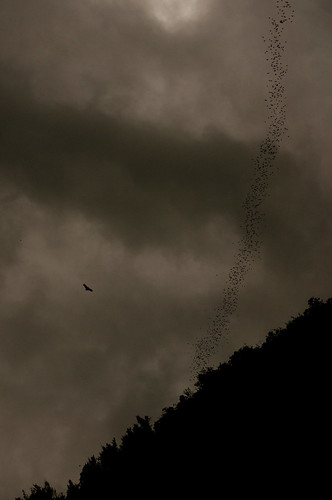
Sodden and sweaty, the rain abated as soon as we reached the entrance. Inside we couldn’t quite see what the big deal was. One hole in the roof, 90 meters up, seemed to have a few bats exiting, but it wasn’t the exodus we’d been promised. Tired of crunching roaches underfoot, we chanced to head back outside and stood dumbfounded. A continuous stream of bats undulated out of the top of the massif the caves meander beneath.

Bat Hawks (Macheiramphus alcinus), the predominant species driving the bats back and forth across the horizon, were new to me. The odd Brahminy Kite (Haliastur indus) also appeared, I suspect looking for cleptoparasitic opportunities, being slightly too slow to catch the lithe bats. A Crested Goshawk, several Wallace’s Hawk Eagles, and a lone and probably coincidental White-bellied Sea Eagle also made appearances. Caves the feature nightly departures of bats always have some winged predators snagging a meal. Fast food.

Misinformation on when the park closed prompted us to leave sooner than we wanted. Yet watching the bats (which I can still not put a species to) was a wonderful way to end Sam’s last evening. An added bonus were fruit bats, floating over the parking lot and we squeezed into the tiny rental.

On the way out a Red Giant Flying Squirrel glided across the road, lit by an almost full moon, closer to Earth than it had been since I was five years old.

And then I took our lives in my hands and drove back to Sandakan in the dark.