comments 5

Malheuring Around Part 2

Shoving as much natural history as a place holds into the space of five days will never promise restfulness. During the course of a few days we drove hundreds of miles in pursuit of birds, mammals, and reptiles. I’m feeling pretty pooped just thinking about it now and blogging about it during the trip was ultimately beyond me completely. In younger years I would have blown off writing completely but I’ve come to realize that memories fade and that this is the craft I wish to work and grow in. When these experiences are penned (or typed), they take on a whole knew life. The photos of this trip will always exist but the embellishment of a good yarn is equally important in immortalizing stories. Years from now I’ll thank myself for recording any experiences I had. I’m already kicking myself for not doing a better job in more formative times.

I left off on day three of our twisting navigation of the Malheur area. We continued to drift on and off the refuge and saw much of the birdlife the place offered.  A few surprises even popped up along the way.

To begin the day we decided to drive Central Patrol Road in hopes of seeing some good birdlife by using our vehicle as a blind. While we certainly saw a few nice things, including the first Brewer’s Sparrow of the year, this turned out to be unproductive in terms of seeing new species on the trip. Adam was particularly vocal in letting us all know we’d not seen any new species much of the day. However, it was a pleasant drive along the Donner und Blitzen River surrounded by the eroded walls and hills of basalt. (No, this river was not named after the reindeer but with German for the thunder, Donner, and lighting, Blitzen, that an early exploration encountered in a crossing).

Central Patrol Road runs practically the length of the refuge North to South, ending at the base of epic block fault Steens Mountain. While the gate to the top is closed till June, when snow from Steens has mostly melted bringing life to the wetlands below, Page Springs campground at the base offers variety to the sage weary. We retreated into the bowels of the upper Donner und Blitzen for a break amongst willows and juniper.

As I mentioned before a lot of the breeding songbirds hadn’t arrived yet. So as we entered the canyon, it was to enjoy new sights more than new birds. We heard both Canyon and Rock Wren, the later of which sat singing in plain sight, but that was the extent of our avian experience. Tristan and Ira sprinted off in search of snakes (and a potential Mountain Quail), hoping the hot day would reveal some serpent treasures (they caught a large Gopher Snake). The rest of us took our time along the slow river, admiring butterflies, plants and geology. Afternoon found us strolling about with no particular aim, what I consider a great joy in life. A few of the more bird manic of the group were initially disappointed as this pace but later admitted it a pleasurable way to spend the less active afternoon.

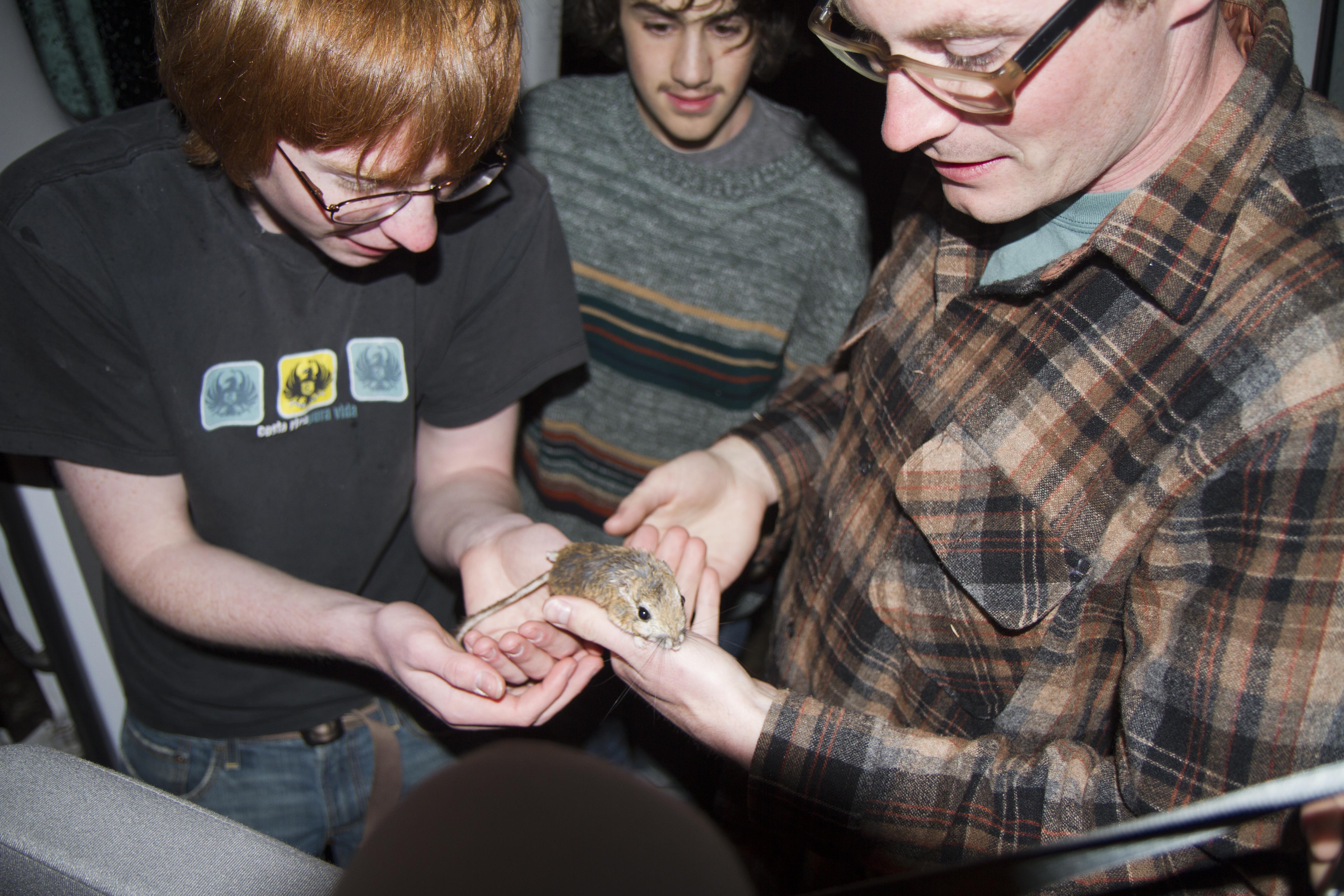
Night drives are one of the pleasures of being out in a place rife with mammals. You’ll never know what will be bounding along the road. What’s more, it offers and opportunity to acquaint yourself with a few of the animals more easily convinced to say a quick hello. Many cottontails and jackrabbits skittered about the roads on the nights Tristan, Ira, and I went out exploring but we were particularly keen to encounter kangaroo rats the most common of which was Ord’s Kangaroo Rat (Dipodomys ordii).

These desert adapted rats were surprisingly easy to find along the road on the nights I got up enough energy to drive us around. Most active at night, they spend their days deep in burrows and emerge in cooler weather to find seeds, which I learned they cache for later use. We spent a lot of time catching reptiles and amphibians during the trip, so it should come as no surprise that kangaroo rats were also handled. Luckily I’d learned from past experiences prowling for nocturnal mammals that they are beyond friendly in the hand, cuddling up, sitting calmly, or gently exploring your shoulder and hair.  (You may take issue to catching wild animals simply to admire but I think the benefits of understanding and appreciation that result far outweigh the negatives – every rat we caught was handled with care and released uninjured).

Bleary eyed from rat catching, I woke to rain and wind the next morning. The sage and rabbitbrush turned a pleasant saturated gray-green to match the weather. Us Seattlites weren’t going to let the rain hold us back and besides this weather was needed. According to Duncan, a director of the field station, it was drier than normal, with 60% less rain than the average. The state of the more pluvial loving Greasewood (Sarcobatus vermiculatus) was evidence of this, having lost most of their succulent leaves in response to the dryness.

Again we had a full day ahead of us and we struck out on a similar route we’d driven our first full day. This reaffirmed my notion that repeat visits gain you new, different sights. Almost immediately we noticed Clark’s Grebes amongst the Western Grebes on Malheur Lake. Stopping to admire one and some Cliff Swallow nests, Adam spotted a rare sight, a Great-horned Owl nest beneath a bridge on a highway!

The rest of the day was spent tooling around, just like we’d done on days before but with more activity. We were treated to a herd of Pronghorns right off the highway – a cooperatively perched Golden Eagle (we visited a nest too) – hundreds more American White Pelicans (which I tried to sneak close to unsucessfully) – a Common Raven nest – for once a sitting Prairie Falcon (all we’d seen were ones on determined wing). And there was one more delight and total surprise, a Snowy Owl!

If you paid any attention to the news or nature in North America this last winter, you’ve probably heard about Snowy Owls being all over the place. Last season was a good lemming year and there were a lot more owls born, which means they need to disperse to find food, often very far from their tundra homes. Many young birds die when they get far south (and in the case of the first record in Hawaii are shot….). That fact was not far from thought as we crept up to this shining white emblem of the North, sitting placidly right off the highway. The theories to explain it’s reluctance to fly were that either it was very sick or that it was stuffed on abundant food. Snowy Owls eat lots of waterbirds in addition to rodents, which could very well have meant it was simply in a blissed out state of heavenly indulgence while the weather stayed cool. Whatever the case, we saw it three times during our stay and it seemed content, even with two trailer semis zooming by mere feet from its fluffy face.

There will be one more installment on the trip coming soon. There’s some star characters to be sure, spectacularly absurd obligates of the shrub steppe that lek. See if you can guess what I’m talking about and stay tuned!

comments 2

Malheuring Around Part 1

Hours of driving take it out of you. Even if you aren’t behind the wheel the whole way, you’ll feel tired after a 12 hour trip. There were a few birds along the way to ease the pain, fifty some Red-tailed Hawks, Mountain Bluebirds, a Great-horned Owl, a Prairie Falcon, and quite a few twittering White-throated Swifts.

In Burns, Oregon we stopped for food in a Subway. Accompanying our fine dinning experience was a sour colored water feature which began dripping on one of our party suddenly and vigorously from a crack in the drywall ceiling. The employee’s response resounded with familiarity of such nuisances:

“Oh, is it raining again?”

Welcome to Eastern Oregon.

On the plus side, and there’s always a plus side, we managed to coerce a friendly kangaroo rat to join us for a visit post dinner.


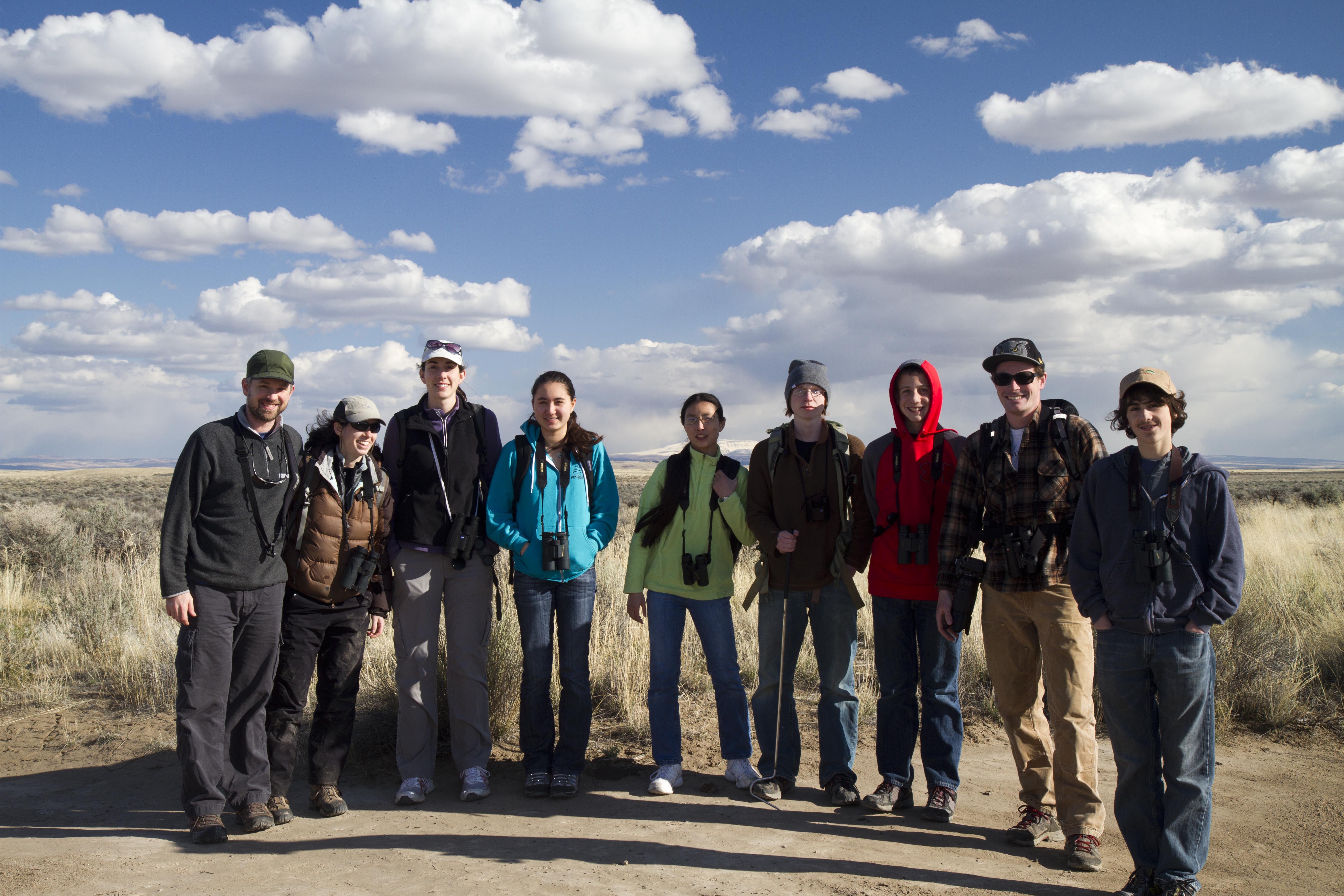
I’m sitting in Malheur National Wildlife Refuge, Harney County, Oregon. Yesterday we trundled out of Seattle in a van stuffed with food, camera gear, and skivvies for five days. Somehow we found room for six high school students and four chaperones. I’m out exploring the high desert, of lava fields and wetlands, with Seattle Audubon’s Birdwatch Program.

Wind was tossing the loose, eroding landscape when we all pulled ourselves from a much needed slumber. Ground squirrels (there was a continued discussion of their identity all day), Nuttall’s Cottontail, and Black-tailed Jackrabbits didn’t seem to mind the buffeting and the cold. Neither did the California Quail. I was a bit concerned because I knew wind wouldn’t favor birding.

Feeling like we’d entered an entirely different vehicle, we spread out in the emptied van and readied for a day of birding. For some, like Adam (who you’ll hear from below), this was a new habitat full of new species. For others like myself, though I’m far from an old hand, we’d been here and explored a bit. Either way we had a blast.

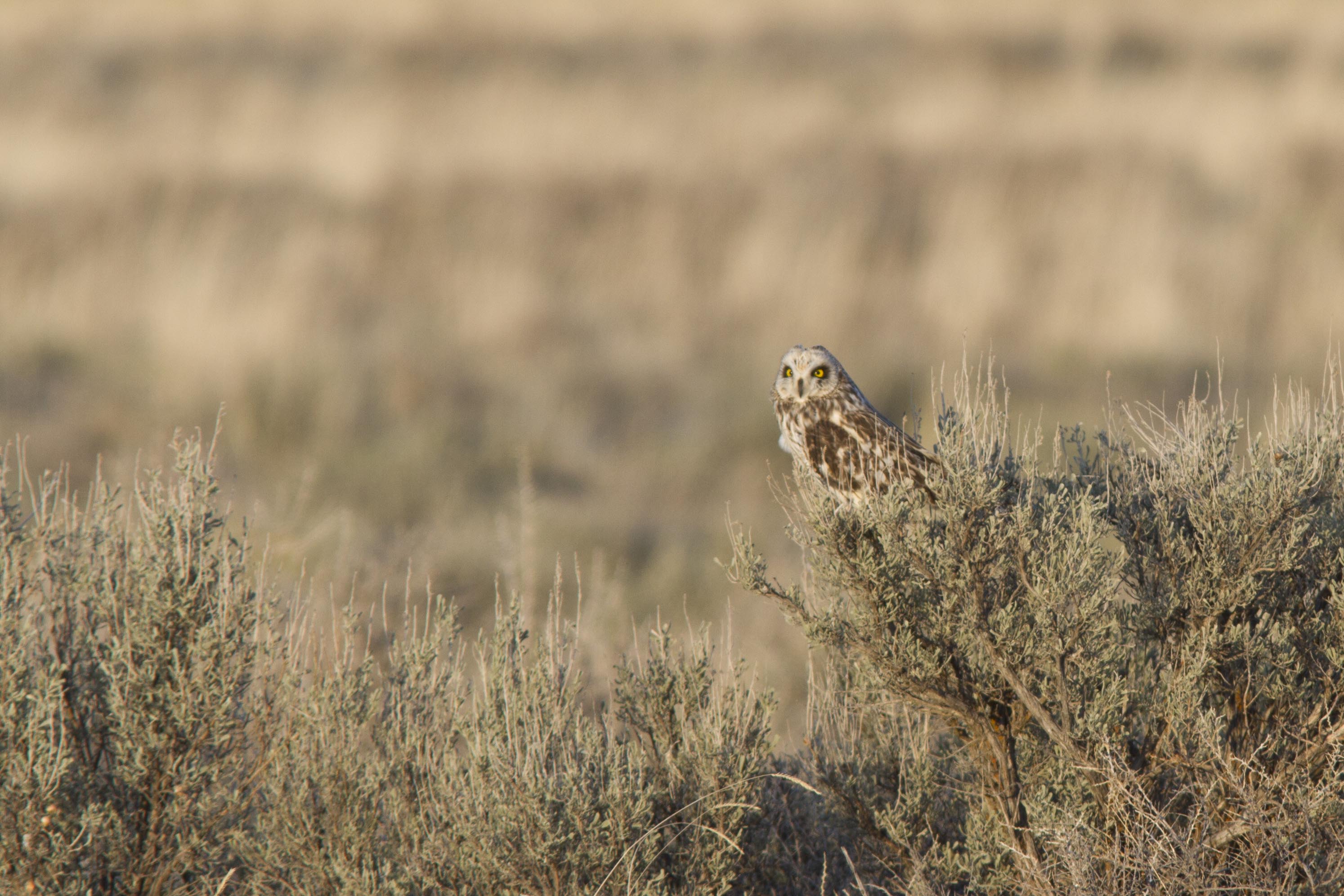
People visit the area for various things. The geology alone is spectacular, consisting of eons of erroded lava and I’m pretty enamored with the shrub steppe ecosystem in general. Yet birds always manage to top the list. Waterbirds flock here because it is an oasis in the desert, excellent breeding habitat with abundant food and safe nesting areas for a myriad of waterbirds. Though a very dry and hot for much of the year, there’s a good amount of open water between the lakes and ponds of the refuge. While National Wildlife Refuges are largely purposed with managing waterfowl populations this also means that other animals are about too. Large ungulates like Pronghorn and Mule Deer stand out most, but Coyotes are common and rodents and rabbits abound. With many small mammals come many raptors. And if you get tired of birds of prey and waterbirds you can jaunt over to some sagebrush and find a whole new community of birds there.

With the first day past, we’ve clean up a lot of the birds that are present. This is the “shoulder season” in many ways. Most of the songbirds have not arrived yet and many of the wintering waterbirds are only around in low numbers. No matter, we saw a lot of flashy, sought after birds.

A target bird of one of the teens, a Ferruginous Hawk, flew by within the first half of the day. Ross’s Geese were a nice surprise, sitting for comparison with a few Snow Geese. Black-necked Stilt and American Avocets gave our mobile blind cold shoulders, but we saw them well anyway. Franklin’s Gulls, Sage Thrashers, Loggerhead Shrikes! Birds, birds, birds!

The most notable for me were the multitudes of American White Pelicans, at least 400, which soared overhead, sailed across the horizon and sat majestically in bright groups that shone across the xeric landscape. Adorned with their breeding “horns” (growths that develop for the breeding season on the upper mandible) and neon orange faces, they looked to me the kings of the shallows.

Probably the most numerous besides blackbirds were American Coots. You could sail a rock blindfolded and probably hit one. Their comical waddling and strange noises prompted an amusing quote from a student:

“If any bird makes being a bird look difficult it’s a coot.”

And in some ways he was right. They were the most numerous dead animal we found all day.

It was still cold in the afternoon but the sun soon got to us. After a much needed siesta we explored some proper shrub steppe habitat. A good deal of people, even honest naturalists and birders will see only monotony in such ecosystems and I made it my goal to erode that mentality a bit with the students. It didn’t help that the wind and early season meant many of the migrant songbirds that are obligates of the sage were absent but it forced us to look at bit harder for things to enjoy. A Coyote track, scat filled with reptile exoskeletons, some cryptobiotic crust. We still saw plenty.

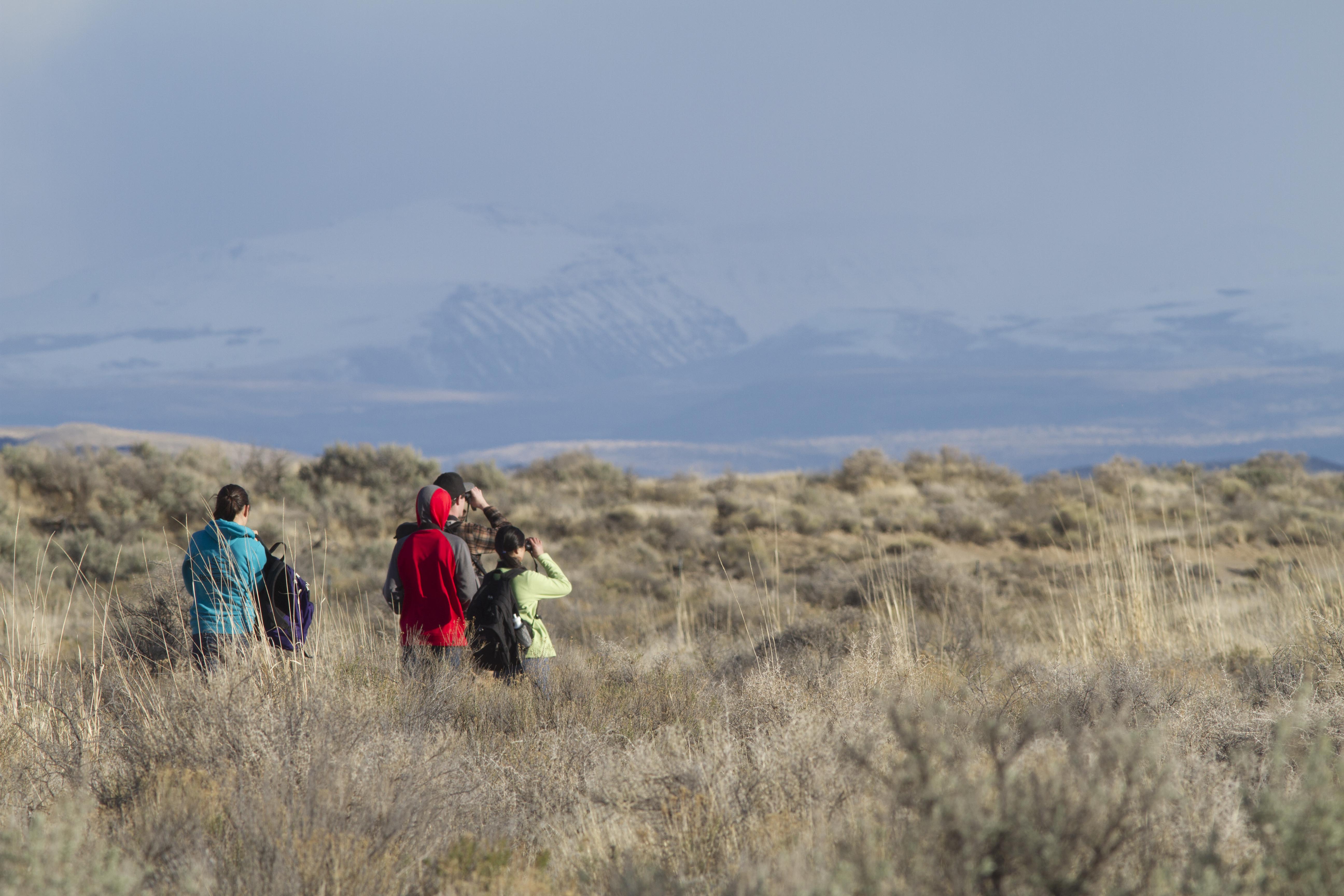
Evening set and the Short-eared Owls changed shifts with the Northern Harriers. Snowy Steens Mountain caught the last of the sunlight as the storm clouds lifted, revealing the tall peaks. We watched a Coyote drooling after a group of geese, laying in wait for an opening in twilight. Black-crowned Night Herons and White-faced Ibis flew dark across a brilliant sunset. Our light had gone for the day.

Adam, a member of Birdwatch had this to say about his time out on the range:

“On my first day in Malheur I saw at least 20 new birds. The habitat is awesome and something I have never seen before. The sagebrush habitat holds many different types of animals including jackrabbits, scorpions, and Sage Thrashers. I learned today that Malheur has many different weather patterns from very sunny to all the sudden cloudy and very windy. I will never forget my first day day here.”

Sounds good to me Adam! Stay tuned in the next couple days, I’ll have more to share and a few more dispatches from the students before we are headed home.

comment 1

A Very Busy Spring

Editors Note: This was written several weeks ago.  Spring is in full swing at this point.  The fact that this was composed so long ago is telling that I’ve been out and about, working and playing a lot.  This is no less telling or interesting despite the tardiness of my actual posting of it. 

Spring is here. The vernal equinox past. Suddenly the birds are singing, the flowers bloomed, and my vegetable garden flourished.

Almost.

Approximations are a rule with the natural world, that’s what keeps those of us that are deeply enamored coming back. No lines can be drawn without finding contradictions just around the bend.

At the very least, it is true that our days in the Northern Hemisphere are getting longer.

As I’m writing this, all my body is telling me to be outside. A rare March day is afoot but I’ve a resolve to get this written before I get lost in the revelry of spring sun in the Pacific Northwest.

I’ve been in my new garden all week. For the first spring in quite awhile, I’ve had the opportunity to start a vegetable garden. Some might not immediately see the connection between an urban garden and natural history but they should be considered inseparable, specifically for the urbanite.

If I were to guess at what first got my curiosity started as a child, it probably dates to crawling about the side yard of the El Segundo storefront where I spent my first years. My parents, artists, hippies, whatever you’d like to call them (I usually just call them Mom and Dad) had the good foresight to get me outside. Sure, this was urban Los Angeles, but I was getting my first taste of nature among the succulents in this small space.

Several years later, we moved to the Seattle area. My mother became a master gardener, my father and I became the labor. In those early days I found weeding and meticulously plucking slugs and cutworms off plants a chore (in fact it was, I got my allowance that way). Whether or not it was intentional, my parents’ insistence that I be outside, that I participate, garnered a deep seeded appreciation (pun intended). Like kids that have grown up on farms or in rural areas, plant life makes sense. In turn this furthers my understanding of ecosystems and especially birds.

Messing around in the garden this week I accomplished a lot in terms of getting ready to have spring vegetables, but I also enjoyed a side benefit of getting to know my new neighbors. A pair of American crows, displaying notable sexual dimorphism (the male hefty next to his mate) have started to collect sticks for their nest. Bewick’s wrens are rampant, singing all day, poking about fence lines. Holdover winter flocks of golden-crowned kinglets and brown creepers are beginning to sing during foraging efforts. American Robins are singing non-stop and getting feisty, chasing each other in the median strip in front of my house. There is no shortage of song these days.

My meager garden work finished, I decided it wouldn’t hurt to take a jaunt down to the local park. I’d been wanting to check the status of the native plants, to look for flowers and fresh foliage. So, it was off to Ravenna park.

I’ve always thought an important trait for a naturalist is forgetfulness in the face of nature. This is a theme I’ve touched on before and others, far greater than myself, have also commented on it. I’m reading Wild America by Roger Tory Peterson and James Fisher at the moment and have had fits of laughter in hearing these idols of mine running out of gas, losing wallets, and best of all, binoculars. We are all alike in losing track of human realities in the face of birds and landscapes. It was 4 PM before I realized I’d not eaten, had water, or done anything to satisfy bodily needs since 11 AM.

The reason being was that the forest of Cowen-Ravenna Park was awakening. In shambles from disturbance, by no means pristine, with a creek that still stinks of city runoff, there is still much to enjoy in this alleyway through the urban world of Seattle. Restoration is in full swing too, sapling cedars the most obvious of the newly planted. The creek itself runs all the way to Union Bay on Lake Washington from Green Lake, finishing adjacent to a favorite spot of birders, the Montlake Fill or the Union Bay Natural Area (natural in a primordial sense it is not). While only a section of this fragrant trickle is daylighted (1.1 km through the park), before 2006 when a project to show it the light of day was finished, it was practically hidden. Standing next to it, I have hard time believing this creek ever had salmon spawning beneath old growth timber lasting as late as the 1920s.

Disconnected from city sewage and flowing once again into Lake Washington, Ravenna Creek is a great escape for the cement weary.

Indian Plum has already made its charge into new growth, the earliest bloomer in this region and I was not surprised to see it flush with creamy pendant blooms and fresh green leaves. However, as I descended from Cowen Park, the “top” end of the creek, I saw hints of pink amongst bare branches.

“The Salmonberry is blooming!” I practically yelled in excitement.

Really, this is no surprise, just a welcome bit of color to match the vibrant birdsong. Pacific Wren trilled endlessly, a Downy Woodpecker called, and even Ruby-crowned Kinglets, not destined to nest here chortled away, flashing scarlet crowns. I always see and hear birds when I walk in the forest, it was just nice to have the yearly renewal of activity.

I listened, with the delusory hope that I’d hear something other than the Anna’s Hummingbirds buzzing about. Rufous Hummingbirds time their arrival with the blooming of Salmonberry (along with other plants). I kept this in mind, but I also was convinced that it was too early still. Taking a guess, I’d say there were probably only 10 percent of the Salmonberry blooms I’d expect in the coming weeks. Then I’d see my first Rufous. (Note: And I did) 

Along with the discarded trash that’s found a resting place in the creekbed, Skunk cabbage was flowering and leafing out. I was humbled, even in a landscape I feel a belong to, where I’ve come of age as a man and a naturalist, that I knew next to nothing about this plant. How was it pollinated? How did it propagate and spread? Getting odd looks from passersby, I squelched over to get a closer look. (In retrospect, I remembered that these plants are stinky, in this case, meaning they are pollinated by insects attracted to their stench).

Where am I going with this diatribe? I’m not really certain and I think that’s the point. One shouldn’t always have to worry about purpose or goals when enjoying the outdoors, I just had a mind to say a few things, to see a few things.

A Varied Thrush half sang from the shadowed crown of a small Western Red Cedar. I’d gone out with an eye to see things, not a checklist to fill out, and been thrilled at every turn.

Back in the garden Yellow-rumped (Audubon’s) Warblers chipped above me in the trees. Any impetuous for time outside is good in my book.

comments 3

What is Adventure anymore?

The day was unusually clear, a bite to the air and bare deciduous limbs the only reminders of the season. We stood at the mouth of the Elwa River, watching the sanguine sunrise over the Strait of Juan de Fuca and Vancouver Island disappearing into ocean mists. I thought of what came before. Of the strong Coast Salish tribes, striking off into the strait in dugout canoes made of cedar. Captain George Vancouver sailing in, charting the coastline, naming prominent landmarks after his benefactors and friends. The time before when vast glaciers would have dredged the land that would become the strait itself as well as scouring the Olympic Mountains to my back.

My friend Tyler and I were on a day trip, to one of the most Northwesterly points in the lower 48, Cape Flattery.

A few miles before the Makah tribe’s reservation and Neah Bay, we hit a Bobcat. Driving around a corner, speeding through a twenty year old Douglas Fir plantation, the cat ran right in front of the car. No chance to avoid or brake. It hit hard, with two jarring thumps. Screeching to a halt, we wanted to find the animal we presumed was either fatally maimed or soundly dead. All we could do was curse. Tyler had seen the body go flying, dislodged fur in airborne puffs. Scouring the roadside, there was no evidence of any vehicular violence. Perplexed, we stood as cars sped by mere feet away, buffeting us with their wind and threatening to throw us the way of cat. No one seem confused or interested in why we were standing on a lonely stretch of highway looking glum. Cutting through our silent mourning and confusion a Hutton’s Vireo scolded from the other side of the road. I stifled an urge to start laughing uncontrollably and chuckled quietly, only to keep from getting teary. Who knows what happened to that poor cat.

We kept pushing on, stopping to look at birds on the shore occasionally, hoping to discover something rare. Our decision to drive all the way out to this point meant too much sitting in the car but because it was so far away from where most people birded regularly, we might have gotten lucky. Ultimately it was just a long drive. Somehow though, when we’d walked the three quarter mile trail to the end of the state, looking out at Tatoosh Island in winter sun, I couldn’t diminish a feeling of accomplishment. The sun was already descending, casting rainbows through spray dashing against the dilapidated coastline and towering sea stacks.

The next week I was on the other side of the Cascade mountains, snowshoeing alone above Cle Ellum Lake. Besides the distant, anxious whine of snowmobile engines in the snowpark at Salmon La Sac, I was alone. Ill fitting boots held back a more serious hike, yet I also felt accomplished with my meager ascent of crusty snow in the open coniferous forest of the east slope. On the way down I found Mountain Lion tracks, old, yet recent enough. The hair on my neck rose and things felt wilder than before.

Weeks later I was in the Paradise Valley on Mount Rainier, again on snowshoes but in fresh, deep powder and guiding a group for work. One of the clients turned to me as the eight of us stood viewing the partially obscured Nisqually Glacier a thousand feet below.

“Do people normally get here? Because I’m feeling quite accomplished right now.”

What exactly is adventure these days? Is what I might call an adventure anything to be proud of these days? REI and The North Face sure as hell make it seem like everyone goes trail running in uncharted wilderness and dozens of companies will happily sell you canned experiences deemed “adventure travel.” I am not criticizing this market (for one I am employed by it), more musing on it. Do our adventures seem less noteworthy, dull even, because now they are available to the masses?

People have always been pushing the limits. With so fringe seeking these days (and more people), I occasionally feel I’m worthless if I don’t risk my neck to achieve some feat of endurance. Like a few of my friends, part of me wants to be an adventurer like the old days. You know, the misanthropic, gun-toting, racist white male, blazing an unknown path to conquer nature. Well. Not exactly. However I do pine for days when more of the world was uncharted than today. I’ve done a lot that most would consider adventurous but I have a hard time calling it much beyond work or fun. I tend to question the point of the adrenaline and travel propaganda I hungrily gobble up in Outside Magazine, (which I hope to contribute to someday). Are these people pushing boundaries just to be seen doing it? Again, does it lessen the experiences available to us?

Slowly, I’m discussing a feeling I get from time to time: that there is nothing left to explore. I’ve spent a greater part of my life romanticizing naturalists like Alfred Russel Wallace, David Douglas, and modern equivalents like Jared Diamond or even E.O. Wilson and Bernd Heinrich. As absurd as it sounds, when I envision the intellectual and natural historical adventures I aspire to, I can’t help but think that it’s all been done. That my life is mundane and soft (the latter is true in relative terms).

That is an absolutely absurd and negative viewpoint. Downright ignorant really. We don’t know everything, we haven’t seen it all, and we never will. So I can rest easy knowing that just because I likely won’t get a bird species named after me, doesn’t mean I won’t have an opportunity to contribute to the world. Contribute to knowledge or appreciation or preservation and conservation. Adventure is grounded in questing after something and can be equally in your backyard watching insect behavior through a hand lens or jumping into the Congo blindly. My epics will always be reliant on the same imagination and excitement I’ve had since childhood. The locale doesn’t matter. (Read: has pen and camera, binoculars, and a bag too full of field guides. Will travel.)

And that reminds me. I am not alone in being an adventurer, seeking lofty and humbling moments with nature across the globe. Over the course of the next year I intend to touch base with people I consider contemporaries in their thirst to explore. These are the people I can almost promise you’ll be hearing about as the years pass (and in other places far more noteworthy than Wingtrip). Writers, photographers, scientists, they are all doing interesting and important things. So stay tuned for the first up, my friend Zachary Shane Orion Lough of Sail Panache.

comments 2

Was it Snowpocalypse for the birds?

So it snowed a little while ago here in Seattle. We tend to make a big deal of it around these parts because snow in the Puget Sound basin, down near sea level, isn’t too common. That said people in Seattle tend overreact to snow. My parents, nervous about me driving to their home from a friend’s, made a comparison of a seven semi pileup on a mountain pass to going across town. We lose power now and then from snow laden branches falling on power lines, but in general, everyone makes it through just fine. While we sit inside our homes with plush blankets, disposable toe warmers, and insulated mugs spilling with spiked hot cocoa, I think mainly about what’s going on outside.

The bird feeder is a major center for my avian education. I remember my first feeder, brimming with sunflower seeds, suspended from a porch beam by a silvery, low gauge chain. The fragility of life was brought to my attention when a lone Pine Siskin with what appeared to be a tumor, collapsed on the deck, as if waiting for the end. I “rescued” it and resolutely watched it die in a box. Yet, when it snowed I almost always realized how tough these birds were. There was no way I could handle being out all day and night in the frigid weather but birds weighing a couple ounces were.

Stuck at home, I settled in to watch my feeders. To some of the more pragmatic of birders, a feeder might seem boring, lacking huge diversity or unique species. To me, recognizing the same individuals, understanding the various behaviors, seeing the pecking orders, and that occasional newcomer – these are essential parts of my appreciation of living creatures. Normally there’s a peak in bird attendance, essentially centered around dawn and to a lesser degree dusk. Many days I am either out of the house before light or I am catching up on sleep, missing out on the tidal flux of bird life in the yard. Thus it’s a luxury to cozy up by a window and be still.

Activity in the cold, snow or otherwise, is necessarily high. High metabolisms work hard in cold weather and even the hardy species need an almost constant stream of calories. For a photographer and a thoughtful observer, this means many more opportunities for comprehension. So, instead of being cozy inside, I was dressed to endure the weather, crouching, laying or standing as the snow settled on my shoulders and my camera.

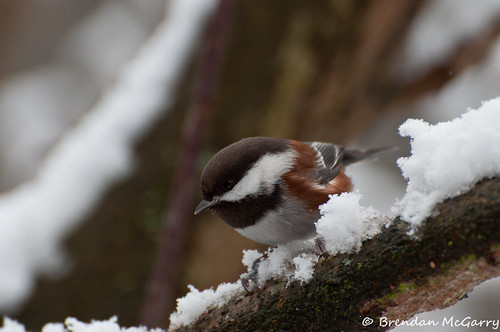
Possibly a bit cruelly, I was taking advantage of their desperate hunger. They had to be at the feeder or finding food elsewhere. By standing nearby, I was forcing them to get over my presence, my slow, calculated movements and possibly altering their behavior enough that I wasn’t going to learn much. The Chestnut-backed Chickadees and the Red-breasted Nuthatches were vocal in their annoyance, but then again, they are nearby and lively when I fill the feeders as well. However, not until two days of posing with my camera did the sparrows come back, albeit cautiously. Fox Sparrows and Spotted Towhees would creep in and scratch away when I was absolutely still. Did I influence the survival of these birds?  Probably not.

There are some that attempt to paint feeding birds as an ethical issue. Suggesting that people shouldn’t have bird feeders because they encourage dependency or that feeding hummingbirds sugar water is somehow like supplying them with junkfood (it’s processed sugar, I’ll give them that). Maybe a few birds are killed at the feeder, either because the neighbor’s cat is outside (a far larger issue) or maybe because they strike your window, being in close proximity to your home. For the most part I dismiss worries about feeding birds. Paramount is that the educational value, the opportunities for appreciation far outweigh the potential ills. Besides, absolutely nothing is lossless. I’d wager that driving your car to go birding or hiking kills more birds than having a bird feeder does. Hummingbirds are getting essentially the same sugar they’d get from a flower and they don’t sit around and starve when you forget to fill your feeder. (Hummingbirds are a special winter issue in the Pacific Northwest because our Anna’s Hummingbirds are resident, though only recently becoming so. People feel rather possessive of their survival because we likely influenced their residency). I have no concrete proof but I’m almost certain that in the vast majority of cases, if a bird isn’t finding food at your feeder, they leave.

My favorite thing about living in proximity to mountains is that we are witness to not only latitudinal migrants but those that are altitudinal. Birds move around for all sorts of reasons, some are seasonal and some temporary. Here in Seattle, when it snows in the lowlands, it’s almost always dumping in the foothills and above. There’s a whole cohort of birds that if they had their way, would stay in the more forested and mountainous regions. So, when it snows hard, new birds show up.

Variety is the spice of life right? I’m not nearly so absolutist to believe that completely, especially in respect to the natural world. However when I saw that flash of yellow dip to my suet feeder, I was nothing but thrilled by the surprise. Our first Townsend’s Warbler had come calling.

The warbler was there for about a week. Along with the two Varied Thrushes eating seeds and suet bits on the ground (this was the first time I’d seen them do this anywhere), we had a little more color gracing the white expanse. More siskins and goldfinches dropped in from high above than normal. Yet, I was still more enamored with the Townsend’s than anything else.

Most Townsend’s Warblers head further south for California and Mexico come winter. A few decide they can stick it out in the lowlands. They join a mixed flock of chickadees, nuthatches, creepers, and kinglets. Or they find a suet feeder to get them through our generally mild winters before heading for the hills again to breed.

Standing out in the snow, snapping shot after shot of this flirtatious warbler and the more common patrons, I was struck by a number of questions. Where did the less frequent birds go when they left? They were all gone after a week. I surmised that the snow had pushed them out of their normal set of behaviors and to our yard desperate for food. Did the Varied Thrushes head back to the foothills, the forest, or were they still around, just not at our feeders? Was the Townsend’s Warbler just spending time foraging in its normal domain, higher in the conifers? There are large Douglas Firs all about my neighborhood, habitat all unto themselves and quite easily hosting a lone warbler. I hear Golden-crowned Kinglets and Brown Creepers high in the trees nearby and yet I almost never see them in the yard. (EDIT: today, while talking to my boss on the phone, I watched a Golden-crowned Kinglet bathing in a bird bath outside, brilliant crown erect like a matador’s flag).

What always sticks is that these temperate birds aren’t bowled over by the infrequent bouts of cold or snowy weather. They know how to survive all the same. Instinctual behaviors are fascinating and sometimes inexplicable. Does a Dark-eyed Junco from the Rocky Mountains know how to survive snow better than one living in or around Puget Sound? I don’t know and I haven’t found an answer in the literature. Somehow I doubt it.

comment 0

Books for Sale!

I suppose writing, taking photographs, designing, and getting everything just right, even with a small book, is a decent endeavor. Truth be told, I had no idea what I was getting myself into when I set out to create a small book. This was a trial and error experiment and an offer to people who backed my Kickstarter campaign last winter. I’ve never been efficient at getting entries on Wingtrip without making sure they’re relatively perfect (yes, errors still happen), despite knowing that blogging is more about posting and fixing later. Perfection seemed necessary for this book and now it’s finally done.

The books I owe people have “gone to press.” But I discovered that I have an opportunity to sell what I created in an ePub format. To be fair to patrons who helped support me at the level that received this book, I will not be offering a print copy (EDIT – I cannot for the life of me figure out how to get rid of the physical copy as an option, so it’s still on there, slightly marked up.  My patience and computer time is full tapped for the day). Equally so, small run, self published books are expensive and I think it’s almost outrageous that a copy is almost $40 for a paperback version. I’m not discrediting the work or the content, just saying I wouldn’t expect anyone to buy an 80 page book for that much. If someone feels very strongly about having a physical copy, we can talk about it elsewhere.

All in all I’m very pleased with this rendition of my travels in Southeast Asia. I’m excited that I have an opportunity to share something that I worked very hard on. Tempted by Ecology: A Naturalist’s Travels Through Southeast Asia is full of what I think is good travel and nature writing. The photos aren’t too bad either!

There are a couple ways to read/download this. I do not personally own an eReader or tablet but the format downloaded is a very universal ePub file. I’ve had luck reading it with photos visible with the Firefox add-on for reading ePublications. Adobe Digital Editions didn’t like my book however and MobiPocket Reader didn’t seem to want to display my images aside from the cover photos. My suspicion is that an iPad or iPod touch will work the best, but I have no way to test that at the moment.

Here is a link to buy a copy for yourself. At $4.99 plus tax this is not a bad deal if you ask me. (In the near future I might have a friend work with me to get this published in another venue, stay tuned).

Thanks for all your support and your readership. A big goal for the coming year is to have more on Wingtrip. I hope you all continue to coming back with a thirst to learn about and enjoy nature, birds, and nerdy hijinks.

comments 2

A (Photographic) Year in Review

It’s been a year since I left for an adventure in Southeast Asia. With the extremely tardy completion of a small book I made for those who supported my Kickstarter campaign for the trip, I started feeling like I’d never be on the road again. Modern expectations, the realities of money, and my desire to be a part of a stable community all seemed to be working against me, pulling me down. Yet, instead of dragging myself down the anguished path of the grounded traveler, I decided that some careful reflection was in order.

This year I’ve been a lot of places, there’s no doubt. From the temperate land I call home to the Asian tropics. To the crest of the Sierras and down to the Great Basin. Consciously or subconsciously, mountains played an undeniable role in my explorations. I was in the the shrub steppe of Steens Mountain in Oregon, the forests and alpine of Mt. Lassen in California and Mt. Rainier in Washington, the elfin evergreens of Doi Inthanon in Thailand, eruption scarred Gunung Sibayak in Sumatra, and the ancient oaks and tree ferns of Gunung Kinabalu in Borneo. In my home I wound through the high desert of interior western North America, the temperate rainforest of the Pacific Northwest coast, the snow of the Cascade range, and the mosaic of forests in the Sierra Nevada. Abroad I traipsed the lowland rainforests of Borneo and clambered about the monsoonal forests of Thailand. I drove to the summit of Doi Inthanon, the tallest mountain in Thailand, and hiked halfway up to the tallest mountain in Southeast Asia, Gunung Kinabalu.

I was captivated by small natural wonders in my own backyard (literally) and stood in awe of a bull elephant thousands of miles away. Birds were held, eyes were met with Orangutans. Animal and plant life always figure highly in my explorations, communities shaped by the landscapes I learned in my wend.

That’s the key. My excitement and passion for this world result from a desire to learn. Curiosity rules my spirit, anyone reading Wingtrip will know that.

Below I’ve compiled a long (yet also very punctuated) series of images from my year in the natural world. If you are curious about the stories behind them please ask or follow a few of the links I’ve provided above (unfortunately, through a flaw in the program I upload photos to Flickr with, literally hundreds of the photos in other entries linked to above are not visible right on wingtrip though still on Flickr – when I have time to sit down to this arduous task, it’ll be fixed). There’s so much worth working to save, these images should remind us all of that.

In short, I’ve got nothing to complain about. I hope you enjoy these shots. May you all have a fruitful year of discovery.

comment 1

Rhodostethia rosea

Who the hell set my alarm for 3 AM?

Right. That was me.

Four hours later I was in Ephrata, Washington, doubting my sanity.

There were two cars in our caravan. Five demented birders. We had about twelve hours of driving from Seattle, Washington to Palmer Lake near Loomis, Washington and back. Where is Loomis? That’s what most people say.

A steel gray morning broke as we climbed onto the Waterville plateau, out of channels of basaltic flows that blanketed out over 4 millions years ago. When lava began to periodically sweep over the landscape millions of years before this, it was lush and wet, a polar opposite of the now arid high desert.

The sun wasn’t yet strong enough to budge the hard frost, an elegant tinsel about the trees lining the few farm houses dotting vast fields of cultivation. Agriculture reigns throughout this part of Washington like many others. We power through it and the small towns heading north. Bridgeport, Omak, Okanogan, Riverside, and finally, after almost five hours, Tonasket. Turn off to the Loomis-Oroville highway things start feeling rustic, exhilaratingly obscure.

If I’d told you we made a 10 hour drive to see one bird, would you think me crazy? Not just any bird, but a gull that without careful observation, most wouldn’t notice as particularly striking in basic (non-breeding) plumage. What about the dozens of other birders clustered around Lake Palmer squinting across the water, shivering and straining through scopes? My non-birder friends would hardly be surprised, but that doesn’t mean they get it. Yet, across the water was a gull that inspired this frenzy of driving. With a vague hue of pink, like the pale sunrise hours before, there sat a Ross’s Gull (Rhodostethia rosea), Washington’s second.

This bird is not only rare here, it is a sought after species in normal range.  This is a truly unique and superbly adapted species, exciting enough to see in its own landscape, let alone Washington. If you want to see a Ross’s Gull, typically you head to Barrow, Alaska in October for migration, or to Siberian or Northern Canadian marshy tundra during the breeding season. If you are truly demented, you could peruse the edge of arctic ice flows during winter. Spending one day with hours of driving across Washington and back, with the strong possibility of dipping on the gull, was odd. Yet, here we all were, some of the hundreds who visited the lake tucked away in the precipitous mountains of north central Washington, thousands of miles away from this bird’s home.

Named for James Clark Ross, an English naval officer who explored the arctic and the antarctic, the Ross’s Gull is monotypic (but certainly not unique in being named after a dead white man). Sole membership to the genus seems immediately appropriate when one is adorned in striking alternate (breeding) plumage. Despite their beauty, there is no accurate count of populations I’ve ever heard, or extensive information on their natural history. Territory on the edge tends to restricts our knowledge base. Their summer diet revolves around insects, abundant for the punctuated profusion of arctic summer. Winter is spent scraping by on algae and likely whatever else is found.


At first the atmosphere was reserved. When we arrived around 9 AM, they’d seen the bird. The deer carcass sustaining the gull’s vagrancy was still iced over; it had flown. Only certain portions of the lake were accessible or visible and there was concern that it would settle in an obscured corner. Thankfully, we didn’t have to drive the frigid lake shore for hours. The chase was fruitful.

A chase was exactly what this was. We saw the bird, watched it for about an hour, and then left. In many ways I was happy to leave. This didn’t feel organic or entirely enjoyable. Thirty birders huddled around watching one bird. Seeing it was a pleasure, how it flew and jumped above the drift ice in foraging behavior that seemed particular to a bird that winters on the edge of arctic ice. We had diagnostic views of dark underwings, a pinkish wash, a wedge shaped tail, and a small dark bill, but it never came close.

Yet something wasn’t right. Without sounding like a hermit or agoraphobic, I don’t relish this aspect of birding. Too many people vying for room, vying for attention to their ego. A crowd is still a crowd, even looking at a cool, rare bird. I didn’t need to hear the woman shouting out every little detail about the gull, as if she was announcing a horse race. I didn’t need to hear the pretentious discussions of binoculars, cameras, and trips. Too much showing off, too little reserve, appreciation, time spent learning, and ultimately, respect. Call me negative but this wasn’t what I looked for in a community. The numerous pleasurable people I spoke with were overshadowed by this miasma of obsession. I was reminded why I don’t always chase rare birds, despite admittance of enjoying adding them to my life list.

What was the point of driving all this distance, using these resources, to see a bird almost certainly destined for death far from home? This little gull had probably gotten lost, arriving here in attempts to find food. As I’ve grown older, this internal battle has raged, largely because I know the value of birding isn’t housed in vagrant species. Yet a part of me is still giddy in the chase or discovery. Some aspects of it warrant intellectual pondering, postulating on the why and how. Yet, the most benficial part of traveling to a remote locale for birding is that it can have a positive economic impact on the communities visited. Very simply, more habitat will be saved if a community sees gain in catering to nature oriented visitors. This works well around the world, a strong basis for local driven conservation efforts.

Passing through Loomis I considered all this. We’d seen other captivating things this day but had to rush by. Two ram Bighorn Sheep, crossed the road in front of us and stood veiled behind bare Douglas maples eying us from mere feet away. A deer kill, I’d guess from a Cougar (they tend to return to a kill and eat, incapable of devouring in the manner of wolves), was covered in Black-billed Magpie, Common Ravens, a young Golden Eagle, and two adult Bald Eagles. I counted a dozen Rough-legged Hawks between Palmer Lake and Seattle, wintering from the north.

The day ended with a beautiful sunset over Cle Elum and the eastern Cascades. I felt justified in having taken this trip but I still felt uneasy about aspects of it. How much of birding recklessly ignores impact in favor of valorous exploits? Does this make our pastime, in extremes or not, any better than something sneered at as explicitly impactful like say, snowmobiling? Did anyone learn anything in seeing the Ross’s Gull or did they just get their check mark?

comments 5

Discovery in the Past

Nature is a highly distracting element of my life. Last week I found myself standing in the middle of a city street in Seattle. A Merlin was running loops around a plethora of irate crows, jays, flickers, and robins overhead. The person who drove up, finding me blocking the road, slack jawed, with glazed over eyes turned skyward probably thought I had mental deficiencies. They kindly refrained from honking for me to move and sat in idle until I came to.

Nature even distracts me from other nature. I can think of a particular time, seven years ago, when just that happened.

I was walking with my fellow Spring Ornithology students down a mountain road in a range of mountains adjacent Ashland, Oregon. There was an air of excitement about the group, we were finding birds new to many of us. Several hours later we saw a Great Gray Owl, plopped stately on her snag topping nest. Yet, what caught my eye and drew me away was a delicately bent lily, emblazoned by filtered afternoon light. Everyone else walked off in search of a Hermit Warbler and I suddenly no longer heard its sweet chip notes from high in the conifers above.

This plant was captivating, the light fantastic, and I bent take a shot. Facing the ground, the base of the petals and the reproductive interior of the flower were a deep magenta. I’d never seen that pigmentation in a wild plant before. Following my eye, I captured an image that still sits among my favorites.

One of the follies in attempting to capture an ecosystem with photography is that the photographer is necessarily ignorant of some aspects. I was a naturalist and a birder long before a photographer but that doesn’t cover all bases. Even when I remind myself that I need to identify everything I manage a decent shot of, it takes a tremendous amount of effort when you are starting at zero. This was most evident in my recent time in Asia. My guess is that there are many so called “conservation photographers” that still don’t have a very complex understanding of the natural world they are immortalizing despite decades of experience (that’s ok though, they still produce valuable work). I’ve photos spanning a decade which I include species I am yet to put a name to. This lily until a few weeks ago was one of them.

Fawn-lilies, trout-lilies, dog’s-tooth violet, adder’s tongue, avalanche lily. All names for the same group of plants in the genus Erythronium. Plants are even more confounding than birds when it comes to classification and naming schemes. Depending on who discovered them and what colloquialism they ascribed, you can end up with any number of names for the same group of plants. Plant classification and names appear to change even more than the elastic and dynamic rearrangement of the class Aves. The pendant like flower I knelt to photograph was most certainly a lily, I knew that at the time. I thought it’d be in my trusty Plants of the Pacific Northwest Coast by Pojar and Mackkinnon, a staple for naturalists in my region.

Nope. And that was the end of it for several years.

This summer I decorated the wall of my room in the Sierras with various photos. I kept staring at this image and wondering. A summer of wondering past and back in Seattle, I asked my mother what she thought it might be. She knew it was a Erythronium, a fawn-lily, a native perennial. With small edible bulbs, they have delicate and attractive, pendulous flowers that are often early spring bloomers. After a bit of poking around in books and on the internet I figured it out: Henderson’s Fawn-lily, Erythronium hendersonii.

E. hendersonii is a fairly restricted species. In fact I was smack dab in the middle of the sole range of the plant, the Kalamath-Siskiyou mountains of Southwestern Oregon and Northwest California. While they are locally common and it’s amusingly silly, I felt a twinge of excitement in unwittingly photographing a pretty plant that was endemic to the small area I had been in (instead of it being an invasive or widespread plant). Walking through their typical habitat of open, dry woodland composed of Garry Oak and Ponderosa Pine, I’d stumbled upon a unique beauty.

The Siskiyou mountains specifically, are noted for their endemic plants and broad diversity. Wedged between the coast and the cascades with isolated peaks and a complexity of climates, it’s not hard to see how a wide variety of plants could have developed here. There is also a fair amount of serpentine that has been exposed for at least 5 million years. Soils over serpentine minerals are generally thin, poor in nutrients, a noted paucity of calcium, and rich in growth retardant, toxic elements. Serpentine plays a complex role in endemism around the world, from places like Mt. Kinabalu in Borneo and throughout California. Eventually specialized plants develop that can handle the poor soils, filling a niche and diversifying. I’ll leave it at that for serpentine, I’m no expert. The takeaway is that it’s no surprise I stumbled upon an endemic plant in these mountains.

Wait a minute though. Henderson? Who the hell was this Henderson? There’s thousands of old white men whose names are affixed to a myriad of organisms. Henderson happens to be well known for his role in Pacific Northwest botany.

Born in 1853 in Roxbury, Massachusets and attending Cornell University, he didn’t arrive out west until 1877 when he became a high school teacher in Portland, Oregon. From that point on, he started botanizing throughout much of Oregon and Washington during free time. He then successively Moved to Olympia, Washington to be a state botanist and forester and then to Moscow, Idaho as the University of Idaho’s first botanist professor, founding their herbarium.

Even after initial retirement in Hood River, Oregon in 1911 he didn’t falter in his passion for plants. He eventually became curator of the University of Oregon herbarium’s native plant collection, further enriching the existing collection. Strangely enough, he may have got this position by swimming across the Columbia River, a day before his seventieth birthday on September 8, 1923. The feat received statewide coverage and it may have caught the eye of the head of the botany department at U of O because he began a correspondence several days afterwords.  Who cares really – dude swam the Columbia river at age 70!

Not until a few years before his death did Henderson slow down. He passed in a nursing home in Puyallup, Washington in 1942 at the age of 88. His specimens number in the tens of thousands, filling the University of Washington, the Smithsonian, University of Oregon, and Oregon state herbariums, among others. Among his achievements, one of the most notable was that he was the first American botanist to explore the Olympic Peninsula of Washington state, a member of the 1890 Olympic Exploring Expedition. At least sixteen species of plants have been named after him, including some I’d already known but never considered a namesake. Included in these is a favorite, Dodecatheon hendersonii, Henderson’s Shooting Star, which he and his wife Kate found on a hike east of Portland.

I discovered all this merely prompted, more than anything distracted, by this one photograph and one flower. I can now see this “grand old man of botany of the pacific northwest” slowly stepping down hillsides and through valleys, stooping to enjoy a particularly beautiful specimen just as I had done. The appreciation of nature most definitely transcends human history.

comment 0

Last Glimpses of a Lost Imperial

Infrequently do I come across a video, a piece of writing, or a photograph that I deem worthy of sharing.  Reiteration isn’t something I think I can escape creatively by avoiding such props, I just don’t find it worth my time or very thought provoking.  Every so often however, I come upon something that is too good to pass up.  In the Auk (the journal of the American Ornithologists Union) this October, a paper was published concluding what most already knew, the Imperial Woodpecker is probably extinct.  But more importantly it also provided restored footage, the only images known, of this species.  This video is more than just another youtube clip, it’s a last documentation, a last glimpse of a bird that probably winked out thirty years before I was born.

At 22-24in long, this bird was nearly as long as a Common Raven, living among giant pines in rugged, treacherous mountains of Northern and Central Mexico.  A woodpecker this size of a raven is hard to imagine.  Because of typical human evils, that’s all we get to do, imagine.  Followers of Wingtrip know that I am a staunch supporter of museum collections and skins exist of these birds, but they do nothing to impress the passion of a live bird, knowing it in the vibrancy of animation.  You can measure, observe, pry details from the preservation but it doesn’t bring the bird back.

Out of human remorse, Imperial Woodpeckers are left as critically endangered on inventories by international conservation groups like Birdlife International and the International Union for the Conservation of Nature .  This is not a listing born of any information or real hope that these birds are still out there.  The 2010 expedition to the Sierra Madre Occidental of Northern Mexico (specifically Durango), where the film was made by dentist and amateur Ornithologist William L. Rhein gave little hope that any of these giants still exist.

Devastating logging practices long ago dealt with sizable stands of old growth pines in these mountains.  Even inaccessible stands, left alone in the onslaught of the 1940s-50s, are now being cleared to grow opium poppies or marijuana.  Birds of their size needed many acres (26 square Km) to sustain a pair, which simply don’t exist anymore.  Paired with massive habitat loss, these birds were considered useful in folk medicine, the nestlings a delicacy by the native peoples of the mountainous regions of Northern Mexico, and finally a pest to valuable timer needing extermination.   The last known bird was a recently shot individual in 1956, the same year this video was filmed.

Watch a female, her crest of curled feathers wobbling as she sidles up a tree.  The great flash of white on black of the flying bird.  This should be strong warning to my generation that we should not leave even less natural wonder for our children than our grandparents and parents did for us.

I’ll be thinking of the dead and the living this weekend, an appropriate thing to dwell on.