Back in April, I had an amazing, and typically tiring trip to South Texas. The following is my tardy beginning to a series on that trip.
I wasn’t entirely sure why I was doing this. Then again, finding yourself in the Houston Airport at 6 AM after a red-eye from Seattle, isn’t exactly a happy thing. Having a bevy of overexcited teenager birders under your wing makes it slightly better, but builds on the exhaustion. What we do for birding.
When I was in high school I was extremely fortunate. Unlike most young naturalists around the country, specifically those growing up in urban cities, I had a way to meet peers and explore without constantly having to rely on my generous parents to drive us places. Seattle Audubon had a high school program called Birdwatch and I’m still so grateful for it that I volunteer with the program today.
Last year, we had an excellent trip to Malheur National Wildlife Refuge, a break from the normal schedule of annual trips to more distant locales. This year we got back on track with a trip to South Texas. To birders this means a paydirt of species, normally well South of the border where tracts of subtropical forest linger. To the uninitiated however, my trip brought blank stares. I can’t really blame them, because as much as I love birding in the Rio Grande Valley, I couldn’t fathom living there. I don’t mean to sound rude, I’m just not a fan of insufferable heat and urban sprawl.
By midday on day one, we were all starting to feel travel weary, and we hadn’t made it to our first stop. Most of the students were too excited to sleep, mindful that every passing bird could be a lifer. When we’d stopped at (forgive us) Walmart to stock up on food, they’d spent their time birding from the parking lot. As we sped south through the dusty coastal plains of the Texas Gulf Coast, we started to see Crested Caracaras and White-tailed Hawks fly by. Crested Caracaras are restricted in the US and White-tailed Hawks are only found in South Texas. Not bad.
Now I’ve been to Texas three times before this, but that means nothing in terms of my ability to navigate by memory. As a result of too much technological reliance, we discovered that we had no paper maps and that Google maps wasn’t doing it’s job. With a minor meltdown involving not having eaten lunch, we finally made it to Laguna Atascosa National Wildlife Refuge.
The great benefit of having visited a place multiple times is that you only partially lust after certain species. I still carry a portion of the enthusiasm of the students, rushing out of the car before we could explain the timeline, but I’ve matured to the point where a missed species doesn’t ruin my trip. The birds wouldn’t become any more observable with frantic speedwalking.
When described by those who live in the region, Laguna Atascosa is called the last remaining wilderness in the Lower Rio Grande. In truth it’s the largest spread of protected natural land in South Texas. Driving through you get a feel for what it must have been like before the cows and the water sucking cities and agricultural land. This is a refuge famous for aplomado falcons, once extripated, reintroduced by the peregrine fund in 1985. Ocelot crossing signs dot the entrance road, despite the almost zero possiblity you’d see one there. The great clearing of coastal prairie began in the 1750s and colonists likely saw only empty land, not a vast, unique ecosystem.
The refuge was dry and the ephemeral wetlands were low. Most of the birds at the refuge we’d see elsewhere and later in the trip. I got the impression that many of our party felt the refuge was a bit of waste. What’s funny is that driving the slow circuit around the refuge, along the saltwater bay lined with yucca and the windblown thornforest topping the lomas (sand and clay dunes), was what I was most excited about. I’m always chasing wilderness, trying to grasp the ecology of the places I visit and was getting a small peephole into just that. As we drove the loop round the refuge, I longed to get out and explore, despite being away of how dusty, spiky, and tick infested the scrub would be. It’s best to not yearn for things that are out of reach, but I couldn’t help myself. There were secrets in there.
We ended our day of birding by driving away from a muted sunset, filtered through the seemingly permanent overcast miasma of South Texas. Pausing to view feral pigs in a corn field outside the refuge, I was reminded that this was just an island of habitat. The sprawling mess of strip malls, Brownsville, was where we’d lay our heads that night, but our minds were far from it, meditating on the remnants of wild South Texas. My slumber was a blank, heavy sleep of deprivation and a long day of travel. And this was just day one.
(A note from Brendan: The main purpose of wingtrip (which is now essentially only written on by me, unless there are tempted contributors out there) is to fuse words, images, and in the near future, video, in discussion of exploring the natural world (hopefully with a new design soon). This is sometimes a lofty goal and the lack of content only means that I am hard at work. I’ve recently gotten a role as a regular contributor to a small local newspaper in Seattle writing about urban natural history. It’s taken a good portion of energy to lately to keep up with it, work, and wingtrip (and my health!). But I’m back on the horse and I have a bank of stories that will be up in the coming weeks. I hope you all will enjoy and continue to come back. This is a big adventure and as any creative knows, it’s a road fraught with self doubt and a lot of rejection letters. Thanks for reading and your support, even though simple clicks!)
The book Sagebrush Country by Ronald J. Taylor had been sitting on my kitchen table (ie writing desk) for several weeks. That’s not to say I’d had time to study, but that at least I’d considered it. Re-reading the introduction, I remind myself that this mosaic is not singularly approachable and that I should just enjoy the time there: “Over this broad steppeland region of western North America – variable climate, topography, and species – the single most important unifying characteristic is the presence of sagebrush, usually conspicuous and often dominant.” As usual I can’t expect to know it all, even after years of practice.
I’ve visited Malheur Bird Observatory, or MABO as we call it, for half a dozen years. This isn’t the bird observatory you might envision, a place with an office, a lab, some interns, a lead scientist. In a ethereal way these things are all true. More substantially, there’s a shitter named Ziggy, a defunct shower, a fire pit, some platforms for wall tents, a well, and the most prominent of structures, the loggerhead shrike emblazoned water tower. I like to think of water tower as the center of the observatory, its height makes it the most prominent promontory.
MABO means many different things to many different people. Generations of naturalists have strung together days and months of their lives on this square of property butted against Malheur National Wildlife Refuge. I say naturalists because there’s a myriad of professional roles the visitors take up. We are all united by love of the natural world and a link in our influential professor Dr. Herman.
When I stand on the platform of the water tower and look out across the landscape, I get caught up in imagining this place before Europeans. I try not to get upset and point fingers, that’s not the reason for visiting MABO, but I find it difficult to watch the orgiastic jets of water from the irrigation on the neighbor’s plot. I prefer to pretend there’s nothing but our fire ring and miles of sagebrush and wetlands covering volcanic scablands between here and the slash of the Steens. Possibly it’s an immature approach to take. I enjoy the impassioned discussions by the fire and find the fervor of my contemporaries and elders inspiring. But I’m here to stare at the horizon and listen to Franklin’s gulls.
Many evenings we are treated to the sagebrush sunset. The mingled colors born of dust and steel laced clouds, desiccation and moisture at odds in the distance. We pray for rain, as we are layered with a temporary but palpable alluvial patina, like the seasoning on our cast irons but not quite as beneficial. You eventually forget about the dust, become one with it, and then it rains. Sometimes insufferable dust turns muck, sometimes it merely congeals to a comfortable walking surface. Every year it seems to be dustier, but that’s not an empirical statement (you have to be careful what you state around here, this is a scientists’ camp after all). Then again, who likes camping in the rain?
Migrant traps, that is verdant habitat and water in literal or proverbial deserts, are something that birders dream about. I’ve been to plenty and I still can’t quite decide how I feel about them. Certainly the birds are copious in the right circumstances, but the right circumstances aren’t always ideal for the birds themselves. On the other hand, birds will struggle in migration with or without human consciousness. Best to toss that twinge of guilt in with the twelve hour drive to get here.
Western Tanagers zip about, marmalade sundrops in the overcast sky. Yellow warblers sing their sweet songs and build their rotund nests of cotton fluff and spider silk. American White Pelicans soar overhead or flotilla on the waterways of the refuge. But don’t ask Dr. Herman why they fly in groups overhead, he hates that question. Sometimes the parsimonious answer is admitting that animals also do things for simple enjoyment.
Away in the desiccated shrubsteppe, you could convince yourself that you are miles from water. Botanize a bit, learn or re-learn species, enjoy the botanical biodiversity that persists where untrampled by bovine blundering. Hear the buzz of Brewer’s sparrows and notice the foolish swaying of a sage thrasher in the throes of territorial posturing. Maybe devote some patience to finding the loggerhead shrike nest that surely exists in a thorny greasewood of the alkaline playa. Several of us did, in succession and unaware of each other, witnessing the successive hatching of their young.
Yet, stooping to enjoy a dwarf monkey flower, just now poking through the soil, you hear the intensity of a willet overhead. You think to yourself, this is a desert (and you would be right). But just over the hill there’s water. Just as the storms mingle with the dust, the curlews, gulls, terns, pelicans, and blackbirds contrast with the sagebrush obligates. And the mosquitoes.
I always want to ramble off and drive somewhere, but it’s difficult to want to sit in a car when you’ve traveled so far already. Still, Page Springs at the base of the Steens, with yellow-breasted chats and ash-throated flycatchers usually lures a group. We’ll drive a portion of the central patrol road (once used solely to stamp out poachers) and enjoy the waterways of cinnamon teal and black terns. Diminutive and gaudy icterids, male bobolink swing around in circles over their wet meadows before evaporating into impossibly short grass. A few cranes and a few surprises every year. This is casual birding at its best, possibly with a beverage in hand.
I’d never seen the road up the Steens open this early and apparently no one else had either. The road’s probably always clear most of the way up, but who would want to deal with a track destroyed during the muddy melt? Our travel up seemed like an adventure, ending at a second gate just short of the Kiger Gorge vista we’d all desired seeing still laden with snow. Mountain bluebirds and wildflowers we’d never enjoyed brightened our day regardless. We were charmed by newly hatched killdeer, unsteadily precocial fluff balls. One joy of knowing a place is seeing it throughout the season and with a locked gate, this joy is denied most on this epic fault block. This was a special experience certainly.
Many complain about the drive, but only because most of us don’t feel much like packing up and leaving when the time comes. In truth, the roadtrip is part of the fun, there’s multiple ways to get there and always new things to see. I stare out the window and pick out plants and birds. A Ferruginous hawk nest and its occupants. Mustard, buckweat, lupine, locoweed, phlox, balsam root. It’s high speed identification paired with a hasty, harrowing breaking to the shoulder to jump out and poke around. If you aren’t in a hurry, you can take nine hours to drive what should take six.
I’m always aware there’s tragedy on the road. We watched six Vaux’s swifts plastered by a truck ahead of us. Two were too smashed to be made into study specimens, but four will grace the education vaults of a non-profit’s museum. I hate seeing birds die but I won’t lie, I also appreciate the opportunity for close scrutiny they present.
Busy with my (foolish) enduring goal of being a professional writer and photographer, it was easy to rush down to MABO and try to document. I always take pictures, I always write, but I had to force myself to ease back. This is the difficulty of my path, missing the divisions between life and work. My scientist friends, currently in the field or otherwise can make this distinction and are happy to relax. These are friends reuniting once a year, people who work as far away as Alaska and those who spend months apart from their loved ones to collect data and help inform the continued existence of the places we love. While I rush around, attempting to fuss with this camera or that, they are back enjoying stories from the North Slope or Mexican islands. After devoting too much time to learning a new wildlife camera and getting nothing from it, I swear I’ll bring no cameras next year. I’ll likely forget or change my mind by then.
This parcel of land evokes strong emotions and is equal parts inspiring while shaking up my resolve. When people talk about god or religion I try to assume they just talking about an abstraction of spirituality for the land. After all, the dust, the mosquitoes, and the frenetic swings of temperature remind all of us that the landscape doesn’t care about our comfort and all we can do is adjust. The shrub steppe, is a blindingly beautiful community and a harsh environment all in one moment in time. I desperately hope it’s around for my children and that when they crest the cascades and descend into the great basin, they’ll see a vibrant biological community, not a desiccated wasteland.
Bonus: I’ve been working on time lapse photography and incorporated off the cuff audio recordings I’ve made into a video.
Strip malls are the essence of vitriol, rising at the back of my throat. Who do people need several Starbucks or Walgreen’s within blocks of each other? The driver of the truck that was pushing us through this distracting mess of concrete read my mind.
“Lovely isn’t it?”
If I blurred my vision against the skyline, between the squat McDonald’s and Taco Bells, I could see twisted crowns here and there. Letting myself imagine we were in fact cruising through a Oregon white oak forest instead of what had replaced it, my heart rate slowed a bit. I’d driven this road half a dozen times with Simone, my friend, contributor to wingtrip, and pertinent at the time, a Falconer.
Rounding a corner, I looked at a corner lot that used to be full of mature Oregon white oak, now full of tasteless condominiums. They were built right up to the edge of the parcel of land that was our destination. Looping through the cemetery, we parked and geared up.
I’m always embarrassed by how much fussing I typically need to do when embarking on a photographic endeavor. But Simone had me matched, not with gadgets, but with animals to curtail. Otis, the diminutive beagle-jack Russell cross was quivering with excitement. He got a shock collar slipped over his head, not because he’s a bad dog but because we’d be close to a road and he’s prone to disobedience when on the scent of rabbits. Simone had to don her vest, a glove for holding her bird, grab a bloody container of miscellaneous animal bits, and grabbed an ax handle for beating brush. Finally, the man of the hour, Chase the red-tailed hawk, needed to be taken out of his box. All this was done in the parking lot of the funeral home, where, judging by the number of cars, a service was taking place. Simone’s been coming here since she first started as an apprentice and no one has ever said a thing to her about parking here. Then again, would you reprimand a woman holding a hawk?
We started out through the scotch broom and blackberries that are slowly being hacked back by the nearby community college. This is good for the potential of restoring a small bit of native Western Washington prairie but no necessarily great for Simone’s ability to go hawking. We were headed straight for the imposing mass of Himalayan blackberries.
You almost always look regal when carrying a bird of prey on your gloved arm. With Otis bounding behind her, Simone walked partway down the field before removing Chase’s hood. Releasing his jesses, he flew off with a jingle of bells, heading straight for his hunting perch, an adjacent telephone pole.
Falconry is not a hobby, it’s a way of life and something that you dedicate your life to. That’s one of many reasons why I’ve never delved into it myself, despite knowing that if I was interested, I’d have a teacher and support. When it’s hawking season in Washington, Simone is fully committed to flying her birds. She spends her time plowing through trashy lots of blackberries in Western Washington and agricultural fields East of the mountains with Chase, cruising random ponds for her Cooper’s Hawk Hula, and training her other two imprint falcons in between. This is a full time job, not a half-hearted hobby.
One day a few months ago, Simone, our visiting friend Danner, and I were headed up to go birding in the Skagit Flats. Danner and I met at her house around 9AM on a cold December morning, a lazy hour for birders, and apparently even more so for falconers. Moments later Simone burst through the door, soaking wet, holding her Cooper’s Hawk. She was beaming and informed us that Hula had gone for a drake mallard in the middle of a pond. Being at most a third of the weight of a mallard but possesing the notorious tenacity of an Accipiter, she wasn’t going to let go of her quarry. Simone had to crash into the pond, filling her pockets with water (containing her iPhone amongst other items) to keep Hula from drowning herself. This was all recounted joyously, while Danner and I stood and listened incredulously.
I stood by the edge of a blackberries as Simone crashed through, disregarding the brambles clawing at her. Otis, following suit, wiggled beneath the hooped vines and quickly began to whine in excitement. Chase watched from above, calling occasionally, waiting for his partners on the ground to flush prey.
Early on Chase made a dive and narrowly missed a rabbit dashing through an opening. While my intention was to stand back and watch, I quickly got caught up in the hunt. Cars zipped by a few hundred feet away, but easily forgotten as we were all focused, watching to see if Chase spied anything from his perch.
Chase started calling more frequently and soon we heard the scream of another red-tailed hawk. A pair of them circled in, unhappy that Chase was here, probably quite near their nest. They were a distracting element, always on the periphery, taunting and threatening this interloper with bells and loops on his feet. However, despite outnumbering him, they never got close enough to lay a talon on Chase.
Plummeting down and pounding into the ground, Chase was impressive. There were many near misses. I held my breath and I watched him try to find an opening on a rabbit that was frozen mere feet from me. All the while Otis was baying with excitement sounding like he was being killed, not following the trail of a rabbit.
The bloodlust I felt during this hunt is abnormal. I didn’t necessarily wish any of the rabbits we were chasing harm, but my presence inherently meant I did. Intellectually I enjoy the idea of hunting for my own meat and I’ve taken the lives of other animals in order to eat them but this rabbit was going to go to Chase. There’s an ethical cascade of issues that can arise hunting with a bird of prey, especially a bird that was once in the wild, like Chase. But I’m not one to start a debate on the subject of Falconry. I will say this: every Falconer I’ve met is beyond doting of the birds they partner with and respectful of the lives they take. If you find fault with this practice, I suggest you spend some time out in the field with the practitioners before you truly judge.
Our jaunt ended without rabbit blood but we’d had a good ramble though the patch. Simone lured Chase back with tasty cut up quail bits and we wandered back through the oaks, imagining we were in expansive prairie and not a remnant grove. Even with his hood on, he looked regal with beautiful coloration and an inherent power that had been demonstrated all afternoon. Red-tailed hawks may be common in numbers, but their grace in the air is breathtaking and you can’t help but admire every bird seen after hunting.
Yet, I still don’t completely get the dedication. Simone and Otis were covered in scratches, Otis had blood streaks across his face. I remembered that this favorite hunting spot was spitting distance from a cemetery, an wrecking yard, and a housing development. Did I mention that Simone is vegetarian?
Dawn was just breaking as we sped by Bellingham. I stared out the window, trying to quell my anxiety. Bald eagles held sentry over every field and rain was imminent, sodden gray clouds making it impossible to tell the North Cascades arched just to the East. Chasing vagrant birds makes me anxious.
I have inconsistent luck finding vagrants. I say “vagrants” specifically instead of “rare birds” because plenty of birds considered rare may also be resident. Recounting my American Birding Association list (a list of birds, vagrant or otherwise, confirmed and seen in the contiguous US, Canada, and Alaska), I was mostly reminded of past failures. For some reason, the worst culprits seemed to be ducks and gulls. These are big, hardy birds, fairly easy to see. So how in the world could I expect to see two birds that would fit in one of my back pockets?
Dashing off to see a bird, whether it’s a vagrant from Asia or simply an unusual occurrence for your state or county, is a time honored tradition in the birding world. People drive and fly countless miles, spending hours, even days standing in wait or circling around suspicious looking bushes searching for birds. We spend lots of money to see them too. The ABA (American Birding Association), even has a code scale by which to rate species occurrence. With codes ranging from 1 to 6, (1 are regularly occurring, 6 are birds that cannot be found e.g. those extinct or extirpated), the vagrants of the day were a 3 (Rare) and a 4 (Casual).
However, to be quite honest, birding by numbers makes me cringe.
I’ve struggled with the inherent issues of chasing birds elsewhere, so I’ll keep it short. I find chasing birds unromantic, fairly unintellectual, and resource guzzling. I also dislike the value system it places on an order of vertebrates that are all of worth and interest. Yet, I am still compelled to do it because I have a twisted love of seeing rare or unusual species.
Mulling this over, my parents and I crossed the border into Canada. While my parents are not ardent birders, they enjoy seeing birds more than your average person and we enjoy going on trips together. In fact, over the course of my adolescence they were darn-right indulgent of my passion for birds. Who uses their hard-earned American vacation time to take their kid on a birding trip to Southern Texas?
Our directions were very specific. Drive to Queens Park in New Westminster, a sleepy suburb of Vancouver, British Columbia. Once there, walk to the playground and shuffle around until you see the bird.
Bird one was a Code 4. A small, old-world flycatcher with red flanks and a blue tail. No one had seen it when we arrived, so we shuffled around, squinting in the understory of second growth Douglas Fir with the rest of the rabble there at 8 AM on a Sunday. The bird has a very descriptive name, the Red-flanked Bluetail (Tarsiger cyanurus). And for people who really don’t get birding, this won’t make any sense at all, I’d seen one before.
But, not in North America, and that was the crux of it. The last time I’d seen one was on top of the tallest mountain in Thailand, Doi Inthanon, where they winter. I was anxious to see it here and understandably nervous we’d driven 130 miles for nothing. I wanted it for my ABA list, not just my life list (the total list of species I’ve seen in my life). And unlike quite a few other occasions, we managed to see the bird within twenty minutes of arrival. The weight on my shoulders was lifted.
We followed it around for an hour, watching it flit about the understory just like I’d seen them do in Thailand. This little female bird, pleasantly adorned with reddish flanks and a blue tail (though not as striking as the males I saw), seemed totally at home here. Afterall, it’s a bird that breeds in Northern Eurasia and winters in the more temperate regions of Southern Asia. While I had my doubts about it returning to breed, I expected that unlike some birds that show up in strange places (like a Summer Tanager that showed up in Seattle in December), it was hardy enough.
The second bird, less of a priority and only rated as a 3, was just up the road in Vancouver. True to the oddity of vagrant birds, it was in a residential alleyway. Also a bird I’d seen before (but in Ireland), this was a stunning Eurasian finch called a Brambling (Fringilla montifringilla).
Similarly, seeing the Brambling was a breeze. We drove up, got out of the car, walked into the alleyway, and there it was. Another Northerly bird, it seemed totally at home, happily sharing a tangle of bushes with our native sparrows and finches. Maybe it was glad to have some company, being a rather gregarious bird, found in flocks of thousands in it’s normal range. A group of birders had gathered by the time we left, gushing over the Brambling, oblivious to the rain and the dingy alleyway they stood in.
My parents and I didn’t do a lot more birding that day, but made quick stops to see Snowy Owls along Boundary Bay and then in the Skagit Valley to see a Gyrfalcon. Both are birds many birders have never seen, especially if not from Northern areas. We drove over 300 miles in a day to see all this and some might call this odd.
And really, it’s all too easy to flaunt how strange the world of birding is, but I do it all the same. However, I’ll never be convinced that seeing a bird far from home, out of place, is more exciting than seeing it in it’s natural habitat. Chasing vagrant birds is a detached extrapolation of studying birds and while I may sneer at it, if it makes people get excited about and care for birds and nature, I’m a fan.
Sea lions barks echoed across the water. Wintering sea ducks foraged near the rocky shoreline. Out where the river washed into the bay Western Grebes and cormorants worked the currents. On land, a Fox Sparrow chipped annoyance at an interloper. A group of crows (could they be Northwestern?) searched the tide line for morsels washed in from the marine world. Below the surface a myriad of epics I’d never know about were unfolding; salmon would begin their runs into the funnel of freshwater irrupting through salt in the coming months.
You’d likely not guess that I was standing spitting distance from the second largest port on the West coast of the United States. That I was less than a mile from two superfund sites created by Boeing and other industrial giants. That I was gazing out across Elliot Bay to downtown Seattle.
Now I’d be the last to suggest that this, even with all the wildlife going about their business before me, was a healthy environment. However, the menagerie was somewhat awe inspiring considering. Puget Sound, particularly where the Duwamish River outlets into Elliot Bay (and more appropriately dubbed the Duwamish waterway because it is so altered), isn’t a spectacle of clean water. And yet, here were all these creatures.
I was here for a short sojourn away from the life of an urbanite. As much as I wish to distinguish myself from the city, it is where I am from and where I’ve lived for most of my life. In part I am responsible for the problems lurking in this ecosystem. Yet, that knowledge doesn’t detract from enjoying a world, one I am not intrinsically a member of, unfold in a little parcel of my favorite inland sea.
Subconsciously, I ask more questions than I realize, a slim number of which are answered. For instance, I wondered where the Barrow’s Goldeneyes I observed were going to disperse to for nesting. The males were beginning their masculine shows of head tossing, giving wild chase to each other. Pairbonds were being (re)established here, I knew that. But would pairs fly off to a secluded Cascadian lake together or head further North or East?
At first when I saw the movement, I was alarmed. Was that the bloated corpse of a marine animal, or….something worse? My immediate thought of death when gazing on the industrial wastes of shoreline below wasn’t unreasonable. Instead, I was pleased to discover four harbor seals, relishing an afternoon nap. They even seemed to be smiling in enjoyment of a secluded spot, free of annoyances, to doze. Their biggest issue appeared to be the occasional boat’s wake wafting in and jostling their half-submerged derelict dock. True seals, even when resting, are such excruciatingly awkward sausages on land.
Sleeping seals were pleasant enough to see, but not terribly captivating overall. However, a hilarious slapstick show was unfolding out in the middle of the channel. California sea lions, just like their seal relatives, are far from uncommon, but the bellowing, writhing mass of blubbery animals stole my attention. The object of all the upset was limited space on two floating anchors. Several smaller sea lions were in constant spiral around each float, looking for a entry point, occasionally wiggling into a small crack. This would typically catapult another into the water or annoy someone else enough to howl and bite their neighbor in misplaced anger. In the two hours I was near the floats, this never seemed to stop because the bellyaching groans were constant.
While the mammals seemed to be spending a lot of their time sleeping or jostling to do so, most of the birds appeared to be in constant search for food. On a dock down the shoreline I kept flushing a group of goldeneyes attempting to feed on morsels attached to the pilings. A red-necked grebe was ambitiously trying to swallow a large fish who was determined to not be swallowed. Bird life on the water seemed to be in a pedantic whirl of diving, resurfacing, and swallowing.
A rocky bit of shoreline along Alki often hosts some surfbirds or black turnstones, resting mere feet from the joggers and bikers trolling the coastline. Their sleeping forms blended well with the surf stained rocks, but here were a group of twittering, pretty birds, within arms length and no one seemed to notice. The wind picked up and I shivered a little bit. Watching the shuffling, half asleep birds, I did not envy their daily exposure. A man in shorts biked by, discordantly spouting “the harder they come,” no doubt bound for a cozy retreat.
One of my goals for the coming year and beyond is to get better at using eBird to record my observations, so I attempted to count everything I saw. There’s value in this because I am abysmal at taking notes of scientific worth (unless it’s actually for science of course) and looking back at my notes from traveling or local haunts I’m rather embarrassed by what I choose to scribble. Diligence of this manner might actually inform my wending words, but probably not my daydreaming.
The mind wanders, and again I was watching behavior instead of counting gulls or simply gazing over the distant water and across to the snowy Olympics. Pleased by what I could see in such proximity to a major, industrialized city, I still couldn’t help but imagine this shoreline a hundred and fifty years ago. It would have been free of cement detritus, the summer home of the Duwamish people. Would there have been more birds wheeling about out there? Where would the seals and sea lions have chosen to rest instead? Would someone have been doing what I was doing, looking wistfully out to sea?
Forming habits around my creative work is always a boon. So, I figure that since I did this last year, I might as well do it again. Some of the photos may be redundant from previous posts but my guess is that most won’t notice or won’t mind.
Another year has passed. My best friends are no longer school peers but life colleagues. My association with the Pacific Northwest region deepens, I’m at a point in my life where a lot of naturalists begin to recognize their home ecosystem. Yet, I also recognize there are many new things yet to see all over the world. That makes me antsy.
Comparing years to one another is a bit of folly but one can’t help but do it. The year of 2012 immediately seems less vibrant than 2011 simply because I didn’t spend over a sixth of the year in the Asian tropics (the farthest I got from home was Wisconsin, a wonderful place nonetheless). However, I did continue to broaden my understanding of the natural world which is the point. My time in 2012 was spent on home ground, on familiar ground. The thing is, that we never know everything.
I’ve never spent so much time in the Olympics or on Mt. Rainier. Even if those repeat visits were to the same spots, guiding people, repeating the same facts, things were always different. I saw magical things in 2012, some of which I managed to photograph and some of which I didn’t. For example I watched a male and female peregrine falcon catch a pigeon in swirling victory mere feet over my head from a kayak near the Ballard locks. That spectacular display of teamwork suffices as memory. The young black bear at Sunrise on Mt. Rainier licking the sap from a freshly peeled fir trunk? I photographed that.
This year I (nearly) made summit on the Brothers, a double peak most Seattlites recognize across the Sound in the Olympics. I got my hands dirty in my friends’ fields, helping build an organic farm, while ravens checked our progress overhead and Pacific chorus frogs jumped between my feet. Regular attendance to the bounty of mountain wildflowers found me all the more impressed with my home. I’d say 2012 was a success.
So for the next year? Somewhat financially grounded from international travel (only momentarily), I plan to see more birds, more corners of my state, and learn even more. That’s always the goal. This year might see me pursuing science or pursuing writing and photography or both (why not?). I’ll probably add farm hand (in the beautiful San Juan Islands) to my title as well. I’ll keep guiding people and sharing my passion. I’ll keep my childish imagination and poetic fascination for this planet. And this problem with verbosity.
A good year to everyone. Thanks for all the support!
(A finale note – as I attempt to move in the direction of supporting myself with my work, I’d like to point out that all photos can be viewed and purchased at http://www.brendanmcgary.com. I’m open to all inquiries on writing, photography, and naturalist work. I love guiding and teaching and would be happy to do either in the Pacific Northwest. Thanks so much for reading, looking, even peeking!)
The major curse of being a birder is that you find yourself evaluating your day based on species counts and the relative obscurity of your observations.
When days are pleasant and birds are numerous enough all is well in the universe. I can stroll about and simply enjoy being outside, communing with nature. What about when it’s miserable outside?
Birders above the 40th parallel spend a good portion of the year bundled up, squinting through scopes or shivering in wait of a rarity. We always hear about the good times but what about the bad times? The weeks we go out birding and don’t really see all that much. I’m not suggesting I don’t enjoy just getting out. I find birding and photography very similar, the more one does it, no matter the conditions, the better one gets.
However, ruts happen.
A summer tanager showed up in Seattle. A huge bird for Washington State, let alone Seattle. I managed to sleep through my alarm on one cold, dark morning, which turned out to be the only time it was at either place it made appearances when I had time to visit.
The Eastern Phoebe. Well, I saw it, but for two seconds, after spending hours walking around in soggy grass. When I realize what most normal people do (not that I desire to be normal), I’m rather perplexed by what drives me to walk around gloomy, wet meadows in December with complete strangers. Sometimes I feel like someone lost their keys in the field and we’re all just do-gooders trying to lend a helping hand.
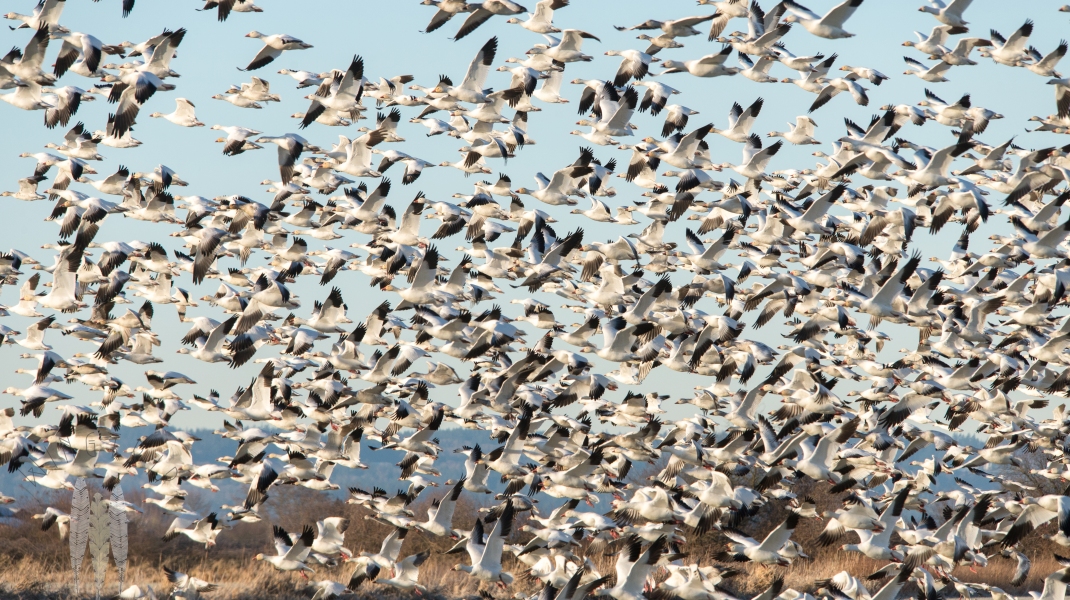
At least some things are given this time of year. Drive up North and descending into the Skagit Valley, the brightest things around (because the sun can’t break through the oppressive cloud layer), are the hoards of swans and geese. This regularity may not get every seasoned birder excited but I’m always flabbergasted by the sheer numbers of snow geese, particularly when thousands thunder to wing mere yards from you. The swans too are quite the spectacle, some of the largest birds in North America just hanging out on the farm nibbling old brassica shoots. No big deal.
In the city, with a keen eye or ear, there’s always a few things to take note of. I continually out nerd my co-workers (at a non-profit for birds), by getting wound up by birds outside our office. A Bewick’s wren clinging to the tactile brick wall, pretending it’s a creeper. The almost daily red crossbills that fly over almost any time I am outside. Even when work and weather don’t allow for extensive adventures, there’s room for my mind to broaden, (…ok, so maybe thinking about birds doesn’t count as broadening).
But while I’m not out exploring distant or difficult terrains in search of feathered species or scoring rare birds by the dozen, my mind is cemented in those things. Asking questions, like: Do other people see at least 20 red crossbills a day in Seattle, no matter where they are? Or what a male King of Saxony Bird of Paradise is doing right at this moment? Or if that short-eared owl I watched in a field with my friends a couple weekends ago knew that the world was supposed to end in the next week? Probably not.